A real google ads competitor analysis starts with Auction Insights, not a third-party dashboard, because Auction Insights shows you exactly who is bidding against you right now, at what impression share, and how often they outrank you. Pull it for your top campaigns and ad groups today, then cross-check active creatives in the Google Ads Transparency Center before you touch any paid research tool.
Success in the next 30 days doesn’t mean a giant spreadsheet. It means a short, prioritized test list you can actually execute:
- Three to five keywords worth bidding on based on competitor pressure, not guesswork
- One or two ad message angles worth testing against your current copy
- A clear list of who’s genuinely competing for your auctions versus who just shows up in a generic search
Key Takeaways
A repeatable google ads competitor analysis works because it treats Auction Insights as the primary evidence and third-party tools as historical support, not the other way around.
| Point | Details |
|---|---|
| Start with auction data | Pull Auction Insights before any third-party tool to see who genuinely bids against you. |
| Archive creatives as evidence | Save Ads Transparency Center ads and landing pages as dated PDFs for tracking changes over time. |
| Treat spend estimates as modeled | Third-party CPC and spend figures are directional estimates, not confirmed competitor numbers. |
| Set a fixed review cadence | Check active tests weekly, monitor competitors monthly, and refresh strategy quarterly. |
| Work with a partner who executes it | Tradewinds United Media builds this exact audit and test cycle into its starter Google Ads engagements. |
Where to keep learning
- Tool pages from Semrush and Ahrefs cover modeled keyword and spend data worth understanding before you trust their numbers.
- For a deeper look at competitive frameworks beyond paid search, Baby Love Growth’s SEO competitor analysis guide covers adjacent research methods worth borrowing.
Table of Contents
- How to run a Google Ads competitor analysis step by step
- Which tools should you actually use for competitor research?
- What should you check when auditing a competitor’s ads and landing pages?
- How do you turn competitor findings into campaign changes?
- How Tradewinds United Media operationalizes competitor monitoring
- Sources
How to run a Google Ads competitor analysis step by step
Skip the temptation to start with a third-party tool’s “top competitors” list. Those lists often surface brands that rank organically for similar terms but never touch your auctions. Auction Insights tells you who’s actually bidding against you, which makes it the more accurate starting point, according to Scrapingbee’s competitor analysis framework.
Here’s the workflow that holds up week after week:
- Pull Auction Insights for your highest-spend campaigns and ad groups. Note impression share, overlap rate, and outranking share for each competitor.
- Capture active creatives through the Ads Transparency Center. Save landing pages as timestamped PDFs so you have a record of what an ad said and where it sent traffic on a specific date.
- Export paid keywords from a third-party platform like Semrush or Ahrefs when you need historical depth Google won’t give you. Treat any spend or CPC figure from these tools as a modeled estimate, not a fact.
- Log everything in one spreadsheet: keyword, ad headline, CTA, landing page URL, evidence type (auction data vs. third-party estimate), and a priority score.
- Set a review cadence. Check active tests weekly, monitor competitor movement monthly, and revisit your overall strategy quarterly to catch seasonal bidding spikes or new messaging themes, a rhythm Semrush recommends for staying ahead of shifts rather than reacting to them after the fact.
Pro Tip: Archive landing pages as clean PDFs, not screenshots. If you ever want an AI tool to help you spot messaging patterns across a dozen competitor pages, a properly formatted PDF prevents extraction errors that garbled screenshots or complex HTML layouts routinely cause.
Which tools should you actually use for competitor research?
Three Google-native tools do most of the heavy lifting, and they’re free. Auction Insights shows real-time bidding pressure on your own account. The Ads Transparency Center shows every active ad a competitor is running across Google’s network, useful for catching video, display, and shopping formats you’d otherwise miss. Keyword Planner rounds out the picture with volume and competition data for terms you’re considering.
Third-party platforms fill the gaps Google won’t. Tools built for advertising research can show years of historical ad copy and estimated keyword overlap, because Google itself never publishes granular competitor spend or CPC data. Those platforms aggregate SERP data to model estimates. That’s a meaningful distinction: a “$4,200 estimated monthly spend” figure is a directional guess built from scraped search results, not a real number pulled from a competitor’s account.
A few free manual methods round out the toolkit:
- Manual SERP checks from different devices and locations to see who actually shows up
- Public ad libraries for spotting creative variations you might not think to search for
- The Wayback Machine for tracing how a competitor’s landing page has evolved over time
One reminder worth repeating: stick to public ad libraries and your own account data. Scraping private data or misrepresenting yourself to access gated competitor information crosses into ethically and often legally shaky territory.
What should you check when auditing a competitor’s ads and landing pages?
A mature funnel looks different from a rushed test, and you can usually tell within five minutes if you know what to look for.
On the ad side, check headline themes across multiple ad groups, note which CTAs repeat most often (“Get a Quote” versus “Call Now” tells you something about their sales process), and look for ad extensions like sitelinks, callouts, and price extensions. Compare mobile and desktop versions separately. They’re often different ads entirely.

On the landing page side, check message match between the ad headline and the page’s own headline. A mismatch usually signals a rushed campaign. Look at form length, page speed, and whether the mobile experience actually works or just technically loads.
Funnel signals matter too:
- Dedicated landing pages built per campaign (versus dumping traffic on the homepage) signal budget and sophistication.
- Visible UTM parameters in the URL show they’re tracking performance seriously.
- Cross-channel presence on YouTube or display alongside search suggests a bigger, coordinated budget.
Pro Tip: Name your archived files by date and competitor, like “competitor-lawnco_landingpage_2026-03-14.pdf”. Six months from now, you’ll be grateful you can trace exactly when their messaging shifted.
How do you turn competitor findings into campaign changes?
Evidence without action is just a spreadsheet nobody opens again. Here’s how to convert it:
- Prioritize ruthlessly. Defend the must-win terms where you already convert well, skip expensive branded battles you’re unlikely to win, and target mid-tail keywords with moderate volume and reasonable CPC, often the best short-term wins compared to fighting over expensive branded terms.
- Design creative tests from what you observed. If three competitors lean on price, test a benefit-led headline instead. If everyone uses “Get a Free Quote,” test urgency copy like “Limited Slots This Month” against it.
- Set budget rules before you spend. Start new tests with a small validation budget, define a specific trigger for scaling it (a CPA threshold, a minimum conversion count), and build some organic support through content or SEO before pouring money into a keyword competitors already dominate.
- Measure on a fixed timeline. Track CTR, conversion rate, CPA, and impression-share shifts weekly, and give each test at least two to three weeks before calling it a win or a loss.
How Tradewinds United Media operationalizes competitor monitoring
Tradewinds United Media builds competitor tracking directly into client Google Ads management, pairing it with the website design and SEO work that shapes the landing pages those ads point to. The workflow stays simple on purpose:
- Pull Auction Insights weekly for active campaigns to catch new entrants and bidding shifts early.
- Archive competitor ads as dated PDFs through the Ads Transparency Center for a running visual record.
- Feed clean, text-based exports into pattern analysis, since AI tools are genuinely useful for spotting messaging trends across dozens of pages but shouldn’t replace human judgment on nuanced strategic calls.
Modeled spend estimates from third-party tools are useful for spotting trends over months, but they’re still estimates. Auction Insights data comes straight from the auction itself, which is why it gets weighted more heavily in any decision about where to shift budget.
What actually moves the needle for clients
One recurring pattern: clients who assumed a competitor was outspending them by a wide margin often discover through Auction Insights that impression share is nearly even, just split across more keywords. That single correction usually reshapes the whole budget conversation. If you want help building this system for your own account, that’s exactly what our Google Ads management team does day to day.
— Michael
A starter Google Ads program built around competitor evidence
There are other paths here. You could subscribe to a third-party research tool and build the workflow yourself, or hand the whole thing to a freelancer piecing it together part time. Both work, if you have the hours to spend chasing modeled estimates and stitching reports together every week.
Tradewinds United Media runs this exact system as a starter Google Ads engagement: a competitor audit using Auction Insights and Ads Transparency Center evidence, a prioritized test list of three to five keyword or creative opportunities, and monthly reporting that shows what changed and why. It’s built for small, local businesses that need measurable lead growth without hiring an in-house media buyer or learning auction mechanics from scratch.
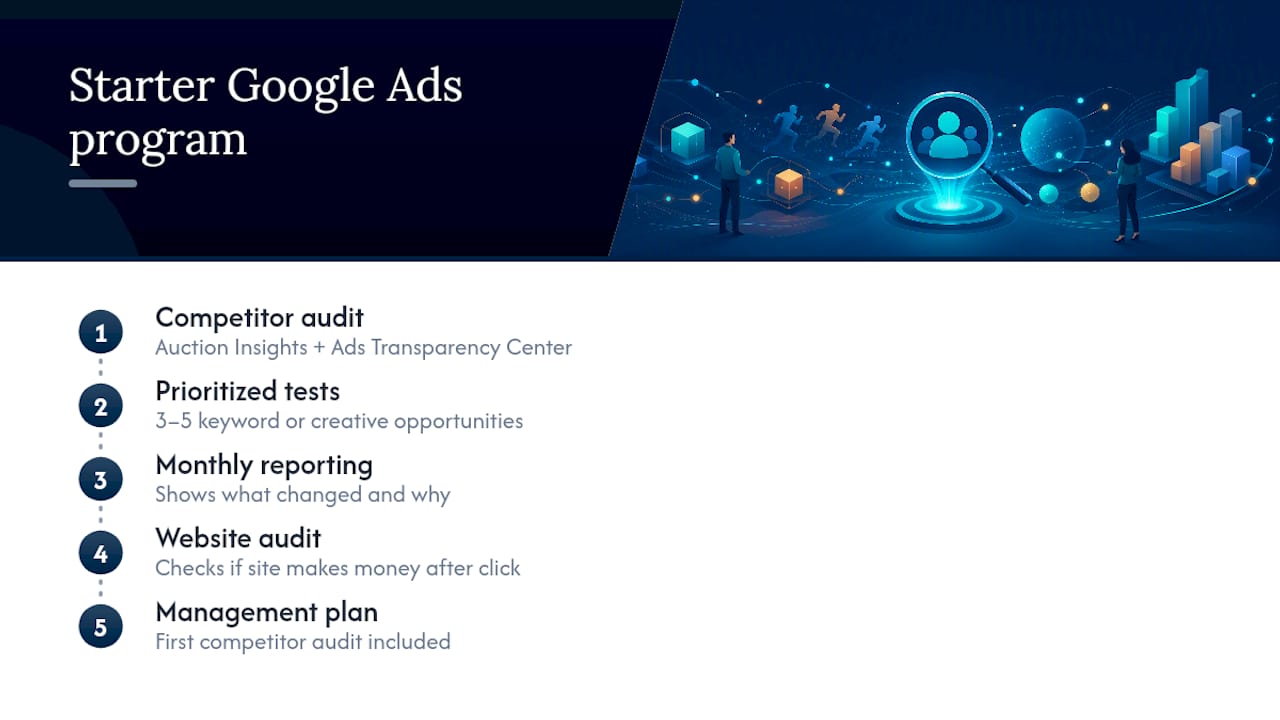
If your ads aren’t converting the way they should, the problem is sometimes the campaign and sometimes what happens after the click. Our team also audits whether your website is actually making you money once traffic lands there. Ready to see where you stand against the competitors actually bidding against you? Get started with Google Ads management and get your first competitor audit built into the plan.
Sources
- Semrush — Advertising research
- Ahrefs — How to do an actually useful PPC competitive analysis using AI
- Scrapingbee — Google Ads competitor analysis system
- Search Engine Land — Google Ads competitor analysis tool