Tracking marketing ROI means connecting every marketing dollar to the revenue it produced, then repeating that comparison on a schedule. You need three things: a formula you trust, a record of where each lead came from, and the sale value tied back to that lead. This guide shows how to set all three up for a local business without enterprise software.
TL;DR
- Basic marketing ROI is (revenue from marketing − marketing cost) ÷ marketing cost × 100. Use profit instead of revenue if you want the stricter, more honest number.
- The formula is the easy part. The hard part is knowing which leads came from which channel and which of them became paying customers.
- Log cost, leads, closed jobs, sale value and cost per lead for every channel, every month. Review quarterly for strategy and weekly for quick fixes.
- A simple CRM or even a disciplined spreadsheet closes the loop between marketing and revenue. Fancy attribution software usually does not pay off at small deal volumes.
- There is no single “good” ROI. Judge each channel against your margins, your sales cycle and what happens to the result when you spend more.
Table of Contents
- What marketing ROI measures
- The formula, with two worked examples
- Set up tracking before you spend
- The numbers to log every month
- Connect leads to revenue with a CRM
- Attribution: keep it as simple as your volume allows
- What counts as a good marketing ROI
- How often to review, and what to do with delays
- Common mistakes that skew ROI
- Our perspective
- Get ROI reporting built into your marketing
- FAQ
- Sources
What marketing ROI measures
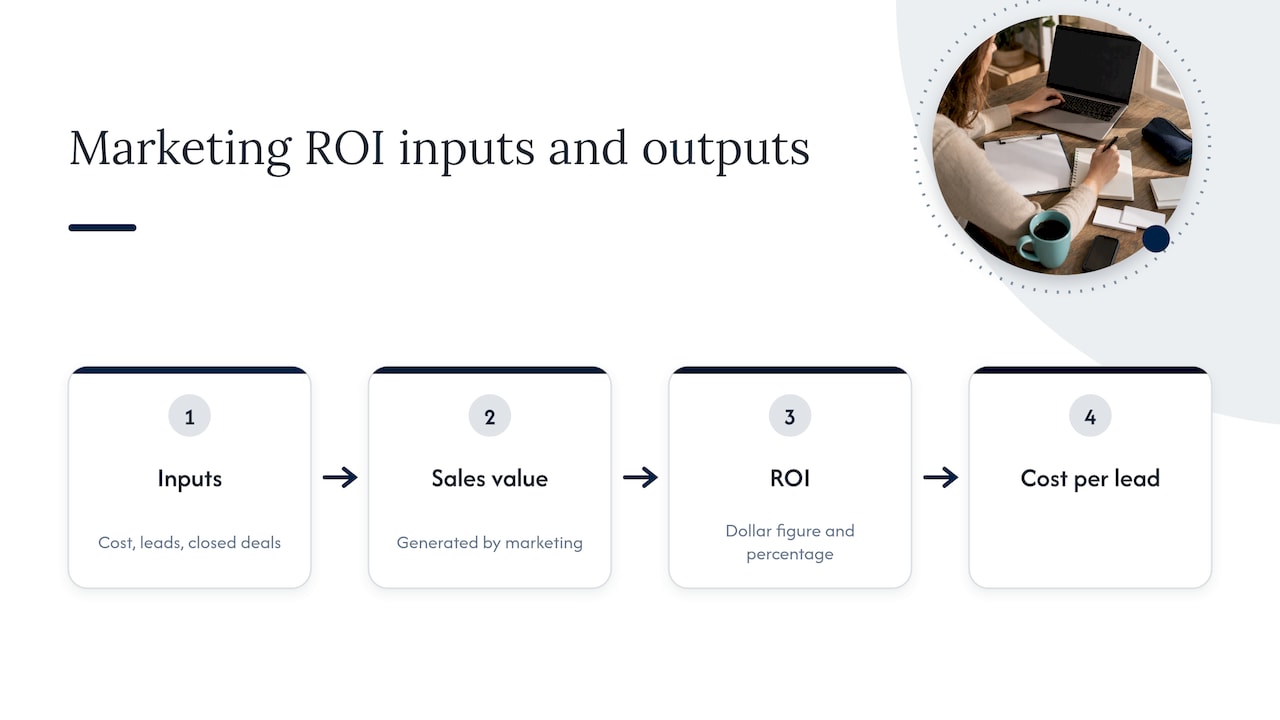
Marketing ROI compares what your marketing earned with what it cost. The American Marketing Association’s ROI calculator asks for the activity cost, leads, closed deals and sales value generated, and returns an ROI dollar figure, an ROI percentage and a cost per lead. Those five inputs are a good template for a small business, because you can collect all of them without technical help.
A 4:1 ratio means $4 in revenue for every $1 invested, as Shopify’s explanation of marketing ROI puts it. The same result expressed as a percentage depends on whether you count revenue or profit, which is why you should decide that before you start and never change it halfway through a year.
The formula, with two worked examples
The standard campaign formula is (sales growth − marketing cost) ÷ marketing cost × 100. Investopedia’s guide to measuring marketing ROI uses $1,000 of sales growth against a $100 campaign to arrive at 900%.
That simple version has a flaw: it assumes every dollar of growth came from the campaign. Investopedia recommends subtracting the growth you would have seen anyway. Its example takes $15,000 of growth, removes $600 of historical organic growth, and compares the remaining $14,400 to a $10,000 campaign cost. The result is 44%, not the 50% the naive math gives.
Here is how that looks with a hypothetical local service business. These numbers are illustrative, not client results.
| Input | Google Ads | Direct mail |
|---|---|---|
| Monthly cost | $2,000 | $1,200 |
| Leads | 40 | 15 |
| Closed jobs | 10 | 4 |
| Average job revenue | $900 | $900 |
| Revenue from marketing | $9,000 | $3,600 |
| Cost per lead | $50 | $80 |
| Revenue ROI | 350% | 200% |
The revenue ROI for Google Ads is ($9,000 − $2,000) ÷ $2,000 × 100 = 350%. Now apply a 40% gross margin. Profit on those jobs is $3,600, so profit ROI is ($3,600 − $2,000) ÷ $2,000 × 100 = 80%. Same campaign, two honest answers. Profit ROI is the one that tells you whether the marketing earned its keep after you paid for materials and labor.
Set up tracking before you spend
Most ROI problems are data problems. If you cannot say which leads came from which channel, no formula can rescue the report. Our own piece on fixing data before choosing an attribution model makes the same point for analysts: clean inputs come first.
Give every channel a way to be counted
Each channel needs a trackable entry point:
- Website forms: record the traffic source with every submission, and mark form completions as conversions in your analytics.
- Phone calls: for most local businesses, the phone is the biggest lead source and the easiest to lose. See our practical guide to call tracking attribution for how to assign calls to ads, listings and organic search.
- Walk-ins and referrals: ask “How did you hear about us?” at booking and write the answer down. It is imperfect and still far better than a blank.
- Paid ads: import your analytics conversions so the ad platform sees what happens after the click. Google documents how to create Google Ads conversions from Google Analytics events, including the need for event names to match exactly between the two.
Record a baseline
Before you change anything, write down your current conversion rate, average sale, lead volume and the typical time from first contact to sale. Without that starting point you cannot show improvement, and you cannot subtract organic growth the way the Investopedia method requires.
Decide what counts as a lead
A form submission from a job seeker is not a lead. A missed call is not a lead until someone calls back. Define “qualified lead” in one sentence and apply it everywhere. Cost per lead only means something if the denominator is consistent.
The numbers to log every month
Keep a single sheet with one row per channel per month. The columns below match the AMA inputs and add the context you need to explain movement.
| Metric | Why it matters |
|---|---|
| Spend (media plus agency or tool fees) | The denominator of ROI. Include everything you pay. |
| Leads | Your top-of-funnel volume. |
| Cost per lead | Spend divided by leads. Spots expensive channels fast. |
| Closed deals | Leads that became customers. |
| Close rate | Closed deals divided by leads. Shows lead quality and sales follow-up. |
| Revenue and profit from those deals | The numerator of ROI. |
| ROI % | The headline number. |
Nielsen advises building plans around outcome metrics such as lead conversions, cost per lead and return on ad spend rather than relying only on views, clicks or likes. A social post with 5,000 views and no inquiries has high reach and zero measurable return. If you need help choosing which social numbers belong in a report, we cover it in what social media stats matter in a marketing report.
For a short weekly routine, our marketing KPIs a small business can act on in 15 to 30 minutes is a good companion to this monthly sheet.
Connect leads to revenue with a CRM
The monthly sheet only works if someone fills in the “closed deals” and “revenue” columns accurately. That is where a CRM earns its place. When a contact record carries the lead source, the quote and the final invoice, you can report ROI by channel without reconstructing it from memory.
This is what people mean by closed-loop reporting: the marketing touchpoint travels with the contact all the way to the sale, so you evaluate qualified pipeline and closed revenue rather than form fills alone. If you want to see what setup looks like for a team with no IT department, this walkthrough of CRM setup for small service teams covers a realistic timeline.
A few practical rules keep a small-business CRM useful for ROI:
- Make lead source a required field. If staff can skip it, they will.
- Use a short, fixed list of sources. “Google Ads,” “Google Business Profile,” “Organic search,” “Referral,” “Mail,” “Other.” Free-text sources produce twenty spellings of the same thing.
- Log the sale value when the job closes. Not when the quote goes out.
- Train the person who answers the phone first. Data entry at the front desk is where most tracking breaks.
The software rarely fails. Habits do. A CRM nobody updates produces a confident-looking report that is wrong.
Attribution: keep it as simple as your volume allows
Attribution assigns credit among the touchpoints a customer used: first click, last click, or a spread across several. For a small business, the useful question is usually modest: which channel produced the lead that became a paying customer?
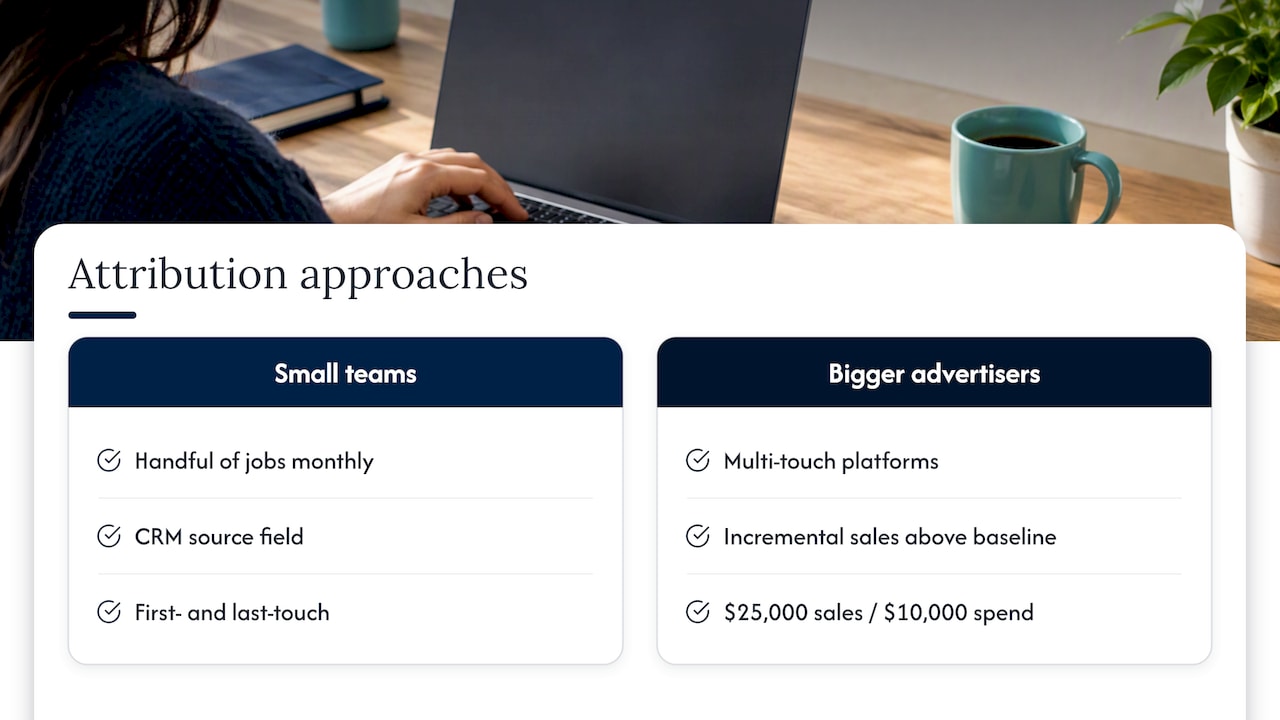
Multi-touch attribution platforms need volume to behave. One vendor analysis, Prooflytics on attribution software for in-house teams, warns of an attribution trap in which small teams buy enterprise tools without the data, volume or technical skill to use them. If you close a handful of jobs a month, a source field in your CRM and a look at last-touch plus first-touch will tell you almost everything a platform would.
Bigger advertisers do go further. Google’s Meridian documentation defines incremental outcome and ROI as the value marketing caused above what you would have sold anyway. It illustrates this with $25,000 of incremental sales on $10,000 of spend, or $2.50 per dollar. You can borrow the logic without the model: pause a channel in one area for a month, or compare against a period when you did not run the campaign, and see what really changed.
What counts as a good marketing ROI
Searchers ask this constantly, and honest answer is that a universal number does not exist. Three things decide what is good for you.
Your margin. A 200% revenue ROI on a business with a 25% margin loses money once you account for costs of delivery. Always compute profit ROI next to revenue ROI.
Your spending level. AMA contributor Dominique Hanssens notes that consumer response is generally nonlinear and often shows diminishing returns, so ROI changes with how much you spend. He recommends looking at sales lift, margins, costs and marginal ROI instead of a single comparative number. Practically: the first $1,000 on a channel often returns more than the fifth. Track the return on the next dollar, not only the average.
Your time horizon. Google ads can pay back within weeks. SEO, reviews and content compound over many months. Judging them on the same 30-day window punishes the slower ones. Our overview of why SEO matters for long-term growth explains why, and deciding between SEO, Google Ads and social shows how to split a budget across different payback speeds.
Spend benchmarks for context
If you need a sanity check on how much to spend, the U.S. Small Business Administration notes that retailers spend about 4% of revenue on advertising and restaurants 1.93%. That figure describes spending, not return, and it dates from 2019. Treat it as a rough reference for the budget line, then let your own ROI data tell you whether to go above or below it.
How often to review, and what to do with delays
The SBA suggests reviewing business KPIs quarterly, with cash flow and customer acquisition cost among the candidates. A workable rhythm for ROI looks like this:
- Weekly (15 minutes): leads and cost per lead by channel. Catch a broken form, a paused campaign or a phone line that is not being tracked.
- Monthly: fill in the full sheet: closed deals, revenue, profit ROI.
- Quarterly: decide where to move budget. Compare channels on cost per customer, not only cost per lead.
Delayed sales
If your sales cycle runs weeks or months (kitchen remodels, commercial contracts, annual service plans), a campaign that ran in March may not produce revenue until June. Match your reporting window to your real sales cycle, and attribute a closed deal to the month the lead arrived, not the month the invoice was paid. Report the most recent months as provisional until the pipeline matures.
Lifetime value
A customer who buys once and a customer who returns for five years are not the same return. For lead campaigns, Investopedia suggests estimating lead value from your historical conversion rates and tracking results over time. Where repeat business is common, add the expected repeat revenue to the sale value, and label it clearly as an estimate so nobody mistakes it for booked revenue.
Common mistakes that skew ROI
- Leaving out costs. Agency fees, ad spend, design work and tool subscriptions all belong in the denominator.
- Counting every sale as marketing-driven. Repeat customers and referrals would often have come anyway. Subtract the organic baseline.
- Measuring clicks instead of customers. Cheap clicks that never call are expensive.
- Averaging away the story. A blended ROI can hide one channel that works and one that burns cash. Report by channel.
- Ignoring conversion rate. If your site turns 2% of visitors into inquiries, traffic increases only help up to a point. Improving the page can lift ROI without extra spend, as in our 30/60/90 roadmap to increase website conversions.
- Changing definitions midyear. If you switch from revenue to profit, restate the earlier months too.
Our perspective
Most of the owners who come to us have been burned by a report full of impressions and rankings that never mentioned a customer. We think a marketing report is only useful when it ends in dollars: what you spent, how many people called, how many of them hired you, and what that was worth.
We also think small businesses over-invest in measurement tooling and under-invest in habits. A clean lead-source field, a phone number that is tracked, and a monthly review beat a dashboard nobody opens. Dashboards help once the inputs are trustworthy, and our Looker Studio marketing dashboard walkthrough shows how to build one around sales rather than traffic. The principle underneath all of it is what we explain in why data-driven marketing matters for business growth: decisions get better when the numbers are real.
So when we run campaigns, we report on cost, leads and results by channel, and we update you regularly on what we are changing and why. If a channel is not paying back, you should hear it from us first.
— Michael
Get ROI reporting built into your marketing
If you would rather have this set up and maintained for you, that is what we do. We build websites with conversion tracking in place, run Google Ads campaigns and SEO for local businesses, and send performance reports that connect spend to the results you care about.

If you are not sure which channel deserves your next dollar, talk to Tradewinds United Media and we will walk through your current numbers with you.
FAQ
What is the simplest way to track marketing ROI?
Keep one spreadsheet with a row per channel per month. Record spend, leads, closed deals, revenue and profit, then calculate (revenue − cost) ÷ cost × 100. It takes minutes once your lead sources are labeled consistently.
How do I calculate marketing ROI if I do not know which sales came from marketing?
Start by asking every new customer how they found you and logging the answer, then add call tracking and a source field on web forms. For the growth-based method, subtract the sales growth you would have expected anyway before comparing against cost, as Investopedia’s guide describes. The result will be an estimate, and it improves as your records do.
Do I need a CRM to measure marketing ROI?
Not on day one, since a spreadsheet works at low volume. A CRM becomes valuable when leads, quotes and sales are spread across several people, because it keeps the lead source attached to the final sale. Its value depends on your team actually using it.
How often should I review marketing ROI?
Check leads and cost per lead weekly, calculate full ROI monthly, and make budget decisions quarterly. The SBA recommends quarterly KPI reviews for small businesses. If your sales cycle is long, treat recent months as provisional.
What is a good ROI for marketing?
It depends on your margin, how much you already spend and how long the channel takes to pay back. Compare profit ROI by channel, and look at what the next dollar returns, not only the average.
Sources
- AMA Marketing ROI Calculator
- Marketing ROI: How to Calculate It, Shopify
- Measuring Marketing ROI: Calculate Campaign Effectiveness, Investopedia
- Create conversions from Google Analytics events in Google Ads, Google Ads Help
- How to plan with business outcomes in mind, Nielsen
- Multi-Touch Attribution Software for In-House Teams 2026, Prooflytics
- Incremental Outcome, ROI, mROI & Response Curves, Google Meridian
- Using Return on Marketing Investment Effectively, American Marketing Association
- How to Get the Most From Your Marketing Budget, U.S. Small Business Administration
- Check Your Business KPIs Before The Holiday Season Starts, U.S. Small Business Administration
- CRM setup for small service teams