For most local businesses, Google Ads is the stronger first investment. It reaches people at the moment they search for what you sell, it has no flat fee or subscription, and it lets you count calls, direction requests and form fills as results. Yelp Ads can add reach on a platform where people already compare local businesses, but it works best as a second channel on top of a Google campaign that already tracks results. Below is how the two work, what each costs, how to measure them and how to decide.
TL;DR
- Google Ads runs on an auction across Search, Maps and other placements. You pay per click on the standard setup and set a daily budget you control.
- Yelp Ads places your business in Sponsored Results on Yelp and on competitors’ pages. Yelp says self-serve ads can start at an average of $5 per day and lists plans from $150 per month.
- Google’s call reporting lets you count phone calls as conversions, which matters for plumbers, dentists, salons and other businesses that live on the phone.
- Start where buyers are searching. Add Yelp once your Google tracking shows you what a lead is worth to you.
- If you were burned by an agency before, ask any provider for plain-language reports that tie spend to calls and booked work.
Table of Contents
- How the two platforms work
- Yelp Ads vs Google Ads at a glance
- What each one costs and how you control spend
- Targeting and reach for local customers
- Measuring results: calls, leads and what they are worth
- Which one fits your business
- A worked example
- Before you spend on either platform
- How Tradewinds United Media can help
- Our perspective
- FAQ
- Sources
How the two platforms work
Google Ads: an auction on search intent
Google Ads is built on keywords. Google explains that keywords can trigger your ads, and that Ad Rank decides whether your ad is eligible and where it appears. Ad Rank is shaped by competition, the context of the search and the quality of your ad. In practice, a roofer who writes an ad that matches what a homeowner typed, and sends that person to a page that delivers on the promise, can compete against a larger company with a bigger budget.
Where do the ads show? Google lists placements above or below Search results, on Maps, in Shopping and on search-partner sites. Display ads can also appear on websites, Gmail, YouTube and apps. For a local business, the Search and Maps placements are the ones that matter first, because they catch people who are ready to call or visit. If you want to understand the difference between those formats, our guide to search vs display ads walks through it for small budgets.
Yelp Ads: a place where people already compare businesses
Yelp is a review and discovery site. By its own description, Yelp Ads put your business in Sponsored Results above or below the regular listings, and on the pages of competing businesses. Yelp also says its ads can reach Yelp users when they search off Yelp. You choose the location and keywords, choose the photos and text (or let Yelp optimize them), and pick a goal: calls, messages, website visits or map directions.
Yelp also offers other formats. Besides the standard search and competitor-page placements, it has themed carousel ads and Showcase Ads for multi-location businesses, which carry more text, a call to action and a separate destination page. A single-location shop will mostly deal with the standard ad.
The main difference is the audience. Google reaches people who typed a need into a search box anywhere on the web. Yelp reaches people who are already browsing local listings and reading reviews.
Yelp Ads vs Google Ads at a glance
| Factor | Google Ads | Yelp Ads |
|---|---|---|
| Where ads appear | Search results, Maps, Shopping, partner sites, plus Display placements | Yelp Sponsored Results, competitors’ Yelp pages, and Yelp users off Yelp |
| How you get shown | Auction based on keywords and Ad Rank | Location and keyword targeting you choose on Yelp |
| Fees | No flat fees or monthly subscriptions | Yelp says as little as $5 per day on average, and lists plans from $150 per month |
| Contract | None required by Google | Yelp says self-serve ads can be adjusted or cancelled any time, with no term contracts |
| Goals | Clicks, calls, directions, form fills and more | Calls, messages, website visits, directions |
| Call tracking | Call reporting and Google forwarding numbers | Yelp Ads Dashboard shows performance and leads |
| Reach beyond one platform | Wide, across Google properties and partners | Yelp’s audience |
What each one costs and how you control spend
Google Ads budgets
Google states plainly that Google Ads has no flat fees or monthly subscriptions. You set an average daily budget. On a given day, spend can reach up to twice that figure, but it stays within your monthly spending limit. Plan around the monthly number, not the daily one.
With cost-per-click bidding, you are charged when someone clicks. What a click costs depends on competition, the search context and your ad quality. A keyword like emergency plumber in a big metro costs more than the same service in a small town, so the same budget buys different amounts of traffic in different places. The cost per click is not the number to judge by. What counts is what you pay for a call or a booked job.
For a closer look at sizing a budget, see our Google Ads budget guide for small businesses and the breakdown of what Google Ads management costs.
Yelp Ads budgets
Yelp’s own US product page says self-serve ads can start at an average of $5 per day, can be changed or cancelled at any time and carry no term contract. Its local business pricing page lists Yelp Ads from $150 per month. Those are Yelp’s published starting points, and what you actually pay depends on your category, your city and the goals you pick.
The low entry point is attractive for a first test. The thing to watch is how the budget is spread if you run more than one location, since each location has its own market and its own competition.
The cost that gets overlooked: the click that goes nowhere
On either platform, the ad is only half the job. If the person lands on a slow, confusing page, or calls and nobody picks up, the budget is gone. Owners who feel burned by an agency often discover the ads were fine and the website was the leak. Our piece on why a business website isn’t making money covers the usual causes.
Targeting and reach for local customers
Both platforms let you target by place. The difference is in what else you can steer.
On Google, you build around what people search. Keyword choice does most of the work, and local phrasing (a service plus a city or neighborhood) tells you a lot about intent. Our local keyword research guide shows how to find those phrases. You can add audience signals on top, which we cover in audience targeting for Google Search ads.
On Yelp, you choose location and keywords, then Yelp handles placement across its pages. The audience is narrower, but it is made of people in a research mindset, often reading reviews before deciding. That makes your review profile part of how the ad performs, since a shopper who clicks will see your rating next to your name.
Google’s reach also includes Maps, where people look for a nearby business and tap to call or get directions. Google describes local actions as direction requests, direct calls and website visits, and says bidding can be set to optimize for calls or directions. For a business with a storefront or a service area, that is the closest thing to paying for foot traffic and phone rings.
Measuring results: calls, leads and what they are worth
Most small businesses are not selling online. They are selling by phone, by message and by walk-in. So the question is whether each platform can show you those events.
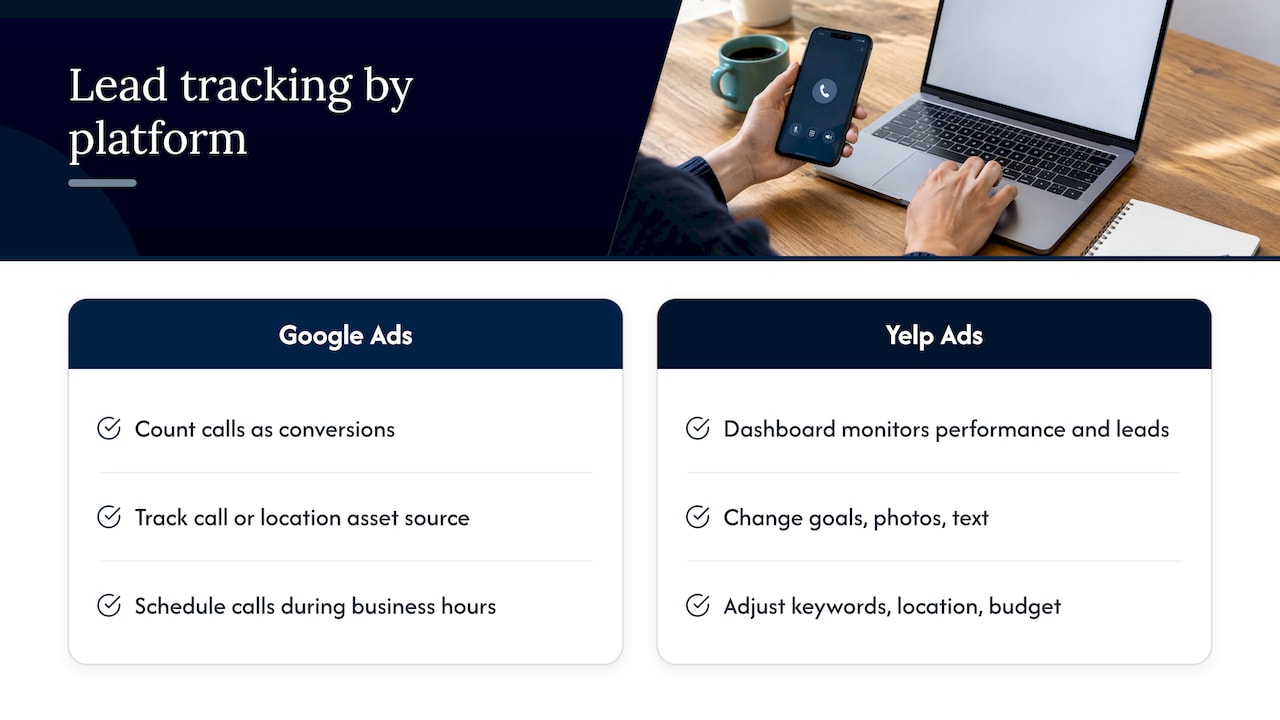
Google can. Its call reporting lets you count calls as conversions, and Google forwarding numbers provide detailed call information. You can measure whether calls came from call assets or location assets, and you can schedule call assets to run only during business hours. That last detail saves money for a shop that closes at 5 p.m. and does not want to pay for calls nobody answers.
Yelp gives you its Ads Dashboard, where you monitor performance and leads, and you can change goals, photos, text, keywords, location and budget as you learn.
Whichever platform you use, define a lead before you spend. A call under 30 seconds is not the same as a 5 minute call about a quote. A form fill from a price shopper is not the same as a booked appointment. Write down what each lead type is worth to you, then judge each channel against that number, not against clicks.
Which one fits your business
There is no universal winner, but there are clear patterns.
Start with Google Ads if:
- People search for your service when they need it (repairs, legal help, dental care, locksmiths, HVAC, pest control).
- Your revenue comes from phone calls and you need them counted.
- You want one budget you can raise or lower as you learn.
- You want to appear in Maps as well as in search results.
Add Yelp Ads when:
- You already have a Google campaign producing measurable leads and want another place to be seen.
- Your category is one where customers browse reviews before choosing, such as restaurants, salons and home services.
- You have a healthy review profile, since it will sit beside your ad.
- You can start with a small budget and track leads separately from Google.
Check your Google format first if you are a contractor or home-service business. Google’s Local Services Ads are a separate format from standard Search ads, and which one pays better depends on your trade and city. We compare them in Local Google Ads for Small Businesses: LSA or PPC?
If you are also weighing social platforms, our comparison of Google Ads vs Facebook Ads uses the same lens.
A worked example
Take a hypothetical independent plumber in a mid-sized US city with a $1,500 monthly ad budget. This is an illustration, not a client result.
- The plumber puts most of the budget into a Google Search campaign built around urgent, local phrases, with call tracking switched on and call assets scheduled for business hours.
- After a month, the plumber reviews how many calls became booked jobs and what the average job paid.
- With those numbers in hand, a smaller slice goes to a Yelp test, with its own phone number or goal so the leads stay separate.
- The plumber moves budget toward whichever channel produces booked jobs at the lower cost.
The order matters. Without Google’s measurement first, the Yelp test has nothing to be compared against.
Before you spend on either platform
A short pre-flight check saves a lot of wasted budget:
- Your Google Business Profile is complete. Hours, services, photos and phone number are accurate, since they feed Maps and local results. See our Google Business Profile optimization playbook.
- Your reviews are in good shape. Both platforms put your reputation in front of the person who clicks. Our guide to responding to bad reviews helps with the tough ones.
- Your landing page matches the ad. A person who clicked on emergency repair should land on a page about emergency repair, with a phone number visible without scrolling.
- Your phone gets answered. Missed calls are the most expensive leak in local advertising.
- You know your numbers. Know what a new customer is worth and what you can afford to pay to get one.
How Tradewinds United Media can help
If you want Google Ads run for you, our Google Ads management covers campaign setup and ongoing management for small and local businesses. We send clear performance reports and regular updates, so you can see how your spend turns into calls and customers. We also handle the pieces around the ads: website design so clicks land on a page built to convert, and Google Business Profile and reputation management work so your listing and reviews support the ad.

If a previous agency left you with reports you could not read and results you could not trace, talk to us about what a transparent setup looks like for your business.
Our perspective
When an owner asks us whether to spend on Yelp or on Google, we start with a different question: how will you know it worked? Most of the frustration we hear about with past agencies comes from reports that list impressions and clicks and never mention a phone ringing.
That is why we put Google Ads first for most local businesses. Search ads catch someone who is looking for your service right now, and call tracking, location actions and conversion reporting let us show a business owner what the spend produced. Our approach is data-driven, and the report is part of the service, not an extra.
We also care about what happens after the click. A well-built website, a complete Google Business Profile and a solid review profile make every ad dollar work harder, on any platform. That is why we offer website design, SEO, Google Ads, Google Business Profile and reputation management together.
Our advice: get Google Ads measured and profitable first, then decide what else to layer on with real numbers in hand.
Michael
FAQ
Is Yelp Ads cheaper than Google Ads?
Yelp says its self-serve ads can start at an average of $5 per day and lists plans from $150 per month. Google has no flat fees or subscriptions, and you set the daily budget yourself. The right comparison is cost per call or booked job, not the starting price.
Can I run Yelp Ads and Google Ads at the same time?
Yes. Many local businesses run both. Start with Google Ads so you have measured results, then add Yelp with its own tracking. That lets you see which channel brings the better leads.
Which is better for getting phone calls?
Google Ads has detailed call reporting, including Google forwarding numbers and the ability to count calls as conversions. You can also schedule call assets for business hours. That makes it easy to see how many calls your ads produce and when.
Do I need a long contract for either platform?
Google Ads has no flat fees or monthly subscriptions. Yelp says its self-serve ads have no term contracts and can be adjusted or cancelled any time. If you hire a management company, the terms are set by that company’s agreement, so read the scope and reporting before signing.
Does my website matter if I use Yelp Ads?
Yes. Yelp lets you choose website visits as an ad goal, and a click that lands on a weak page wastes spend. A clear page with your phone number, services and proof of quality turns visitors into leads.
Sources
- Using Google Ads for online marketing, Google Ads Help
- Where your ads can appear, Google Ads Help
- How much does Google Ads cost?, Google Ads
- About call assets, Google Ads Help
- About local ads, Google Ads Help