Facebook ads are the better first test for most small businesses, because they reach a huge consumer audience and start at a very low daily budget. LinkedIn ads earn their higher price only when you sell to business decision-makers and one closed client pays for the whole campaign. If your customers are local and searching for you right now, neither platform may be your best first move, and we explain why below.
TL;DR
- Choose Facebook when you sell to consumers, your offer is visual or emotional, or you want cheap reach and retargeting. Ads can start from about $1 a day.
- Choose LinkedIn when your buyers are defined by job title, industry or company size, and your average customer is worth enough to absorb much higher click costs.
- Cost per click is not cost per customer. A cheaper click that never becomes a lead is the expensive one.
- Local service businesses often get more from people already searching on Google than from interrupting people on either social feed.
- Give each channel one job, one budget and one success number before you spend anything.
Table of Contents
- The core difference: who you reach and why they are there
- Side-by-side comparison
- Targeting: where LinkedIn is precise and Facebook is broad
- Campaign types and what each is built for
- Cost: why the cheaper platform is not always the cheaper lead
- Lead quality: what you get for the higher price
- When LinkedIn is worth it for a small business
- When Facebook fits better
- The third option most comparisons skip: people already searching
- A five-step way to decide
- Common mistakes with both platforms
- Where we can help
- Our perspective
- FAQ
- Sources
The core difference: who you reach and why they are there
The two platforms sell the same thing, attention, in two very different moods.
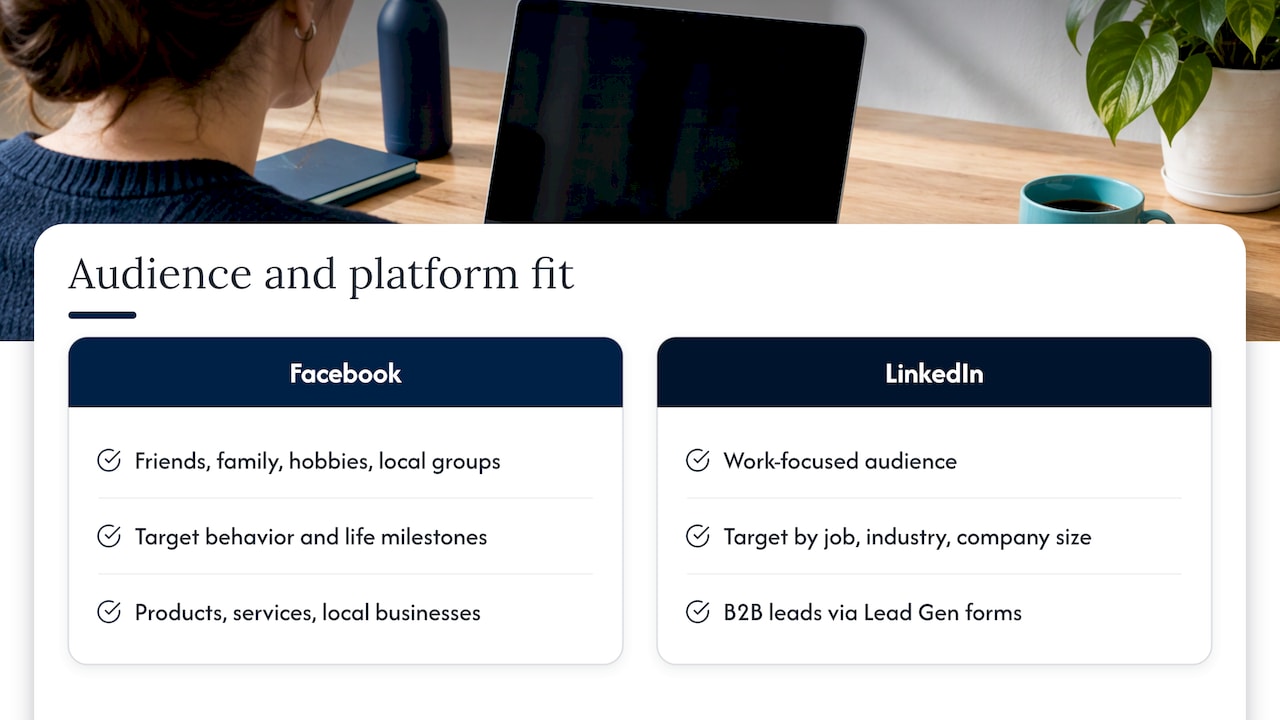
Facebook is where people go for friends, family, hobbies and local groups. Your ad appears between personal posts. That makes it strong for products that people can see and want: a restaurant special, a salon makeover, a home renovation, a fitness class. Facebook has a larger user base and lets you target on behavior and life milestones, such as a recent move or an engagement, which matters when your service sells at life events.
LinkedIn is where people go to think about work. Members expect professional content, and advertisers can aim at people by job title, industry and company size. FitSmallBusiness describes LinkedIn ads as best for generating B2B leads, particularly through Lead Gen forms that are filled in with details already stored in a member’s profile.
So the first question is not “which platform is better.” It is “where is my buyer when they are open to hearing from me?”
Side-by-side comparison
| Factor | LinkedIn ads | Facebook ads |
|---|---|---|
| Best audience | Business decision-makers, defined by role, industry, company size | Consumers and local households, defined by interests, behavior, life events |
| Typical buyer mindset | Professional, researching solutions | Casual, scrolling, open to impulse |
| Click cost | High, commonly quoted at $8 to $15 or more per click | Low, commonly quoted at $1 to $3 per click |
| Daily budget to start | Higher, and meaningful data usually needs more | Very low, from about $1 a day |
| Strength | B2B lead generation with high-intent forms | Awareness, retargeting, visual and emotional offers |
| Ideal customer value | High (thousands of dollars or more) | Low to high |
| Weak spot | Budget can drain before you learn anything | Broad reach can bring low-quality leads if targeting is loose |
The click ranges come from a 2026 U.S. small business guide. Treat them as a planning range, not a promise: your industry, audience size and ad quality move them in both directions.
Targeting: where LinkedIn is precise and Facebook is broad
LinkedIn’s edge is that people describe themselves professionally. You can reach “operations managers at companies with 50 to 200 employees” in a way that is hard to match on a consumer platform. If you sell payroll software, commercial cleaning contracts to office buildings, or consulting to firms in a single industry, that precision saves wasted impressions.
Facebook’s edge is scale and behavioral signals. You build audiences from interests, location, past website visitors and customer lists. Both platforms also let you start from an audience you already have and find similar people: Facebook calls this Lookalike Audience and LinkedIn calls it Audience Expansion. That means your own customer list is the most valuable targeting asset on either platform, so keep it clean.
A practical warning on both: narrow targeting raises costs, and broad targeting raises waste. Start with an audience big enough for the platform to learn from, then tighten based on which leads actually become customers.
Campaign types and what each is built for
Both platforms organize campaigns around goals. LinkedIn’s objectives are Awareness, Consideration and Conversions, and its ad formats include Sponsored Content, Message Ads, Text Ads and Dynamic Ads. Facebook organizes its objectives the same way: Awareness, Consideration (traffic, engagement, video views, lead generation, messages) and Conversion (conversions, catalog sales, store traffic).
Two differences matter in practice:
- Store traffic and catalog sales are Facebook objectives that suit retailers with a physical location or a product feed. LinkedIn has no equivalent, which tells you what it was built for.
- Message Ads on LinkedIn put your pitch in a member’s inbox. They can work for a specific, high-value offer, but they punish generic copy faster than a feed ad does.
Pick the objective that matches the action you can actually measure. A “traffic” campaign that sends people to a slow or confusing page measures nothing useful. If your site is the weak link, fixing it first usually pays back more than any ad, and a clear small business website is the foundation under every campaign.
Cost: why the cheaper platform is not always the cheaper lead
The headline numbers say Facebook is far cheaper. FitSmallBusiness reports ads starting from $1 a day and an average cost per click just over $1. LinkedIn clicks run several times that.
But the click is only the first step. What you pay for is a customer. Consider a simple example with made-up round numbers, not a benchmark:
- Facebook: 1,000 clicks at $1.50 is $1,500. If 2% become leads, that is 20 leads at $75 each. If 1 in 10 becomes a customer, you have 2 customers at $750 each.
- LinkedIn: 200 clicks at $10 is $2,000. If 8% become leads, that is 16 leads at $125 each. If 3 in 10 become customers, you have about 5 customers at roughly $400 each.
Change the close rate or the lead rate and the answer flips. That is the point: you cannot pick a platform from click prices. You need your own lead-to-customer rate, which you only get from tracking calls, forms and booked jobs back to the ad that produced them.
What this means for your budget
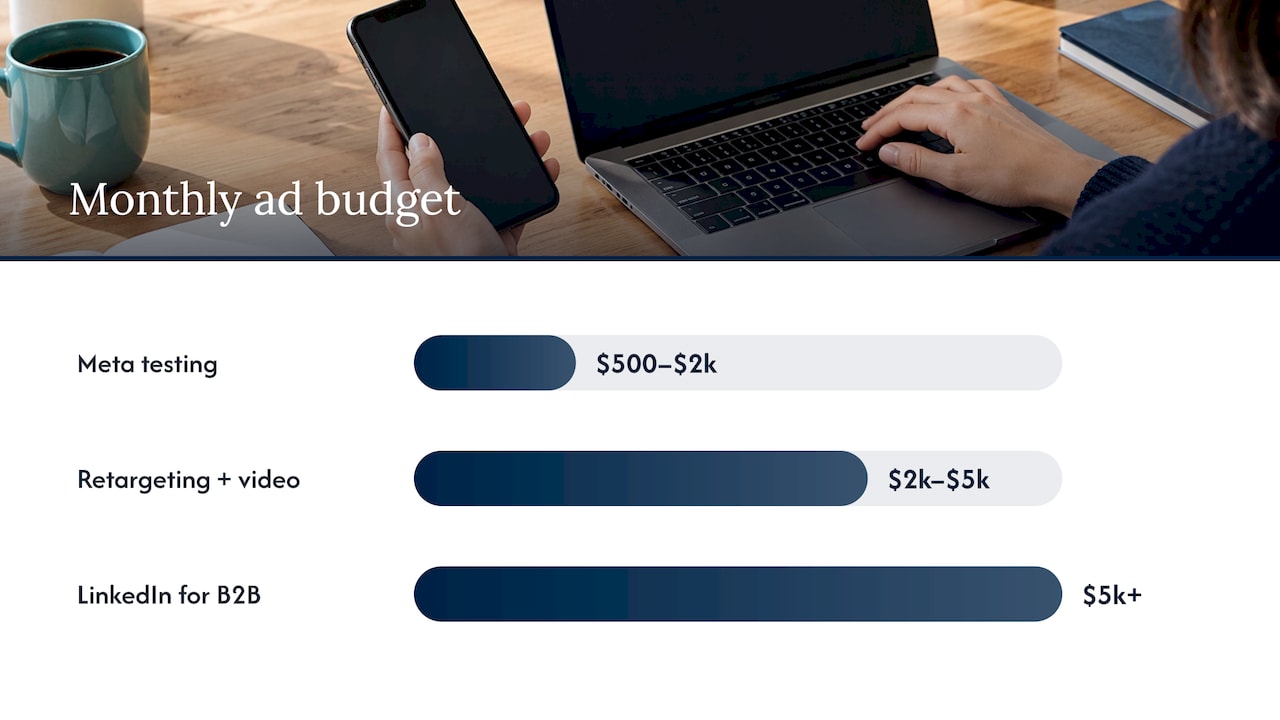
A sensible small business plan runs in stages. One practical guide suggests $500 to $2,000 a month for Meta ad testing, adding retargeting and better video at $2,000 to $5,000, and considering LinkedIn only at $5,000 or more a month for B2B, when one closed client can cover the campaign cost. That ladder matches how the platforms behave: Facebook lets you learn cheaply, LinkedIn asks you to commit before it teaches you much.
If you are deciding how to split money across more than social platforms, our guide on whether to spend on SEO, Google Ads or social media walks through the trade-offs.
Lead quality: what you get for the higher price
LinkedIn leads tend to be better qualified for B2B because the form arrives pre-filled with a real name, employer and job title, and the person is in a work mindset. You pay more for fewer, more relevant contacts. For a company where a single contract is worth thousands, that can be the right trade.
Facebook leads arrive in greater volume and cost less each, but quality depends heavily on your offer and your qualifying questions. A short form with no friction brings more leads and more junk. Adding one or two qualifying questions, such as budget range, timeline or service area, cuts volume but raises the share you can actually serve.
Whichever platform you use, the fastest quality gain comes from what happens after the form is submitted. Leads that get a call back within minutes convert far better than leads that sit in an inbox. Connecting lead forms to your CRM so that nobody has to copy and paste is a small step that protects every ad dollar you spend.
When LinkedIn is worth it for a small business
LinkedIn makes sense when most of these are true:
- Your customers are other businesses, and you can name their job titles.
- The average customer is worth enough that one sale covers the campaign.
- Your sales cycle involves several people or several weeks, so a trusted professional setting helps.
- You can spend enough per day to collect meaningful data, not a token amount.
- You have a specific offer, such as a consultation, audit or webinar, rather than a vague “contact us.”
Examples: a commercial HVAC contractor targeting facilities managers, an accounting firm pitching to owners of companies in a certain size band, an IT services provider selling managed support contracts. In each case the buyer is findable by title, and the contract value is high.
When Facebook fits better
Facebook is usually the right first test when the following hold. Guidance for U.S. small businesses points to the same signals: the product looks good on camera, customers buy on impulse or emotion, you are building awareness for something new, you have an existing audience to retarget, or you serve consumers.
That covers a large share of local businesses: restaurants, boutiques, fitness studios, salons, home services that sell to homeowners, event venues. Facebook also does a useful second job: reminding people who have already visited your site. If you want to understand that tactic, bringing back visitors who left without buying explains how retargeting works and where it fits.
The third option most comparisons skip: people already searching
Both LinkedIn and Facebook interrupt people. Someone scrolling a feed was not looking for a plumber, an accountant or a roofer. Google Ads reaches the person who just typed that need into a search box, which is why many local service businesses see a more direct path to booked work there. We compare the two approaches in Google Ads vs Facebook Ads, and if you are still sizing up the spend, real Google Ads budgets for small businesses gives a grounded picture.
This does not make social ads a bad idea. It means each channel should have a different job: search captures demand that exists, Facebook creates awareness and retargets, LinkedIn reaches a narrow professional audience. Mixing up those jobs is the most common reason small business ad budgets disappoint.
A five-step way to decide
- Write down your ideal customer in one sentence. If it includes a job title, LinkedIn is a candidate. If it includes a neighborhood or a life situation, look at Facebook and search.
- Calculate what a customer is worth. Average first-year revenue, minus the cost of delivering it, is your ceiling for what you can pay to win one.
- Set a test budget you can lose. On Facebook that can be modest. On LinkedIn, a test too small to gather data teaches nothing, so decide whether you can fund it properly or wait.
- Choose one measurable goal. Calls, booked appointments or qualified forms, not impressions or clicks.
- Track every lead to a result. Use call tracking, form tracking and a note of which leads became customers. Review it monthly and move money toward what closes.
A useful principle from the research: don’t run LinkedIn ads just because competitors do, and don’t expect Facebook ads to work without a clear offer. Each channel needs a job, a budget and a success measure.
Common mistakes with both platforms
- Sending traffic to the homepage. A dedicated page with one offer and one action converts better than a general site.
- Judging results after a week. Platforms need time and data to learn. Give a test a full cycle before changing it.
- Ignoring reviews. People check your reputation after seeing an ad. Strong reviews raise the return on every channel, which is why responding well to bad reviews belongs in a marketing plan.
- Splitting a small budget across too many channels. Two channels done properly beat four done thinly.
- No tracking. Without it you are guessing which platform works.
Where we can help
We are a digital marketing agency for small and local businesses. We manage Google Ads campaigns, build websites and run SEO, and our offer list also includes social media marketing and reputation management. Our approach is data-driven: we provide clear performance reports and regular updates so you can see how your investment turns into business results.
If you have been disappointed by an agency before, we start from your goal and report against it.
To talk through where your first ad dollar should go, contact us through our site.
Our perspective
Owners ask us whether LinkedIn or Facebook is “better,” and the honest answer is that the platform matters less than the match between your buyer, your offer and your budget.
We have built our service around the idea that marketing should be accountable. That means a clear goal, a clear report and no mystery about where the money went. A platform that looks cheap on paper but cannot be tied to calls and customers is not cheap.
For most local businesses, we think the strongest foundation is a website that converts, a Google presence that captures people already looking, and then social ads with a defined job layered on top. Our offer list covers each of those pieces, so the work stays connected and the reports tell one story.
If you do sell to business decision-makers at high contract values, LinkedIn deserves a serious, properly funded test. Whatever you choose, measure it, and tell your agency to show you the numbers every month.
Michael
FAQ
Are LinkedIn ads more expensive than Facebook ads?
Yes, per click, by a wide margin. A 2026 U.S. guide quotes $8 to $15 or more per click on LinkedIn against $1 to $3 on Facebook. The gap in cost per customer is usually smaller, because LinkedIn leads can close at a higher rate when you sell to businesses.
Which is better for B2B lead generation?
LinkedIn is the stronger fit when you can define buyers by job title, industry or company size and each customer is worth a lot. FitSmallBusiness points to LinkedIn Lead Gen ads as a strong B2B option. Facebook can still work for B2B when your buyers are small business owners who also behave like consumers.
What is the minimum budget to start on each platform?
Facebook ads can start from about $1 a day, so a small test is possible. LinkedIn needs a larger daily spend before you gather useful data. In both cases, set a budget that runs long enough to produce real results.
Can I run both at the same time?
Yes, once each has its own goal. A common pattern is Facebook for awareness and retargeting of site visitors, and LinkedIn for a narrow professional audience. With a small budget, start with one channel and add the second when the first is tracked and working.
Should a local service business use either one first?
Often the better first step is Google Ads, because it reaches people already searching for your service. Social ads then support it by building awareness and following up with visitors. The right mix depends on your market and margins.
Sources
- A Small Business Guide to Social Media Advertising Platforms
- LinkedIn vs. Facebook: Which Is Best for Your Business?
- LinkedIn ad objectives and formats
- Meta Ads campaign objectives
- How to Choose the Right Ad Platform for Your Small Business
- Pros and Cons of Social Media Marketing for Small Businesses