A competitor website analysis is a structured look at how rival sites win attention and turn it into customers: who ranks for what, what their pages say, how they get a visitor to call or book, and how they show up locally. Done well, it ends with a short list of changes to your own site, not a spreadsheet nobody reads. This guide shows a small business owner how to do it by hand, with free tools, in an afternoon.
TL;DR
- Start by finding your real search competitors. They are often review sites, directories and publishers, not just the shop down the street.
- Compare four things: search visibility, page content, the path from visitor to inquiry, and local signals such as your Google Business Profile and reviews.
- Look at the conversion path before vanity metrics. Navigation, calls to action and booking steps tell you more about a rival’s revenue strategy than a domain score.
- Repeat the analysis on a schedule and ask why a competitor changed something, not only what changed.
- Finish with a ranked action list: fix, build, or ignore.
Table of Contents
- Who your competitors really are online
- Step 1: Set one clear question
- Step 2: Map their search visibility
- Step 3: Read their content like a customer
- Step 4: Study the conversion path
- Step 5: Check the technical layer
- Step 6: Compare local signals
- Step 7: Apply the 4 Ps to the online picture
- Step 8: Turn findings into an action list
- Our perspective: treat it as a periscope, not a snapshot
- When to bring in help
- Common mistakes to avoid
- FAQ
- Sources
Who your competitors really are online
Your list of competitors in the real world and your list in Google are different lists. According to Shopify’s competitive analysis guide, retailers and service providers should expect to compete in search results against large review sites, industry aggregators and informational publishers, not only other businesses in the neighborhood.
So build three groups before you open any tool:
- Direct competitors. Businesses that sell what you sell to the same customers in your service area.
- Search competitors. Any site that appears when you search the phrases your customers use. Search ten of them in a private browser window and write down every domain on page one.
- Aspirational competitors. One or two larger brands in your field whose sites you admire. They are useful for ideas, not for head-to-head ranking targets.
If you are a plumber, a dentist or a boutique retailer, group two will usually include a national directory and a how-to publisher. You will not beat those with the same page they have. You will beat them by being the obvious local choice, which is where the rest of this guide points.
Step 1: Set one clear question
The CIENCE nine-step framework starts with establishing your aims, and that is the step most owners skip. “See what competitors do” produces notes. A sharper question produces decisions. Pick one:
- Why do three rivals outrank us for “emergency AC repair” in our city?
- Why does a competitor with a weaker-looking site get more calls?
- Which services should we add or promote that they already prove people want?
Write the question at the top of a document. Everything below feeds it.
Step 2: Map their search visibility
Search visibility is the first thing most guides cover, and it is worth doing, as long as you keep it simple.
What to collect
| What to check | Where to look | What it tells you |
|---|---|---|
| Pages that rank for your target phrases | Manual Google searches, plus a free or paid keyword tool | Which page types win: service pages, location pages, blog posts |
| Page titles and meta descriptions | Right-click, view page source, or a browser SEO extension | How they phrase the promise and which words they target |
| Estimated top keywords | A keyword research tool with a domain lookup | Topics you may be missing |
| Backlinks | A backlink checker | Which local or industry sites link to them and could link to you |
| Paid presence | Search your key phrases and note who buys ads | Which terms rivals consider valuable enough to pay for |
Treat tool numbers as estimates. They are good for comparing one site with another and poor as absolute truth. If you want a deeper method for keyword gaps, we wrote up the process in our small business keyword gap guide.
For paid search, the auction itself is evidence. Our piece on what a proper Google Ads competitor analysis reveals explains how to read who you are bidding against and where they appear.
If part of your business lives in an app store, the same logic applies there. A competitor intelligence platform for app store listings lets you track rival listings, keywords and rank changes in one place.
Pay attention to the page, not just the keyword
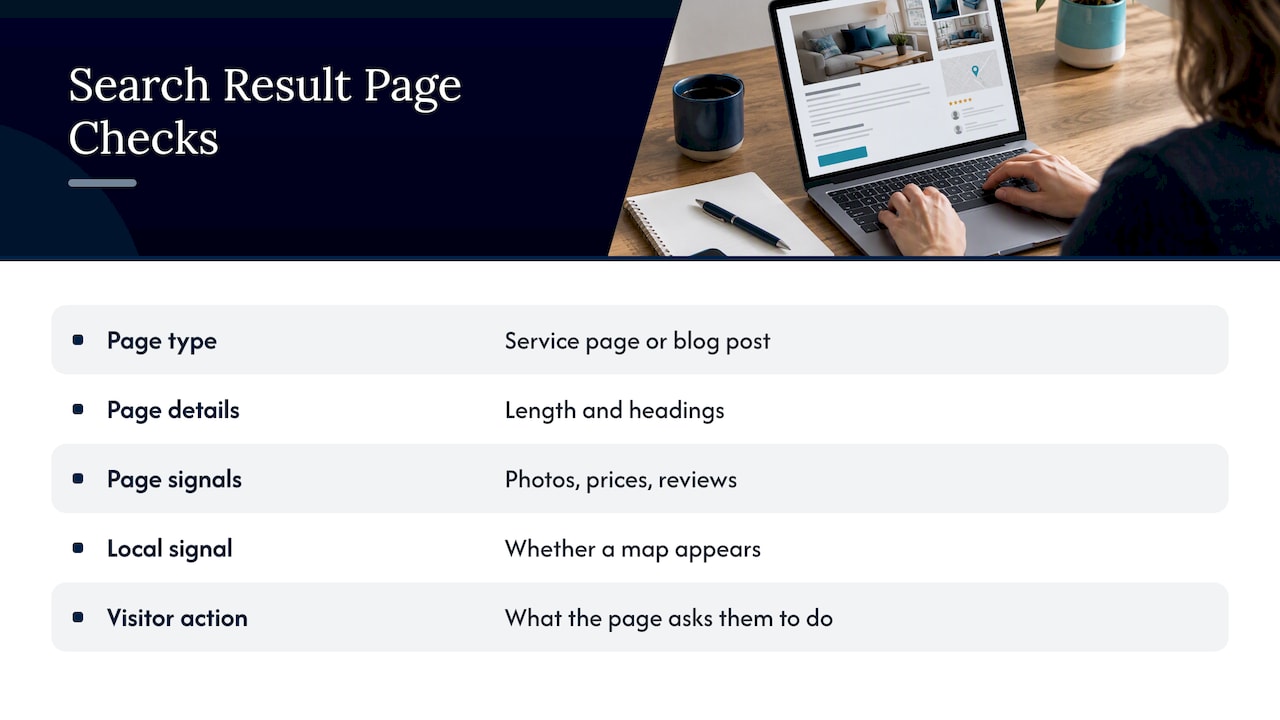
For each phrase, open the top three results and note the page type, the length, the headings, whether there are photos, prices, reviews or a map, and what the page asks the visitor to do. Search intent shows up fast: if every result is a city-specific service page and yours is a blog post, you have found your problem.
Step 3: Read their content like a customer
Open a competitor’s site and spend ten minutes as a buyer. Then spend ten more as an analyst, with these prompts:
- Offer clarity. Can you tell in five seconds what they sell, where, and to whom?
- Proof. Do they show reviews, case studies, license numbers, before-and-after photos, guarantees?
- Depth. Do they have a separate page per service and per location, or one page that lists everything?
- Gaps. What questions do customers clearly have that no one answers? Pricing ranges, timelines, what to expect on the first visit?
- Freshness. Are pages updated, or do they date back years?
The gaps column is where small businesses win. A competitor with a thin page for a high-value service is an opening. A competitor with a deep page on a topic you ignore is a to-do item.
Step 4: Study the conversion path
Most business owners focus on vanity metrics like domain authority. The more telling exercise is to trace how a competitor moves a visitor from an informational search to a contact form or booking button, an approach 42Signals describes in its framework as part of benchmarking. Look at where the navigation menu leads and which calls to action get the most emphasis. That often reveals more about their actual revenue strategy than any automated keyword report.
Walk each competitor’s path with a checklist:
- What is the primary button in the header? Call, quote request, book online?
- How many clicks from a service page to a way to contact them?
- How long is the form? Does it ask for a budget or a photo?
- Is the phone number tappable on mobile?
- What happens after you submit: a thank-you page, a confirmation email, a promised response time?
- Is there a second option for people not ready to buy, such as a guide, a financing page or a quote calculator?
Now run the same walk on your own site, on your phone, with someone who has never seen it. Our article on what makes a website convert visitors into customers covers the fixes that usually come out of this exercise.
Step 5: Check the technical layer
A less obvious step in professional local competitor analysis is auditing the structured data on rival sites. Search Engine Journal’s guide to analyzing local search competition points to crawling competitor sites for Schema.org markup, which can explain why certain competitors consistently win rich snippets. A website crawler will list the markup types for you. Google’s own documentation notes that properly marked-up FAQ pages may be eligible for rich results, so if rivals show star ratings or FAQ dropdowns in results and you do not, check their markup first.
Also look at the basics: mobile layout, page speed on a phone, secure connection, and whether service pages are reachable from the main menu. Poor navigation is a frequent hidden cost, and we cover it in our post on solving navigation problems with professional website design.
Step 6: Compare local signals
For a business that serves a city or region, the website is only half the comparison. Customers check you out before they visit. A HubSpot consumer report on local search found that reviews and your website matter most, with 51% of consumers saying reading reviews is the first thing they do.
So add these checks for each rival:
- Google Business Profile: primary category, listed services, photos, posts, hours, and whether the description is filled in.
- Review count, average rating, how recent the newest reviews are, and whether the owner replies.
- Consistency of name, address and phone number across directories.
- Where they sit in the map results for your key phrases.
Google states that local results are based mainly on relevance, distance and prominence, so complete profiles and active review handling are among the cheapest edges you can build. See our guides on Google Business Profile optimization and ranking in the Google map pack for the specific steps, and how to respond to bad reviews if a rival’s reply habits beat yours.
Step 7: Apply the 4 Ps to the online picture
The classic marketing mix still works as a lens. Crunchbase’s competitive analysis guide is not the only place to find it, but its framing is useful for web work: Product, Price, Place and Promotion. Online, “Place” means where a competitor is visible, such as Google Ads, social channels or specific directories. That tells you which platforms deserve your attention first.
| P | What to note on a competitor’s site |
|---|---|
| Product | Services listed, packages, guarantees, specialties |
| Price | Published prices, ranges, financing, free estimates, discounts |
| Place | Service areas, directories, ad channels, social profiles |
| Promotion | Offers, seasonal campaigns, email sign-ups, content themes |
If you are deciding where to put a limited budget after this exercise, our comparison of SEO, Google Ads and social media spending walks through the trade-offs.
Step 8: Turn findings into an action list
An analysis only pays off when it changes something. Sort every finding into one of three bins:
- Fix now. Problems on your own site that rivals have solved: a missing tappable phone number, no service page for your most profitable job, an incomplete business profile.
- Build next. Content or pages that fill a gap: a city page, a pricing explainer, a proof page with case studies.
- Ignore. Things that look impressive but do not tie to revenue, such as a rival’s follower count or a high authority score.
Give each item an owner and a date. A one-page plan with five items that get done beats a forty-slide deck.
Our perspective: treat it as a periscope, not a snapshot
We look at competitor sites most weeks, and the pattern we see is consistent: owners run one big analysis, file it, and never look again. The better habit is a light monthly check. Practitioners describe competitor analysis as an ongoing periscope rather than a one-off report, and CIENCE’s guide makes the same point about the biggest pitfall: treating it as static reporting instead of a tool that shapes strategy.
When a rival suddenly rewrites a service page or shifts the keywords in its titles, ask why. It may signal a new service line or a push into a new area before it is obvious in the market.
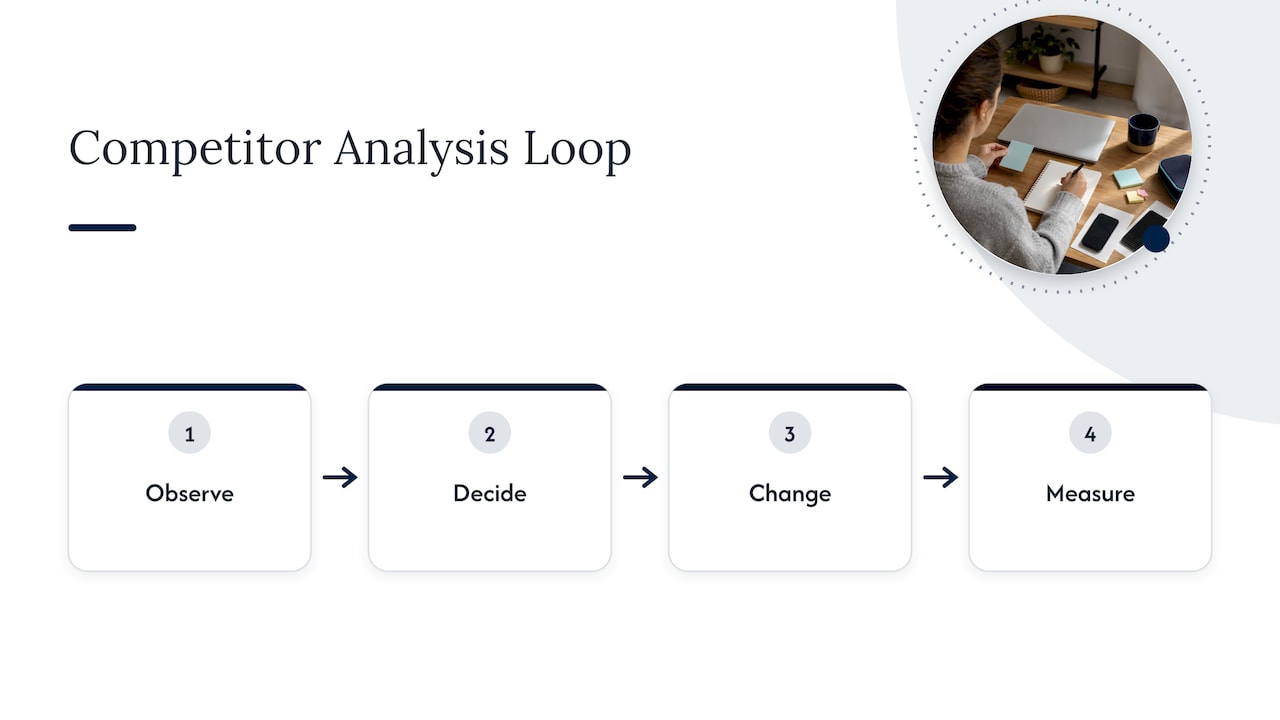
We also push clients away from chasing every metric. The numbers that matter are the ones tied to inquiries: calls, form fills, direction requests, booked jobs. That is why our reporting centers on how marketing spend converts into business results, and why we explain what we are changing and why in regular updates. A competitor analysis should feed that same loop: observe, decide, change, measure.
— Michael
When to bring in help
You can do everything above yourself. Where owners get stuck is time and interpretation: the tools produce a lot of data, and it takes experience to tell a real threat from noise. If you want a second set of eyes, our team handles SEO, Google Ads management and website design for small and local businesses, and we start with where you stand against the businesses taking your customers. If you are earlier in the process, our local SEO report page is a good place to see how we present findings. You can also start from our home page to see all services, including Google Business Profile and reputation management.
If you are a smaller player facing larger brands, read how local businesses can compete with larger companies online next.
Common mistakes to avoid
- Copying instead of differentiating. If every plumber in town says “fast, friendly, affordable,” saying it louder does not help. Use the gaps you found.
- Benchmarking against the wrong sites. Comparing yourself with a national brand’s traffic will only discourage you. Compare on local phrases and local profiles.
- Ignoring the mobile view. Most local searches happen on a phone, so do your walkthrough there.
- Trusting tool estimates as exact. Use them for direction.
- Worrying about sabotage. Google says it works to prevent other site owners from harming your ranking, so a rival’s rise is far more likely to come from better pages than from tricks.
FAQ
How do I analyze competitor websites?
Start by listing direct, search and aspirational competitors. Then compare their search visibility, page content, conversion path, technical markup and local signals against your own site, and write down what to fix, build or ignore.
How do I check who my website competitors are?
Search your ten most important customer phrases in a private browser window and record every domain on page one. Those domains are your search competitors, and they often include directories and publishers as well as local rivals. A keyword tool with a domain lookup can confirm the overlap.
What are the 4 Ps of competitor analysis?
They are Product, Price, Place and Promotion. For a website review, check what services a rival offers, how they present pricing, where they are visible online, and which offers and content they push.
How often should I repeat a competitor analysis?
Run a light check monthly and a fuller review every quarter or after a major change, such as a rival redesign or a new competitor entering your area. Treating it as ongoing is what lets you spot shifts early.
Sources
- CIENCE: 9-step competitor website analysis guide
- Search Engine Journal: Analyzing your local organic search competition
- 42Signals: Competitor analysis framework
- Shopify: Competitive analysis guide
- Crunchbase: What is competitive analysis
- Google Business Profile Help: Tips to improve your local ranking
- HubSpot: The Lowdown on Local Search consumer report
- Google Search Central Blog: Rich results and Search Console
- Search Console Help: Competitors and your site’s ranking