A short, specific, empathetic public reply posted within 24 hours is the single most effective move you can make when a negative review appears. It protects conversions, signals professionalism to every prospective customer reading that thread, and often recovers the unhappy reviewer. Here are three micro-templates you can edit and post right now.
Genuine service failure:
Product defect:
Unverifiable or suspected fake review:
Tone rule: Never get defensive, never admit legal liability, and always sign with a real name or role. The reply is written for the hundreds of prospective customers reading it, not just the one who left it.
Pro Tip: Keep every public reply under 100 words. Brevity signals confidence. A long, defensive wall of text signals panic.
Table of Contents
- How to respond to bad reviews: the step-by-step checklist
- Ready-to-use response templates for common scenarios
- Platform-specific rules for Google, Yelp, Facebook, and TripAdvisor
- How to handle fake, anonymous, or unverifiable reviews
- Response timelines, who should reply, and your internal policy
- How a negative review can become a business win
- When should you hire a reputation management agency?
- Key Takeaways
- Why the response matters more than the review itself
- Tradewindsunitedmedia handles the reputation work so you don’t have to
- Useful sources and platform policy links
How to respond to bad reviews: the step-by-step checklist
The moment a negative review appears, most business owners feel the urge to either ignore it or fire back. Both are mistakes. What works is a short, structured response that follows a clear sequence.
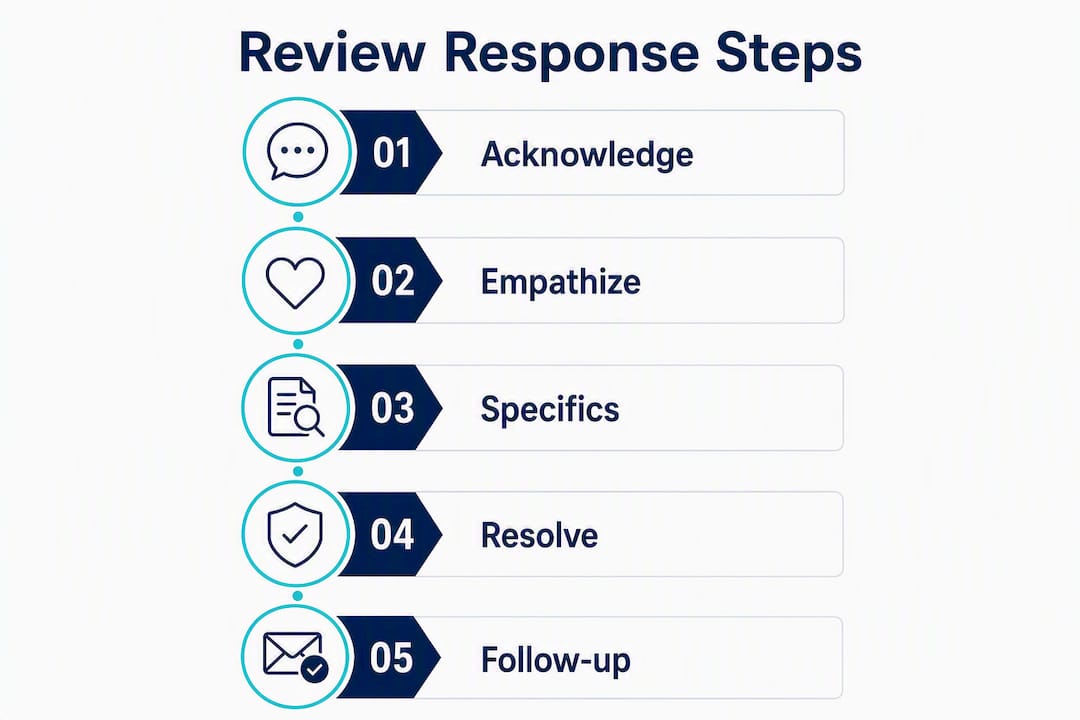
The response workflow
- Read the review twice before typing anything. Identify the core complaint, the emotional tone, and whether the reviewer is a real customer you can verify.
- Verify internally. Check your records for the name, date, order number, or service ticket. This takes 60 seconds and changes how you respond.
- Acknowledge the reviewer by name (if they used one). “Hi Sarah” outperforms “Dear Customer” every time.
- Thank them for the feedback. Not sarcastically. A reviewer who bothered to write a complaint is giving you free quality-control data.
- Express empathy without admitting fault. The phrase “I’m sorry your experience didn’t meet our usual standard” is legally safe and genuinely human. Avoid language that confirms negligence or accepts legal liability.
- Take ownership of the situation. You own the resolution, not necessarily the cause. There’s a difference.
- State a concrete next step with a deadline. “Please email us at [address] and we’ll follow up within one business day” is a promise future readers will notice.
- Move the conversation offline. Give a direct email or phone number. Public back-and-forth rarely ends well and exposes private customer data.
- Sign with a real name and role. “— James, Owner” carries more weight than “The Team.”
What to say vs. what to avoid
| Say This | Avoid This |
|---|---|
| “I’m sorry your experience didn’t meet our standard.” | “We’re sorry you feel that way.” |
| “Please contact me directly at [email].” | “As per our policy…” |
| “We’d love the chance to make this right.” | “This has never happened before.” |
| “Thank you for bringing this to our attention.” | “You must be mistaken.” |
| “We’re looking into this right away.” | “We can’t control everything.” |
The left column signals accountability. The right column signals defensiveness, and prospective customers read both.
Specificity builds trust faster than any other move: reference the product name, the service date, or the specific issue the reviewer mentioned. It costs seconds and tells every reader you actually engaged with the complaint rather than pasting a form letter.
Pro Tip: Draft your response in a notes app first. Reading it aloud before posting catches defensive phrasing your eyes skip over.
Ready-to-use response templates for common scenarios
These templates are built to be edited, not posted verbatim. The bracketed fields are where you add the specific detail that makes the reply feel genuine rather than automated.
1. Restaurant: food quality or service complaint
Public reply:
“Hi [Name], thank you for visiting [Restaurant Name] and for taking the time to write this. I’m sorry the [dish name / service] fell short on [day of visit] — that’s not the experience we work hard to deliver. I’d love to make it right. Please reach out to me directly at [email or phone]. — [Owner/Manager Name]”

Private follow-up (after they contact you):
“Hi [Name], thank you for reaching out. I’ve looked into what happened on [date] and I want to personally offer [specific remedy: replacement meal, refund, invitation to return]. I’d appreciate the chance to show you what we’re really about.”
2. Retail: product defect or wrong item
Public reply:
“Hi [Name], I’m sorry the [product name] arrived [damaged/incorrect]. That’s a quality issue we take seriously. Please email [address] with your order number and we’ll send a replacement or issue a full refund — whichever you prefer. — [Name, Role]”

Private follow-up:
“Hi [Name], I’ve pulled your order #[number]. We’re shipping a replacement today via [carrier] and I’ve added a [discount/credit] to your account as an apology for the inconvenience.”
3. Service appointment: missed, late, or poor workmanship
Public reply:
“Hi [Name], thank you for flagging this. A [late arrival / incomplete job] is not acceptable, and I’m sorry it happened during your appointment on [date]. Please call me directly at [phone] so I can schedule a return visit at no charge. — [Name, Owner]”
Private follow-up:
“Hi [Name], I’ve reviewed the job notes from [date]. I’d like to send [technician/team member] back out on [specific date] to address [specific issue] at no cost to you.”
4. Healthcare or sensitive service: privacy-aware response
Public replies in healthcare, mental health, legal, or financial services require extra care. Never confirm or deny that the reviewer is a client. Never reference any detail of their visit or account.
Public reply:
“Thank you for sharing your experience. We take all feedback seriously and are committed to providing respectful, high-quality care to everyone we serve. Please contact our office at [phone/email] so we can address your concerns privately. — [Practice Name / Manager Name]”
Private follow-up: Handle entirely through your standard patient/client communication channel. Do not reference the review in writing.
Adjusting tone by star rating
- 1-star: Lead with empathy, move offline fast. Keep the public reply under 60 words.
- 2-star: Acknowledge the specific issue, offer a concrete fix, invite contact.
- 3-star with specifics: Thank them for the partial positive, address the gap directly, offer to follow up.
Referencing a specific detail from the review — a product name, a date, a staff member’s name — is the fastest way to signal that a real person read the complaint. Generic replies signal the opposite.
Platform-specific rules for Google, Yelp, Facebook, and TripAdvisor
Each platform has its own verification requirements, reply mechanics, and policy tools. Knowing the differences saves time and prevents mistakes.
Google Business Profile
Google requires your business to be verified before you can reply to reviews. Once verified, replies appear publicly below the review and are visible in both Google Search and Google Maps. The reviewer receives a notification when you respond, which is one reason a thoughtful reply sometimes prompts a rating update.
To reply: log into your Google Business Profile, navigate to the Reviews tab, and click “Reply.” Replies can be edited after posting but cannot be deleted by the business. If a review violates Google’s policies (spam, fake, conflict of interest), use the flag icon to report it after posting your public reply. Consistent responses on Google correlate with higher Local Pack rankings, so the habit compounds over time.
For a deeper look at how review management connects to local search performance, the guide on ranking in the Google Map Pack covers the full picture.
Yelp
Yelp allows verified business owners to post one public comment per review. The tone Yelp’s community expects skews slightly more conversational than Google. Yelp also offers a private messaging tool, which is the right channel for sensitive follow-ups. Do not argue with reviewers publicly on Yelp; the community notices and the platform’s algorithm may flag adversarial exchanges. To report a review that violates Yelp’s Content Guidelines, use the flag option on the review itself.
Facebook reviews (now called Recommendations) allow public replies from the business Page. The audience here often includes people who already follow your page, so the tone can be slightly warmer and more community-oriented. Facebook does not offer a native flagging tool for individual reviews the way Google does; if a review violates Facebook’s Community Standards, report it through the standard content-reporting flow. Response time expectations on Facebook tend to be shorter because users associate it with real-time communication.
TripAdvisor
TripAdvisor is the most read-heavy platform for hospitality businesses. Replies are called “Management Responses” and appear prominently below the review. TripAdvisor’s audience reads responses carefully, so a slightly longer reply (up to 150 words) is acceptable here. To flag a review for removal, use TripAdvisor’s Review Dispute process, which requires documented evidence. Moving complex or sensitive cases offline immediately applies on every platform, but TripAdvisor’s hospitality audience particularly notices when a business engages substantively before redirecting.
24-hour action checklist for any platform:
- Log in and verify the review is live
- Check your records for the customer
- Draft your reply in a separate document
- Edit for tone (remove any defensive phrasing)
- Post and note the date/time in your log
How to handle fake, anonymous, or unverifiable reviews
A review with no matching record in your system is not automatically fake. It could be a first-time customer who paid cash, a guest who booked under a different name, or someone who had a bad experience but never told you. Start with verification, not accusation.
Verification checklist before you respond
- Search your CRM or booking system for the reviewer’s name, username, and any date mentioned in the review
- Check for similar complaints in your records from the same time period
- Ask your team if anyone recalls the situation described
- Look at the reviewer’s profile: zero reviews, no photo, and a review posted the same day the account was created are signals worth noting
- Check whether a competitor’s name appears in the reviewer’s history (a conflict-of-interest flag on Google)
If you cannot verify the experience after a reasonable internal check, respond publicly with a factual, professional tone and an invitation to contact you directly. The goal is to show other readers you take feedback seriously without publicly accusing anyone of lying.
Safe public reply for unverifiable reviews:
“Hi, we’ve carefully reviewed our records and are unable to locate an experience matching this description. We take every concern seriously. Please contact us directly at [email/phone] so we can investigate personally. — [Name, Role]”
Flagging and reporting steps
- Google: Click the three-dot menu on the review, select “Flag as inappropriate,” and choose the relevant policy violation. Google’s review team evaluates the flag; removal is not guaranteed and typically takes several days.
- Yelp: Click “Flag” on the review and select the violation type. Yelp’s moderation team reviews flagged content.
- Facebook: Use the three-dot menu on the Recommendation and select “Find support or report.”
- TripAdvisor: Use the “Report a problem” link on the review and submit through the Review Dispute process with supporting documentation.
Post a calm public reply before or alongside any flag submission. The reply is part of your evidence chain: it shows future readers and the platform that you engaged professionally. Keep a log of the review URL, the date flagged, and any platform case number for follow-up.
Response timelines, who should reply, and your internal policy
Speed matters more than most business owners realize. Responding to negative reviews within 24 hours signals active monitoring and genuine care. A review that sits unanswered for a week tells prospective customers the business either doesn’t care or isn’t paying attention.
Recommended timelines
- 1–3 star reviews: Same day, within 24 hours. These are the reviews prospective customers scrutinize most.
- 4–5 star reviews: Within 24–48 hours. A brief, warm acknowledgment is enough.
- Exception — when to wait: If a review involves a legal threat, a potential HR matter, or a claim you need to verify with legal counsel, draft a holding reply (“Thank you for reaching out — we’re looking into this and will follow up shortly”) while you consult internally. Never post a substantive response to a legally sensitive review without review.
Who should sign the reply
- 1-star disputes and serious complaints: The owner or founder. A reply signed by the owner signals the business takes the issue seriously at the highest level.
- Common service issues (2–3 star): A trained customer service manager or operations lead, using a consistent signature format.
- High-volume businesses: A designated team member with a shared login, using a standard signature that includes the business name. Never post anonymously.
Short escalation matrix
- Escalate to owner/manager: Any review mentioning injury, legal action, discrimination, or a named employee in a serious context.
- Escalate to legal counsel: Reviews containing defamatory statements, doxxing, or threats. Do not respond publicly until you have guidance.
- File a platform report: Reviews that violate platform policies (spam, fake, conflict of interest) after posting a calm public reply.
- Log for follow-up: Every 1–3 star review, the date responded, the resolution offered, and whether the reviewer updated their rating.
Respond to every 1–3 star review without exception. For businesses with high review volume, prioritize negatives and neutral reviews first, then respond to a representative sample of positives to maintain a visible engagement rate.
How a negative review can become a business win
The reply is not the end of the process. It is the beginning of a recovery sequence that, handled correctly, can produce a rating update, a returning customer, and a process improvement that prevents the same complaint from appearing again.
The recovery sequence
- Post the public reply within 24 hours using the templates above.
- Resolve privately. Once the reviewer contacts you, focus entirely on fixing the problem. Offer a concrete remedy: a refund, a replacement, a return visit, a credit.
- Confirm resolution in writing. A brief email or message confirming what was done creates a paper trail and often prompts goodwill.
- Ask once for a review update. After the issue is resolved, it is appropriate to say: “If your experience has improved, we’d appreciate it if you had a chance to update your review — but no pressure either way.” Ask once. Never offer an incentive for an update; that violates platform policies on every major platform.
- Log the complaint type. If the same issue appears in three or more reviews, it is a process problem, not a one-off.
Turning complaints into process improvements
Run a monthly review of your negative feedback. Group complaints by category: wait time, product quality, staff behavior, communication, billing. Any category with two or more complaints in a month warrants a team conversation. This is how a bad review becomes a quality-control meeting that prevents the next ten.
The word-of-mouth reputation effect is real: a business that visibly handles complaints well attracts more referrals than one with a perfect (and suspiciously uncontested) rating. A mix of reviews with professional responses reads as more credible to prospective customers than a wall of five-star ratings with no engagement.
Research tracking businesses that responded to reviews found a modest average rating increase and a rise in positive reviews over time — a compounding effect that starts with the first reply. (Reviewz)
When should you hire a reputation management agency?
DIY review management works well when your volume is low, your team has bandwidth, and the complaints are straightforward. It stops working when any of the following are true.
Hire-vs-DIY checklist
- You receive more than 10 reviews per month across platforms and responses are falling behind
- You have multiple locations, each needing a separate Google Business Profile managed
- A review has legal implications (defamation, a named employee, a safety claim) and you need professional guidance
- Your average rating has dropped and you don’t have a system for tracking or responding
- You’ve tried responding but your replies are generating more negative engagement, not less
- You want review responses tied to a broader local SEO strategy, not handled in isolation
Consistent review responses correlate with higher Local Pack rankings and better conversion rates in analysis of U.S. business profiles. That connection between reputation management and local SEO growth is exactly where an agency adds value beyond what a busy owner can manage alone.
What Tradewindsunitedmedia does for reputation management
Tradewindsunitedmedia works with small businesses to monitor, respond to, and systematically improve their review profiles across Google, Yelp, Facebook, and TripAdvisor. The service includes a Google Business Profile audit, a response policy tailored to your industry, and monthly performance reporting that shows rating trends, response rates, and Local Pack visibility changes. Clients get clear data on what’s moving, not just activity reports.
Questions to ask any reputation management agency
- Do you respond to reviews in my brand voice, or do you use generic templates?
- How do you handle legally sensitive reviews before posting a reply?
- What reporting do you provide, and how often?
- Do you also manage the Google Business Profile, or just the responses?
- How do you measure success beyond star rating?
Pro Tip: Ask the agency to show you three real response examples from a client in your industry. Generic templates that could apply to any business are a red flag.
Key Takeaways
Responding to every 1–3 star review within 24 hours, with a specific and empathetic reply that moves the conversation offline, is the most direct way to protect conversions and recover customers.
| Point | Details |
|---|---|
| Reply within 24 hours | Same-day responses to 1–3 star reviews signal active management and protect prospective buyers’ trust. |
| Never admit legal liability | Use empathy language (“I’m sorry your experience didn’t meet our standard”) rather than fault-confirming phrases. |
| Specificity builds credibility | Reference the product, date, or issue from the review — generic replies signal inattention to every reader. |
| Flag fakes after replying | Post a calm public reply first, then report policy violations through the platform’s flagging tool. |
| Tradewindsunitedmedia | Provides reputation management, Google Business Profile audits, and local SEO services with monthly performance reporting for small businesses. |
Why the response matters more than the review itself
Most advice on this topic focuses on damage control. That framing misses the bigger opportunity. A negative review that receives a calm, specific, solution-oriented reply is not a liability. It is evidence of how your business behaves under pressure, and prospective customers read it that way.
The public reply is written for the audience, not the reviewer. Every person who searches your business name and lands on that review thread is evaluating whether you’re the kind of operation that takes responsibility or deflects. A single well-crafted response can do more for conversion than five new five-star ratings, because it demonstrates character in a way that praise alone cannot.
What most businesses underestimate is the compounding effect. One professional response encourages the reviewer to update their rating. That update shifts your average. A higher average attracts more clicks. More clicks generate more reviews. The cycle starts with a 60-word reply posted before the end of the business day.
The businesses that treat review responses as a chore, something to get through quickly and forget, are the ones who watch their ratings drift and their inbound leads dry up. The ones who treat it as a customer recovery and brand-building process are the ones who show up in the lead quality conversation from a position of strength.
Tradewindsunitedmedia handles the reputation work so you don’t have to
Keeping up with review responses across Google, Yelp, Facebook, and TripAdvisor takes consistent attention that most small business owners simply don’t have. Tradewindsunitedmedia gives you a done-for-you reputation management service that includes a full Google Business Profile audit, platform-specific response policies written in your brand voice, and monthly reporting that ties your review performance to real local search results.

The difference from a generic agency: you get clear data showing how your rating trends and response rates connect to Local Pack visibility and inbound leads, not just a spreadsheet of replies. Every response is reviewed for legal safety, brand consistency, and platform compliance before it posts. If you want to see exactly where your reputation stands right now, request a free audit and get a prioritized list of fixes within one business day.
Useful sources and platform policy links
The following resources are worth bookmarking for ongoing reference. Platform policies change, and checking the official source before flagging a review or drafting a legally sensitive response is always the right call.
- Google Business Profile: Replying to Reviews — Google’s official guidance on verification, reply mechanics, and review policies
- How to Respond to a Bad Review: Playbook + Templates — operational playbook covering timing rules, response coverage, and AI drafting guidance
- How to Respond to Negative Reviews (Flento) — analysis of 2,000+ U.S. business profiles on response rates and Local Pack performance
- How to Respond to Google Reviews (1upreview) — practical guidance on specificity, unverifiable reviews, and tone
- How to Respond to Negative Reviews: L.A.S.T. Framework (Reviewz) — framework-based approach with research on rating recovery after responses
- How to Handle a Bad Business Review (U.S. Chamber of Commerce) — practical business guidance on tone, authenticity, and when a mix of reviews builds trust
- How to Respond to Google Reviews (Plaudit) — timing targets, legally safe language, and response workflow
When to consult legal counsel: If a review contains a specific false factual claim, a threat, doxxing, or a named employee in a context that could constitute defamation, do not post a substantive public reply until you have spoken with an attorney. This article is general guidance, not legal advice; a qualified attorney familiar with your state’s defamation and privacy laws is the right resource for those situations.
Recommended
- “I Run on Word-of-Mouth.” So Why Has the Phone Stopped Ringing?
- Fixing Poor Search Rankings: Why SEO Experts Are the Solution You Need – Tradewinds United Media
- How Can I Bring Back Customers Who Left My Website Without Buying?
- Is Your Business Invisible To Siri? Why Voice Search Optimization Is Critical For Treasure Coast Growth