Most small businesses running Google Ads for the first time should plan on spending a sufficient monthly amount to gather enough data to make decisions. Average Search CPCs vary but the overall average CPC across industries is approximately $2.69, though that number hides a wide range: a personal injury attorney might pay a much higher CPC than ecommerce stores, which pay a much lower amount per click. Display ads cost far less per click (around $0.63), and YouTube charges by the view, typically $0.01–$0.03. Your actual spend depends on your industry, your location, and how well your campaigns are built.
Here is what three common starter budgets look like in practice:
- A low starter budget might afford enough clicks to test one campaign, but probably not enough to optimize with confidence.
- A moderate starter budget is usually enough for gathering conversion data and making meaningful adjustments.
- A higher budget provides volume sufficient to run A/B tests, segment by device and location, and scale what works.
Pro Tip: Before you set a budget, use the Google Ads cost estimator to get a benchmark for your specific industry and location. It takes about five minutes and gives you a realistic daily spend target before you commit a dollar.
The practical minimum for a test that actually teaches you something is $500–$1,000 per month. Google technically allows $1 per day, but at that level the data is too thin to act on.
Table of Contents
- What does Google Ads cost across channels and industries?
- What actually drives your Google Ads price up or down?
- How to estimate your Google Ads budget before you spend anything
- How much should small businesses actually spend on Google Ads?
- Tactical moves that lower your cost per lead right now
- How to measure ROI and know when to scale
- How we derived these numbers
- Key Takeaways
- The part most guides skip
- How Tradewindsunitedmedia can manage your Google Ads budget
- Useful sources and further reading
What does Google Ads cost across channels and industries?
The numbers below reflect 2026 aggregated benchmarks. They are averages, which means your actual CPC will land higher or lower depending on your vertical and targeting.

Cost benchmarks by campaign type
| Campaign Type | Avg. CPC | Pricing Model | Typical CPA / Lead Range |
|---|---|---|---|
| Search | ~$2.69 | Cost-per-click | $6–$50+ (varies by industry) |
| Display | ~$0.63 | Cost-per-click | $50–$200+ (lower intent) |
| YouTube | ~$0.01–$0.03 | Cost-per-view | Varies; brand awareness focus |
| Shopping | ~$0.63 | Cost-per-click | Varies by product margin |
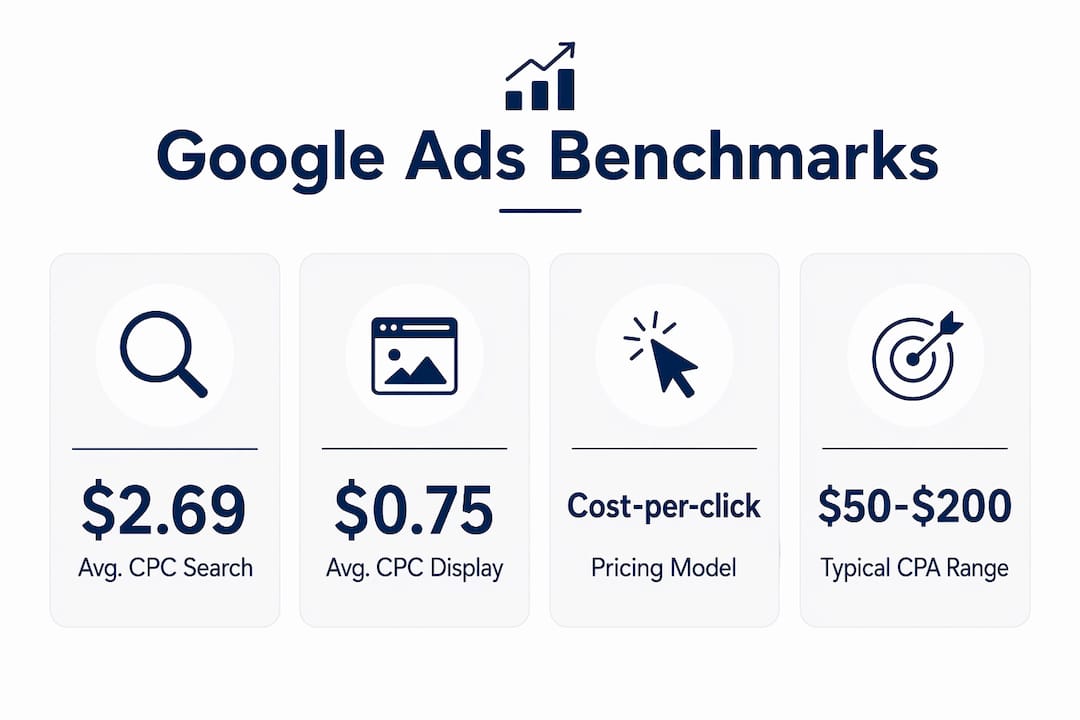
Search commands the highest CPC because the intent is highest. Someone typing “emergency plumber near me” is ready to call. Someone seeing a Display banner while reading a recipe is not. That gap in intent explains why Display CPCs are so much lower and why Display conversion rates (around 0.57%) lag well behind Search (around 4.4%).
Industry variance is the number that actually matters
Backlinko’s 2026 analysis shows legal averaging $22.75 per click and ecommerce averaging $0.82. That is a 27x difference. The reason: legal keywords attract multiple well-funded law firms bidding for the same high-value client. Ecommerce keywords face competition too, but the average customer value is lower, so firms bid less aggressively.
A few industry reference points:
- Legal / personal injury: $15–$50+ per click; CPA can exceed $200
- Home services (HVAC, plumbing, roofing): $6–$20 per click
- Healthcare / dental: $5–$15 per click
- Ecommerce (general): $0.50–$2.00 per click
- B2B SaaS / software: $8–$30 per click
One thing worth understanding: the mean CPC is skewed by a handful of extremely expensive keywords. The median CPC for most industries sits noticeably below the mean. If you are in a mid-competition vertical, your real-world CPC will likely be lower than the headline average suggests.
What actually drives your Google Ads price up or down?
Google Ads runs on a real-time auction. Every time someone searches, Google runs a lightning-fast calculation to decide which ads appear and in what order. Your position is not simply the highest bid. It is your Ad Rank, which combines your bid with your Quality Score and the expected impact of your ad extensions.
Quality Score is Google’s 1–10 rating of how relevant your keyword, ad, and landing page are to the searcher. A score of 8 or higher can let you outrank a competitor who bids more. A score of 3 means you pay more per click for worse placement.
The main cost drivers:
- Industry and keyword competitiveness: Legal, finance, and insurance keywords are the most expensive. Niche or local keywords are often far cheaper.
- Match types: Broad match captures more traffic but attracts irrelevant clicks. Exact match costs more per click but converts better. Long-tail phrases (three or more words) typically cost less and convert at higher rates.
- Landing page relevance: A landing page that matches the ad’s promise raises Quality Score. A generic homepage tanks it.
- Device and location: CPCs in competitive U.S. metros can run 2–3x higher than smaller markets for the same keyword. Mobile CPCs are often lower than desktop, but conversion rates vary by industry.
- Time of day and day of week: Bidding during peak hours in competitive categories drives costs up. Ad scheduling lets you pull back spend during low-conversion windows.
- Seasonality: A roofing company will see CPC spike after a major storm. A tax preparer sees it in January. Budget for these swings or you will blow through your monthly cap in the first week.
- Competitor bidding: If a well-funded competitor enters your keyword space, your CPC rises even if you change nothing.
Pro Tip: Improving Quality Score is almost always more cost-effective than raising your bid. A jump from a Quality Score of 5 to 8 can reduce your effective CPC by 20–30% while improving your ad position. Start there before touching your bid settings.
On bidding strategy: manual CPC gives you full control but requires active management. Smart Bidding strategies like Target CPA or Target ROAS use Google’s machine learning to adjust bids in real time. Smart Bidding tends to outperform manual bidding once a campaign has enough conversion data, typically after 30–50 conversions. Before that threshold, manual or enhanced CPC is usually safer.
How to estimate your Google Ads budget before you spend anything
Using Google’s cost estimator
The Google Ads cost estimator is the fastest way to get a realistic benchmark for your market. Here is how to use it:
- Go to the Google Ads budget tool and select your industry category.
- Enter your target location (city, state, or radius).
- Set your primary goal: calls, website visits, or store visits.
- Review the output: recommended average daily budget, estimated monthly spend, and projected clicks or impressions.
- Compare the tool’s suggested budget against your own CPA target to see whether the math works.
The tool does not guarantee results, but it gives you a defensible starting point rather than a guess.
The manual calculation that matters
Once you have a benchmark CPC, run this calculation before committing:
Formula: Monthly budget ÷ Average CPC = Estimated monthly clicks × Expected conversion rate = Estimated leads
Worked example: A local HVAC company targets a $1,500/month budget. Average CPC in their market: $12. Expected conversion rate on a well-built landing page: 5%.
- $1,500 ÷ $12 = 125 clicks/month
- 125 × 5% = 6–7 leads/month
- If each job is worth $800 and they close 50% of leads: 3–4 jobs × $800 = $2,400–$3,200 in revenue
That is a positive return. Run the same math with your own numbers before you launch.
How Google calculates your monthly spend
Google multiplies your average daily budget by 30.4 to set your monthly spending cap. On any given day, Google may spend up to twice your daily budget to capture high-traffic moments, but it will not exceed the monthly cap. A $50/day budget means a maximum of $1,520/month, regardless of daily fluctuations.
Key figure: Google’s monthly spend formula is average daily budget × 30.4. Set your daily budget by dividing your target monthly spend by 30.4, not by 30 or 31.
How much should small businesses actually spend on Google Ads?
The honest answer: spend enough to get statistically meaningful data, not just enough to say you tried it.
Many small-to-medium businesses spend a few thousand dollars monthly on Google Ads, with a practical minimum budget required to produce usable data. Below that, you may get a handful of clicks but not enough conversions to know whether the campaign is working.

Budget bands and what they realistically deliver
Budgets can be categorized as low test, moderate test, and scale according to advertiser goals and capacity to optimize, with low test budgets providing some insight and higher budgets allowing sophisticated optimization and scaling.
Scenario examples by business type
Local service business (plumber, electrician, roofer): Local service businesses often start with a moderate monthly budget targeting exact-match and phrase-match keywords, aiming to generate several leads monthly. If you are weighing paid ads versus organic search, ads deliver faster results while SEO builds over time.
Ecommerce store: Ecommerce stores often start with modest monthly budgets on Shopping campaigns. Lower CPC means more clicks per dollar, but you need a well-structured product feed and strong landing pages.
B2B lead generation: B2B lead generation often requires a higher monthly budget minimum. CPCs are higher, sales cycles are longer, and you need enough volume to track leads through to closed deals. Consider whether Google Ads fits your lead-gen model before committing.
The 90-day rule
It is generally recommended to commit to at least 90 days before drawing conclusions to gather sufficient data and account for variability. Google’s algorithm needs conversion data to optimize Smart Bidding, and 90 days gives you enough seasonal variation to separate signal from noise. Make small adjustments weekly, but hold off on major structural changes until you have a full quarter of data.
Pro Tip: Your total Google Ads cost is not just ad spend; leveraging analytics tools like Valiz can help you track and optimize your campaign performance for better ROI. Factor in management fees, which can vary significantly depending on scope, creative production, and any third-party tools. A $1,500/month ad budget managed by an agency might cost $2,200–$2,500 all-in. Budget for the full number, not just the media spend.
Tactical moves that lower your cost per lead right now
Most campaigns have a few obvious inefficiencies at the start that are important to fix early. Here is where to look first.
Highest-impact fixes:
- Landing page relevance: If your ad promises “emergency roof repair in Tampa” and the landing page is your homepage, your Quality Score suffers and your CPC rises. Build or link to a page that matches the ad’s specific promise. A professional landing page that loads fast and has a clear call to action can double conversion rates without touching your bids.
- Negative keywords: Add irrelevant search terms as negatives from day one. “Free,” “DIY,” “jobs,” and “reviews” are common negatives for service businesses. Letting these terms eat budget is one of the fastest ways to inflate CPA.
- Long-tail keyword targeting: Specific, longer phrases cost less per click and convert at higher rates than broad terms. “Emergency HVAC repair Austin TX” beats “HVAC” on both dimensions.
Medium-impact fixes:
- Ad copy and CTR: Higher click-through rate signals relevance to Google and improves Quality Score. Test two or three headlines per ad group. Rotate for 2–4 weeks, then pause the weaker performer.
- Ad scheduling: Pull back bids or pause ads during hours when your audience does not convert. A B2B company rarely needs to run ads at 2 AM. Use your conversion data to identify peak windows and concentrate spend there.
- Geo-targeting refinement: If you serve a specific metro, exclude zip codes outside your service area. You are paying for every click, including ones from people you cannot serve.
Quick wins:
- Enable all relevant ad extensions (call extensions, location extensions, sitelinks). They increase ad real estate and CTR at no extra cost per click.
- Set a frequency cap on Display campaigns to avoid burning budget on the same uninterested users.
- Use remarketing to re-engage visitors who did not convert. These audiences typically convert at lower CPA than cold traffic.
Pro Tip: When time or budget is tight, fix landing pages and negative keywords first. These two changes consistently produce the largest CPA reductions in the shortest time. Creative testing and bid strategy refinement matter, but they compound on top of a solid foundation.
How to measure ROI and know when to scale
The metrics that actually tell you whether it’s working
CPC (cost per click): Total spend ÷ total clicks. Your baseline efficiency metric.
Conversion rate: Conversions ÷ clicks × 100. For Search campaigns, AdPredictor’s 2026 data puts the average at 4.4%. If yours is below 2%, the problem is usually the landing page, not the ads.
CPA (cost per acquisition): Total spend ÷ total conversions. This is the number to compare against your customer lifetime value. If your LTV is $500 and your CPA is $80, you have a profitable campaign. If your CPA is $600, you do not.
ROAS (return on ad spend): Revenue generated ÷ ad spend. A ROAS of 3.0 means you earned $3 for every $1 spent. For ecommerce, a ROAS of 4.0 or higher is generally considered healthy, though margins vary.
A sample calculation
A dental practice runs a $2,000/month Search campaign. Average CPC: $8. Clicks: 250. Conversion rate, conversions, patient value, CPA, revenue, and ROAS can be calculated to evaluate campaign performance, though figures vary by practice and campaign.
That is a campaign worth scaling. A data-driven approach to tracking these numbers weekly is what separates businesses that grow their ad spend confidently from those that guess.
When to scale, when to pause
Scale when: CPA is consistently below your target for at least 60–90 days, conversion rate is stable, and you have exhausted your current keyword list’s volume.
Pause or restructure when: CPA is above LTV for more than 30 days with no clear cause, click volume is high but conversion rate is below 1%, or Quality Scores are consistently below 4.
The 90-day window matters here too. Do not make a scaling decision based on two weeks of data. Seasonality, algorithm learning, and random variance all distort short windows.
How we derived these numbers
The benchmarks in this guide draw from three primary sources: AdPredictor’s 2026 aggregated dataset, which covers SMB spend patterns and average CPCs across industries; Backlinko’s 2026 analysis of U.S. Search CPC figures and industry breakdowns; and Google’s own documentation on budget pacing and billing behavior.
All figures reflect U.S. market data. Conversion rate benchmarks use a standard definition: a user completing a defined goal action (form fill, call, purchase). Industry averages are means unless noted as medians. Because CPC means are skewed by a few high-cost keywords, the median for most small-business verticals sits below the reported average. The average Search conversion rate across industries is 4.4% and Display is 0.57%.
Assumptions and limitations: These are population averages. Your actual CPC will depend on your specific keyword list, Quality Score, and local competition. A campaign built on broad-match keywords in a high-competition market will cost more than these averages suggest. A tightly targeted exact-match campaign in a mid-size market will often cost less.
Sourced benchmark: AdPredictor’s 2026 data shows the average Search CPC across industries at approximately $2.69, with Display at $0.63 and Search conversion rates averaging 4.4%. These figures represent aggregated SMB campaign data and serve as the baseline for the starter budget calculations throughout this guide.
Anonymized example: A home services client in a mid-size Florida market ran a $1,800/month Search campaign targeting exact-match plumbing keywords. After 90 days: average CPC $9.40, 191 clicks, 14 conversions (7.3% conversion rate), CPA $128. Average job value: $450. The campaign generated roughly $6,300 in revenue against $1,800 in ad spend, a 3.5x ROAS before accounting for management fees.
Key Takeaways
Google Ads can deliver a positive return for small businesses, but only when the budget is large enough to generate real data, the campaign is built around tight keyword targeting and strong landing pages, and performance is measured against a clear CPA target over at least 90 days.
| Point | Details |
|---|---|
| Realistic starter budget | Plan on $1,000–$5,000/month for a test that produces usable data; $300/month is too thin to optimize. |
| Average CPC benchmarks | Search averages ~$2.69; Display ~$0.63; industry variance is wide (legal $22.75 vs ecommerce $0.82). |
| 90-day test window | Commit to 90 days before scaling or pausing; Google’s algorithm needs conversion data to optimize. |
| Quality Score first | Improving Quality Score from 5 to 8 can cut effective CPC by 20–30% without raising your bid. |
| Tradewindsunitedmedia | Offers managed Google Ads campaigns with 90-day test packages, setup, optimization, and monthly reporting for small businesses. |
The part most guides skip
There is a version of this conversation that focuses entirely on averages and leaves you thinking Google Ads is a predictable vending machine: put in $1,500, get out 6 leads. The reality is messier, and the messiness is actually useful information.
The single biggest mistake small businesses make with Google Ads is not the budget. It is the landing page. You can have a perfectly structured campaign with excellent Quality Scores and still lose money if the page people land on is slow, confusing, or asks for too much before it gives anything. The ad gets the click. The page gets the conversion. Most small businesses spend 90% of their attention on the ad and almost none on what happens after.
The second mistake is quitting too early. Thirty days of data is not a campaign. It is a warm-up. The businesses that see Google Ads work are almost always the ones that committed to a real test window, made incremental adjustments, and resisted the urge to declare failure after a slow week.
One more thing worth saying plainly: the average CPC figures in this guide are means, and means lie. If you are in legal, finance, or home services in a major metro, your real CPC will be well above $2.69. Budget for your actual market, not the industry average. Use the Google cost estimator with your specific location and keywords, not a national benchmark, as your planning number.
How Tradewindsunitedmedia can manage your Google Ads budget
Running Google Ads well is not complicated in theory. In practice, it requires consistent attention: weekly search term reviews, bid adjustments, landing page testing, and conversion tracking that actually fires correctly. Most small business owners do not have that time, and a poorly managed campaign burns budget fast.

Tradewindsunitedmedia builds and manages Google Ads campaigns specifically for small and local businesses. A typical engagement includes a full account audit, campaign setup with tight keyword targeting, landing page review, and monthly performance reports that show exactly where your budget went and what it produced. The 90-day test structure described in this guide is the same framework used for every new client, because it is the minimum window needed to make confident decisions.
If you are ready to stop guessing at your budget and start running campaigns backed by real data, the St. Petersburg Google Ads team at Tradewindsunitedmedia is the next call to make. You can also explore the full Google Ads management service to see what a managed campaign looks like from setup through reporting.
Useful sources and further reading
The benchmarks and calculations in this guide come from the following primary sources. Each is worth bookmarking if you plan to run or manage Google Ads campaigns.
- Google Ads Budget Tool: Google’s own cost estimator. Enter your industry and location to get a recommended daily budget and projected clicks. The most reliable starting point for any new campaign.
- Google Ads Help: Understanding Costs and Payments: Official documentation on how billing works, monthly spend caps, and Smart campaign pricing. Read this before you set up billing.
- Backlinko 2026 Google Ads Cost Analysis: Aggregated U.S. CPC data by industry with median and mean breakdowns. Useful for benchmarking your keyword costs against industry norms.
- AdPredictor 2026 Pricing Data: SMB-focused dataset covering average CPCs, conversion rates, and recommended spend ranges. The source for most of the starter budget figures in this guide.
- WordStream Google Ads Cost Benchmarks: Industry-level CPC and conversion rate benchmarks widely cited as a reference point for U.S. advertisers.