Run a quick gut check: if you operate more than one location, or customers say they found the wrong address or an old phone number, hire a professional citation cleanup service. If you’re a single-location business and haven’t lost a customer to bad listing data yet, run the one-hour DIY audit below first. Either path starts with the same source of truth: your Google Business Profile. Data aggregators like Data Axle and Neustar feed hundreds of directories from a handful of upstream records, so fixing the profile without fixing the aggregators just means the errors come back.
- Claim and verify your Google Business Profile today if you haven’t already.
- Not sure where you stand? Run the DIY checklist further down before spending money.
- Multiple locations or repeat errors? Request a Local SEO Report from Tradewindsunitedmedia and skip the guesswork.
Pro Tip: Screenshot every listing before you touch it. You’ll need proof of the “before” state to confirm the “after” actually stuck.
| Point | Details |
|---|---|
| Verdict | Multi-location or repeat-error businesses should hire a pro; single-location owners can try the DIY audit first. |
| First move | Claim and verify Google Business Profile before touching any other directory. |
| Root cause | Data aggregators feed most directories, so upstream fixes matter more than one-off edits. |
Key Takeaways
Consistent NAP data across Google Business Profile, data aggregators, and directories protects both local search rankings and customer trust.
| Point | Details |
|---|---|
| Start with Google | Claim and verify Google Business Profile before touching any other listing. |
| Fix upstream, not just downstream | Correcting aggregators like Data Axle stops errors from re-propagating to directories. |
| Demand proof | Require before/after screenshots and manual review, not just automated scraping. |
| Expect staged timelines | Priority fixes take 1 to 4 weeks; aggregator and long-tail cleanup can run 8 to 12 weeks. |
| Tradewindsunitedmedia’s role | Runs manual audits with before/after reporting, tied to broader Local SEO and Local Map Domination services. |
Table of Contents
- What Does Citation Cleanup Actually Mean?
- Why Does Citation Consistency Affect Local SEO?
- What Should a Citation Cleanup Service Actually Deliver?
- How Long Does a Citation Cleanup Take?
- How Much Does Citation Cleanup Cost?
- How Do You Choose the Right Citation Cleanup Provider?
- Can You Run a Citation Audit Yourself?
- How Does Tradewinds United Media Handle Citation Cleanup?
- What Package Fits Your Business?
- Frequently Asked Questions
- Sources
What Does Citation Cleanup Actually Mean?
Citation cleanup means making your business name, address, and phone number (NAP) consistent across every third-party listing, data aggregator, and local directory that mentions you. It’s not one task. Correcting a single wrong listing on Yelp is different from reconciling five duplicate profiles on the same platform, which is different again from stopping an aggregator like Data Axle from re-pushing an old address every quarter.
A business moves offices and updates its website. Six months later, three directories still show the old suite number, and one has an outdated phone line that rings a disconnected number. That’s a live citation, decaying in place.
- Single-listing fix: correcting one wrong field on one platform.
- Duplicate reconciliation: merging or suppressing two or more profiles for the same location.
- Upstream control: correcting the aggregator record so directories stop reverting your fixes.
Why Does Citation Consistency Affect Local SEO?
Search engines cross-reference your NAP data across the web to judge how legitimate and locatable your business is. When your listings disagree, that’s a weaker trust signal, and it tends to show up as lower local rankings. Consistency also directly touches revenue: a wrong phone number means missed calls, and a “closed” flag left over from a temporary closure can quietly kill foot traffic for weeks.
-
Wrong address on a top-10 directory: customers show up at the wrong building, then leave a one-star review.
-
Stale “temporarily closed” status: Google can suppress the listing from map searches entirely.
-
Old phone number on legacy directories: calls ring dead lines instead of your front desk.
Google Business Profile carries the most search weight, but aggregators like Data Axle sit further upstream and quietly feed hundreds of smaller directories from a single record. Fix the aggregator, and the fix cascades. Skip it, and the same error resurfaces every few months.
What Should a Citation Cleanup Service Actually Deliver?
A reputable vendor works from a documented, verifiable process, not a black box. Here’s the sequence you should expect:
- A comprehensive citation inventory covering major directories, niche verticals, and data aggregators.
- A severity-scored audit that flags which errors are costing you customers versus which are cosmetic.
- Claimed and verified updates to your highest-traffic profiles.
- Aggregator resubmissions to stop errors from re-propagating downstream.
- Duplicate suppression for redundant or abandoned listings.
- A before-and-after cleanup report showing exactly what changed and where.
Some fixes require your login credentials, since platforms like Facebook or Yelp verify ownership before allowing edits. Others, especially aggregator-fed directories, can be corrected through direct outreach or formal resubmission requests without ever touching your accounts. A good vendor will tell you upfront which is which.
- Ask whether the audit is manual, automated, or both.
- Ask for before/after screenshots, not just a summary paragraph.
- Ask for case IDs on anything escalated to a platform’s support team.
Pro Tip: Insist on manual verification, not just automated scraping. Automated tools are great at finding listings but notoriously bad at judging whether a “fix” actually applied correctly. Even CiteFix, a well-built automation tool built for correcting citation errors, always routes proposed changes through a human review step before anything gets published. That’s the right instinct applied to your business listings, too.
How Long Does a Citation Cleanup Take?
Expect a staged rollout, not an overnight fix. The SCAR method, short for Source, Citation, Audit, Reconciliation, starts by locking down a single authoritative “truth record” for your business details, then maps every listing against it before touching anything.
- Truth record and discovery crawl: locking your official NAP and finding every existing listing (3 to 7 days).
- Audit and severity scoring: ranking errors by customer impact.
- Priority fixes: claiming and correcting your highest-traffic listings (1 to 4 weeks).
- Aggregator submissions and long-tail cleanup: resubmitting to upstream sources and chasing smaller directories (up to 8 to 12 weeks).
- Monitoring: rechecking corrected listings to catch reversions.
Staged rollouts exist for a reason: bulk overnight changes across dozens of platforms can trip spam flags, and directories crawl on their own schedules, so a rushed batch of edits can look inconsistent before it settles.
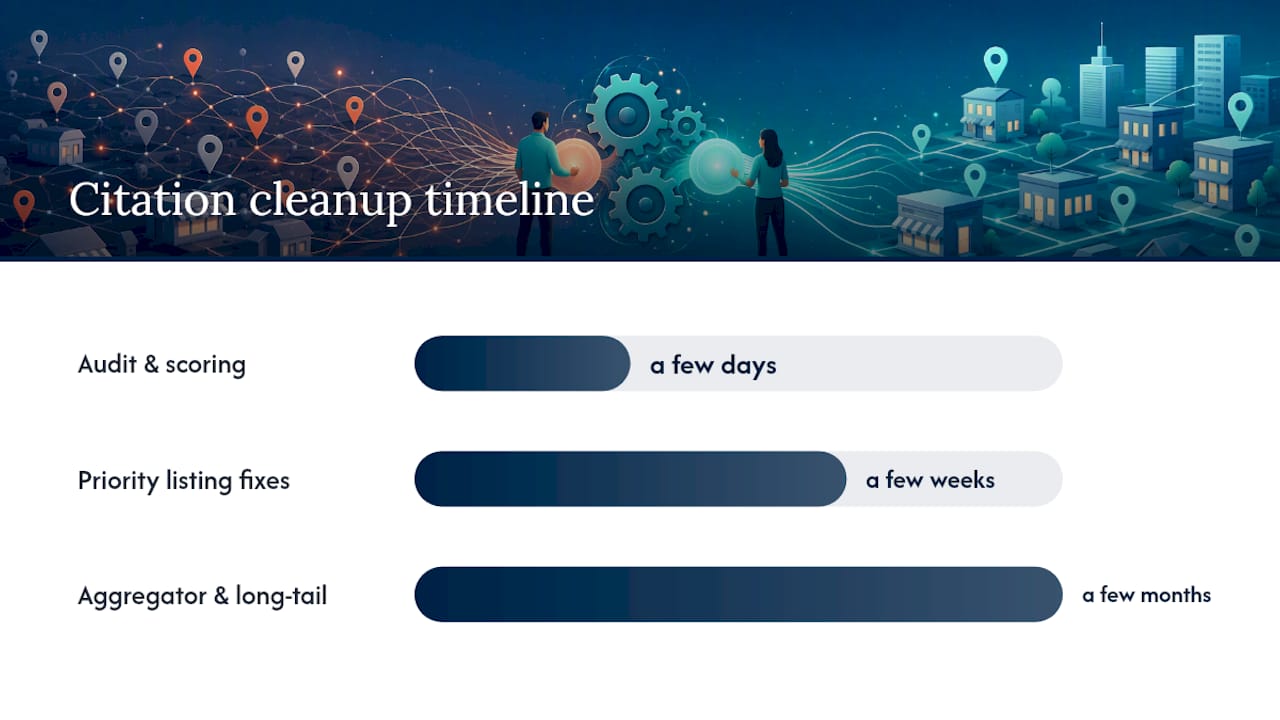
| Phase | Typical duration |
|---|---|
| Audit and scoring | a few days |
| Priority listing fixes | a few weeks |
| Aggregator and long-tail cleanup | a few months |
How Much Does Citation Cleanup Cost?
Vendors typically price this work three ways: a flat audit fee plus per-listing correction charges, a bundled package sized to your business (small, medium, or enterprise), or an hourly retainer reserved for escalation-heavy cases where a platform won’t budge without repeated follow-up.
| Business type | Typical scope | What drives the price up |
|---|---|---|
| Single location, low listing count | Audit plus 10 listing corrections | Extra time if duplicates need manual merging |
| Multi-location business | Audit plus aggregator submissions per location | Number of locations, not just listing count |
| Aggregator-heavy or franchise setup | Full reconciliation across upstream sources | Legal takedowns or platform escalations that resist standard requests |
- Duplicate suppression on stubborn platforms often costs extra since it requires manual escalation.
- Suppression or merge requests can take 4 to 6 weeks on some platforms, and that timeline should be priced into any proposal, not treated as a surprise.
- Get a written scope before you sign. “Cleanup” means different things to different vendors.
How Do You Choose the Right Citation Cleanup Provider?
Vet a provider the same way you’d vet any contractor working on something you can’t easily inspect yourself. Ask direct questions and watch how confidently they answer.
- Ask what percentage of the audit is manual review versus automated scraping.
- Ask how they handle aggregator resubmissions specifically, not just individual directory edits.
- Ask for proof of past edits: before/after screenshots, not verbal assurances.
- Ask about reporting cadence. Weekly updates during active cleanup, monthly during monitoring, is reasonable.
- Ask what happens if a platform refuses to correct an error. Do they escalate, or do they stop trying?
Trust signals worth looking for: documented case studies, a willingness to work through outreach rather than demanding every login you own, transparent pricing published somewhere you can see it before a sales call, and a process they’re comfortable explaining in detail.
Red flags that should end the conversation fast: promises of guaranteed ranking jumps, a refusal to show before/after proof, a process that’s entirely automated with no human review step, or vague language about who technically “owns” the corrected listings once the contract ends.
- Fewer than 15 listings and comfortable managing your own account logins? Try the DIY audit first.
- Multiple locations, repeated errors, or aggregator-level problems? Hiring saves you months of chasing directories one at a time.
Pro Tip: A partner resource like BabyLoveGrowth’s citation audit tool is worth a look for a quick automated scan, but treat the output as a starting list, not a finished audit. Every flagged item still needs a human to confirm it’s actually wrong.
Can You Run a Citation Audit Yourself?
Yes, if your listing count is small and you have your login credentials handy. Set aside an hour and work through this:
- Write down your exact, official NAP details in one place. This is your truth record.
- Search your business name plus old phone numbers and old addresses to surface outdated listings.
- Check Google Maps and your Google Business Profile for accuracy first, since that’s the highest-traffic listing.
- Run reverse phone and reverse address lookups to catch listings that don’t even show your business name.
- Log every finding in a simple spreadsheet: field, current value, correct value, and the listing’s URL.
Fix wrong phone numbers, incorrect addresses, and outdated “closed” statuses first. Photos and descriptions can wait.
Pro Tip: Screenshot every listing before editing it. If a directory reverts your change or a customer disputes the correction later, you need dated proof of what it looked like before you touched it.
How Does Tradewinds United Media Handle Citation Cleanup?
Tradewindsunitedmedia builds a single truth record for your business, then runs a manual citation audit across directories and aggregators rather than relying only on automated scraping. Fixes get prioritized by customer impact: wrong phone numbers and dead addresses first, cosmetic details later. Aggregator resubmissions follow, so corrections don’t quietly revert in a few months.
- Manual review on every flagged listing before it’s marked corrected.
- Before/after reporting with screenshots and platform references for anything escalated.
- Performance reporting that ties cleanup work back to visibility, not just a list of “fixed” items.
| Deliverable | What it proves |
|---|---|
| Citation inventory | Every listing found across directories and aggregators |
| Before/after report | Documented evidence the correction actually took |
| Performance reporting | Whether cleanup translated into visibility gains |
Citation work also connects to your website’s own schema markup, since search engines cross-check your site’s structured NAP data against third-party listings. If cleanup uncovers site-level issues, a Local SEO Report is the natural next step.
Pro Tip: If you’re already investing in Local Map Domination, citation cleanup should happen first. Fixing your map ranking strategy on top of inconsistent NAP data is building on sand.
A Practitioner’s View on Citation Drift
. In practice, most cleanup projects aren’t dramatic. They’re a slow accumulation of small errors: an old suite number here, a disconnected fax line there, a duplicate profile nobody remembers creating. The businesses that struggle most are the ones who treat cleanup as a one-time fix instead of ongoing maintenance. Schedule a quarterly mini-audit. It’s the cheapest insurance you’ll buy all year.

What Package Fits Your Business?
Tradewindsunitedmedia gives you a documented, human-reviewed cleanup instead of a fire-and-forget automated scan, which matters because automated tools flag problems but rarely confirm they’re actually fixed. If you’re weighing a DIY pass against paying for one, the real cost of DIY isn’t the hour of searching. It’s the months of not knowing whether the fix held.

- Audit only: a full listing inventory and severity-scored report, no changes made yet.
- Audit plus cleanup: the audit, plus claimed/verified corrections and aggregator resubmissions.
- Ongoing monitoring: quarterly checks to catch drift before it costs you customers.
Request a Local SEO Report to see exactly where your listings stand and get a sample package quote before committing to anything.
Frequently Asked Questions
How long does citation cleanup take from start to finish?
Most projects run several weeks to a few months in total, with priority listings fixed early and long-tail aggregator issues resolved later.
Do I need to give a citation cleanup service my account logins?
Sometimes. Platforms that require ownership verification, like Facebook, need login access; aggregator-fed directories are often correctable through direct outreach instead.
Will citation cleanup actually improve my local search rankings?
Consistent NAP data is one of several trust signals search engines use, and inconsistent listings tend to weaken local ranking performance, but cleanup works best alongside a broader local SEO strategy.
What’s the difference between a duplicate listing and an inconsistent one?
A duplicate is two separate profiles for the same location; an inconsistent listing is one profile with wrong details, like an outdated phone number.