Claim, verify, and complete every field in your Google Business Profile, then keep it active with photos, posts, and review responses. That single sequence, done consistently, is what separates businesses that show up in the Google Map Pack from those that don’t. Google’s own ranking documentation confirms that complete, accurate profile information directly improves your chances of appearing in relevant local searches. The three factors Google weighs are relevance, distance, and prominence. You control two of them.
If you have some time right now, here is where to start:
- Claim and verify your profile at business.google.com
- Set your primary business category (most specific option available)
- Add your phone number, address or service area, and business hours
- Upload several photos showing your exterior, interior, and team or work in progress
- Configure your website link and any booking or appointment URL
- Send your first review request to customers you trust
This week: write your business description, add your services or products, seed the Q&A section, and post your first Google Post. This month: pull your GBP Insights, check call volume, and review what search queries are driving profile views. Local SEO is a compounding investment, and the businesses that treat their profile as a living asset consistently outperform those that set it and forget it.
Table of Contents
- Your 90-minute Google Business Profile optimization checklist
- How to claim and verify your Google Business Profile
- Complete every profile field the right way
- What photos and videos actually move the needle
- Reviews and reputation: how to get them, respond to them, and protect your profile
- Use Posts, Products, Services, and Offers to convert searchers into customers
- Q&A, messaging, and bookings: use them before your customers do
- Track performance: GBP Insights, UTMs, and conversion measurement
- How Google determines local ranking and what to prioritize
- Common mistakes and policy pitfalls that can get your profile suspended
- How much does Google Business Profile optimization cost?
- Key Takeaways
- What most GBP advice gets wrong about small businesses
- Tradewindsunitedmedia’s local SEO and GBP services
- Authoritative sources and further reading
Your 90-minute Google Business Profile optimization checklist
Practitioner guides consistently show that GBP optimization is not a one-time task. But there is a clear priority order, and the first 90 minutes matter most.
- Claim or verify your profile — Go to business.google.com. If your business is already listed, claim it. If not, create it. Verification comes next (see Section 3 for methods and timelines).
Items 1 through 5 directly affect Map Pack eligibility. Items 6 and 7 affect conversion once someone finds you. Both matter, but in that order.
Matching your NAP across citations is non-negotiable. If your website says “Suite 200” and your profile says “Ste. 200,” Google treats those as potential mismatches. Pick one format and use it everywhere: your profile, your website footer, Yelp, your chamber of commerce listing, and any directory where your business appears.

How to claim and verify your Google Business Profile
Google treats verification as proof that you represent the business at the listed address. Until you verify, your profile has limited visibility and you cannot fully manage it.
Verification methods
Postcard by mail is the most common method for new listings. Google mails a postcard with a verification code to your business address. Delivery can take several days to a couple of weeks. When it arrives, log into your profile and enter the code. Do not change your address while waiting — that resets the process.
Phone or email verification is available for some businesses. If eligible, you will see the option when you start the verification flow. Google calls or texts a code to the number on file, or sends it to the email address associated with the account.
Instant verification applies if your business website is already verified in Google Search Console under the same Google account. The system recognizes the connection and may skip the postcard step entirely.
Bulk verification is available for businesses with 10 or more locations. You submit a spreadsheet through the Business Profile Manager and Google reviews the batch. Expect a longer review window.
Common roadblocks and how to fix them
PO boxes and virtual office addresses are not eligible for a standard storefront listing. If your business operates from a service area (you go to customers rather than having them come to you), set up a service-area business instead and hide your address. Using a UPS Store or virtual office address as a physical location violates Google’s guidelines and can trigger a suspension.
If another person or agency previously claimed your listing, you will need to request ownership transfer through the profile dashboard. Google sends the current owner a notification and gives them seven days to respond. If they do not, you can escalate through the support flow.
Pro Tip: Add a secondary owner or manager to your profile immediately after verification. Go to Business Profile Manager, select “Managers,” and add a trusted email. This prevents you from losing access if your primary Google account is ever compromised. Also add a recovery phone number and backup email to the Google account itself.
Complete every profile field the right way
Every unfilled field is a missed opportunity. Google’s category guidance makes clear that your primary category is the strongest relevance signal in the entire profile, but the supporting fields collectively determine whether a searcher calls you or scrolls past.
The fields that matter most
- Business name: — Exactly as it appears on your signage and legal documents. No city names, keywords, or taglines appended. “Smith Plumbing” not “Smith Plumbing Best Plumber Austin TX.”
Writing your business description
You have 750 characters. Use the first 250 wisely — that is what shows before the “More” link truncates the text. Lead with what you do, where you do it, and what makes you worth calling. Weave in one or two relevant keywords naturally, but write for the customer, not the algorithm.
A service business example: “Smith Plumbing has served Austin homeowners since 2008. We handle emergency repairs, water heater installations, and full bathroom remodels with same-day availability on most calls. Licensed, insured, and backed by a 100% satisfaction guarantee.”
A retail example: “Austin Bike Co. carries over 400 road, mountain, and commuter bikes from Trek, Specialized, and Cannondale. Our certified mechanics offer same-day tune-ups and free fittings on every purchase.”
Neither example stuffs keywords. Both tell a customer exactly what to expect.
Attributes and special features
Attributes appear as labels on your profile and filter results for customers using specific search terms. Accessibility attributes (“wheelchair accessible entrance”), identity attributes (“women-led,” “veteran-led,” “LGBTQ+ friendly”), and service attributes (“online appointments,” “curbside pickup”) all influence which filtered searches surface your profile. Pick every attribute that genuinely applies. Claiming an attribute that is not true is a policy violation.
Services vs. products
Use the Services section for service-based businesses: list each service line, add a brief description (what it includes, who it is for), and add a price or price range if you are comfortable publishing it. Use the Products section for physical goods. Both sections feed into Google’s understanding of what your business offers and can appear directly in search results.
What photos and videos actually move the needle
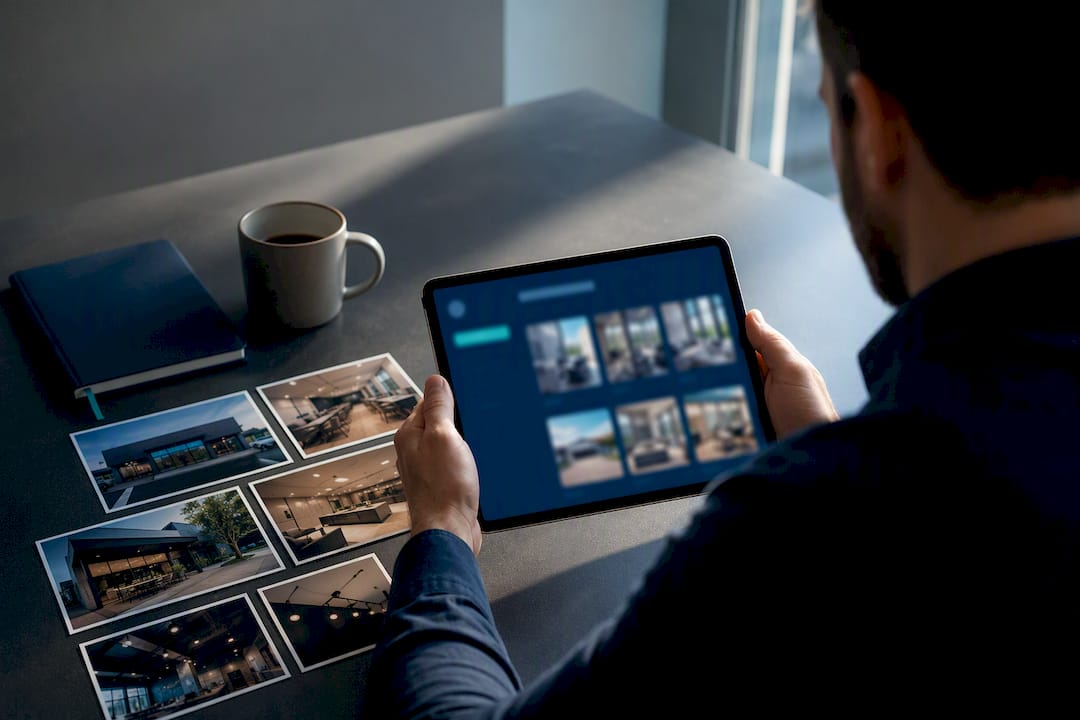
Profiles with photos tend to attract more direction requests and website clicks than those without. The types of images matter as much as the count.
Photo types by priority
Exterior/storefront shots help customers recognize your location before they arrive. Shoot from the street, at the angle a customer would approach from, in good daylight. Include your signage.

Interior photos set expectations and reduce friction. A dental office, restaurant, or gym that shows a clean, welcoming interior converts better than one that leaves it to the imagination.
Team photos build trust. A photo of the actual technician, chef, or stylist who will serve the customer is more persuasive than a stock image.
Work-in-progress and before-and-after shots are the highest-converting photo type for service businesses. A plumber showing a completed pipe repair, a landscaper showing a yard transformation, or a painter showing a finished room all answer the question “can they actually do the work?”
Product shots matter for retail. Clean backgrounds, accurate colors, and multiple angles outperform phone snapshots.
Technical specs
Google recommends JPG or PNG format, a minimum of 720 x 720 pixels, and files between 10 KB and 5 MB. For cover photos, 1080 x 608 pixels displays cleanly across devices. Name your files descriptively before uploading (“austin-plumber-water-heater-install.jpg” rather than “IMG_4823.jpg”) — Google’s image recognition reads file metadata.
Videos
Short videos (30–60 seconds) showing your team at work, a quick facility tour, or a before-and-after process perform well. Keep them under 75 MB and shoot in landscape orientation. Add a caption that includes your business name and primary service.
Regularly adding new photos signals ongoing activity to Google. Seasonal updates (holiday decorations, new menu items, seasonal services) give you a natural cadence.
Pro Tip: When a job goes well, ask the customer right then: “Would you mind snapping a photo and uploading it to our Google profile?” User-generated photos carry a different trust signal than owner-uploaded ones. To moderate them, go to your profile dashboard, select “Photos,” and review the “By customers” tab. You can flag inappropriate images for removal through the three-dot menu.
Reviews and reputation: how to get them, respond to them, and protect your profile
Review volume and recency are among the clearest signals of prominence in Google’s local ranking system. Responding to reviews signals activity to Google and builds trust with customers — both matter for ranking and conversion.
How to solicit reviews ethically
The most effective moment to ask is immediately after a positive interaction: at checkout, at job completion, or in a follow-up text or email sent within 24 hours. Copy your direct review link from the profile dashboard (it looks like g.page/yourbusiness/review) and include it in every request.
Review request workflow:
- Complete the job or transaction.
- Within 24 hours, send a text or email: “Thanks for choosing [Business Name]! If you have a moment, we’d love a Google review. It takes about 60 seconds: [link].”
- If no response after five days, send one follow-up. Stop after two attempts.
- Never offer discounts, gifts, or any incentive in exchange for a review. Google’s policy prohibits it, and it can get your profile suspended.
Response templates
Positive review:
“Thank you, [Name]! We’re glad the [service] went smoothly and that [specific detail they mentioned] stood out. We look forward to seeing you again.”
Neutral review (3–4 stars, no specific complaint):
“Thanks for the feedback, [Name]. We’re glad [positive aspect] worked well. If there’s anything we can do better, feel free to reach out directly at [phone/email].”
Negative review:
“[Name], thank you for letting us know. We’re sorry [specific issue] didn’t meet your expectations. Please call us at [phone] so we can make it right.”
Keep every response under 100 words. Never argue, never get defensive, and never repeat the reviewer’s complaint verbatim in your response — that amplifies it in search results.
Handling fake or policy-violating reviews
If a review is clearly fake, from a competitor, or violates Google’s content policies (spam, off-topic, conflict of interest), flag it directly from the profile. Click the three-dot menu next to the review, select “Report review,” and choose the appropriate reason. Document the review with a screenshot before flagging.
If Google does not remove it after 3–5 business days, escalate through the Business Profile support chat. Gather any documentation that supports your case: proof the reviewer was never a customer, evidence of a competitor’s connection, or a screenshot of a policy violation.
Use Posts, Products, Services, and Offers to convert searchers into customers
Google Posts appear directly on your profile in search results and on Google Maps. They expire after seven days (standard posts) or on the event end date (event posts), so a consistent posting cadence keeps your profile looking active.
Post best practices
Keep posts between 150 and 300 words. Lead with the most important information — Google truncates after the first line in many views. Every post should include a call-to-action button: “Call now,” “Book,” “Learn more,” or “Get offer.” Use a real photo, not a stock image.
A simple post calendar for a service business:
- Week 1: Seasonal service reminder (“AC tune-ups before summer heat — book now”)
- Week 2: Before-and-after project photo with a brief description
- Week 3: Team spotlight or behind-the-scenes photo
- Week 4: Customer review highlight or a limited-time offer
Offers and events
Offer posts let you add a coupon code, a start and end date, and terms and conditions. They display with a special “Offer” label in search results, which increases click-through rates. Use them for genuine promotions, not permanent discounts repackaged as limited-time deals.
Event posts work well for open houses, seasonal sales, workshops, or community events. They stay live until the event ends, so they have a longer shelf life than standard posts.
Booking and appointment links
Add your scheduling URL under “Appointment links” in the profile editor. If you use a scheduling platform like Acuity Scheduling, Calendly, or a practice management system, link directly to the booking page, not your homepage. The fewer clicks between “I want to book” and “I booked,” the better your conversion rate.
Pro Tip: Before creating a new post, check which of your social media posts from the past 30 days got the most engagement. Repurpose that content for GBP — the audience intent is different (they are already searching for your service), so a post that performed well on Instagram will often perform even better on your profile. Test two different cover images on consecutive posts to see which drives more clicks.
Q&A, messaging, and bookings: use them before your customers do
Seeding the Q&A section
The Q&A section is public and anyone can post a question or answer. That means a competitor or a disgruntled person can answer your customers’ questions before you do. Get ahead of it.
Log into your profile and post the five questions your customers ask most often, then answer them yourself. Common examples:
- “Do you offer free estimates?” Yes, we provide free on-site estimates for all projects over $500.
- “Are you licensed and insured?” Yes, we are fully licensed in [state] and carry $1M in general liability coverage.
- “What areas do you serve?” We serve [City], [City], and surrounding areas within 30 miles.
- “Do you offer emergency services?” Yes, we offer 24/7 emergency service for existing customers.
- “How do I schedule an appointment?” Call us at [phone] or book online at [URL].
Check the Q&A section weekly. When a customer posts a question, answer it within 24 hours. You can also upvote your own answers to push them to the top.
Messaging
Google’s messaging feature lets customers text you directly from your profile. Enable it only if you can commit to responding within 24 hours — Google tracks your response time and will disable the feature if you consistently miss that threshold.

Set an automated greeting that confirms you received the message and gives a realistic response window: “Thanks for reaching out to [Business Name]! We’ll get back to you within a few hours during business hours. For urgent needs, call us at [phone].”
Booking integrations
For businesses in categories like restaurants, salons, medical offices, and fitness studios, Google offers booking integrations for certain business categories that enable customers to book appointments directly from the profile. Check your profile’s “Bookings” tab to see which integrations are available for your category.
Track performance: GBP Insights, UTMs, and conversion measurement
Vanity metrics (profile views, photo views) feel good but do not pay bills. The metrics that matter are the ones tied to customer actions: calls, direction requests, website clicks, and bookings.
GBP Insights metrics to watch
| Metric | Why it matters | Action threshold |
|---|---|---|
| Search queries | Shows what terms trigger your profile | Add missing keywords to description/posts if high-volume queries are missing |
| Direct vs. discovery searches | Discovery = new customers finding you; direct = brand awareness | Low discovery searches suggest weak category or relevance signals |
| Website clicks | Measures profile-to-site traffic | Declining clicks with stable views = landing page problem |
| Direction requests | Proxy for foot traffic intent | Spike after a post or photo update confirms content impact |
| Phone calls | Direct conversion signal | Track day/time patterns to staff accordingly |
UTM tagging for GBP links
Add UTM parameters to every URL you place in your profile so GA4 can attribute traffic correctly. A standard template:
?utm_source=google&utm_medium=organic&utm_campaign=gbp&utm_content=[field]
Replace [field] with the specific location: website_button, post_cta, booking_link, or offer_link. In GA4, create a custom report filtering by source = google and medium = organic to isolate GBP-driven sessions from standard organic search traffic.
Call and booking conversion tracking
GBP’s built-in call history (available in some markets) logs calls made directly from the profile. For more reliable data, use a call-tracking number from a service like CallRail and place it in your profile as the primary number. Set up a goal or conversion event in GA4 for booking form completions. Together, these give you a clear picture of how many leads your profile generates each month.
Pro Tip: Set a monthly 30-minute calendar block to review your GBP Insights alongside GA4. Look at three numbers: profile views, website clicks, and calls. If views are up but clicks and calls are flat, the problem is your profile content. If clicks are up but calls are flat, the problem is your website. That distinction tells you exactly where to focus next. When handing off reporting to an agency, include a one-page summary of these three metrics plus the top five search queries that triggered your profile.
How Google determines local ranking and what to prioritize
Google’s local ranking system weighs three factors: relevance, distance, and prominence. Understanding each one tells you where to spend your time.
Relevance is how well your profile matches what someone searched for. The primary category is the strongest lever. A complete business description, accurate service listings, and keyword-rich posts all contribute. A plumber who lists “water heater installation,” “drain cleaning,” and “emergency plumbing” as services is more relevant to those searches than one with a blank services section.
Distance is how far your business is from the searcher or the location they specified. You cannot move your business, but you can expand your service area, build location-specific landing pages on your website, and earn citations from local directories that reinforce your geographic relevance.
Prominence is how well-known your business is, both online and offline. Review volume and rating, backlinks from local websites, mentions in local press, and your overall web presence all feed into prominence. This is the hardest factor to move quickly, but it compounds over time.
Short-term vs. long-term priorities
Do this week (short-term, high ROI):
- Set the correct primary category
- Complete all profile fields (description, hours, services, attributes)
- Upload 5–10 photos
- Send review requests to recent customers
- Seed the Q&A section
Do this month (medium-term):
- Publish weekly Google Posts
- Respond to every new review within 24 hours
- Build or clean up citations on major directories (Yelp, BBB, Apple Maps, Bing Places)
- Add UTM tracking to all profile links
Do this quarter (long-term, prominence building):
- Earn local backlinks (sponsor a local event, get listed in a local business association, pitch a local news story)
- Build location-specific pages on your website for each service area
- Monitor and respond to Q&A weekly
- Review category selection as your services evolve
Understanding how Google Maps fits into your broader digital marketing strategy helps you prioritize these activities against your other marketing investments.
Common mistakes and policy pitfalls that can get your profile suspended
Profile suspensions are more common than most business owners realize, and recovery can take weeks. Most suspensions stem from a handful of avoidable mistakes.
Name stuffing is the most common policy violation. Adding your city, keywords, or tagline to your business name field (“Smith Plumbing Best Plumber Austin TX”) violates Google’s guidelines. Your business name in the profile must match your real-world business name, period.
Fake reviews are a fast path to suspension and a permanent trust problem. Posting reviews from your own devices, paying for reviews, or asking employees to post reviews all violate policy. Google’s systems detect patterns in reviewer behavior, device IDs, and IP addresses.
Duplicate listings confuse Google and split your review equity. Search for your business name before creating a new listing. If you find a duplicate, request ownership or flag it for removal through the support flow.
Incorrect address or PO box as a physical location triggers verification failures and potential suspension. Service-area businesses must hide their address and list service areas instead.
Miscategorized businesses hurt relevance and can attract the wrong customers. A tax preparer who lists “Financial Planner” as their primary category will rank poorly for tax-related searches and may attract inquiries they cannot serve.
Misleading attributes (claiming wheelchair accessibility you do not have, or marking your business as “women-led” when it is not) violate policy and erode customer trust.
Pro Tip: If your profile is suspended, do not create a new listing. That compounds the problem. Instead, go to the Business Profile support page, select “Appeal a suspended profile,” and submit documentation: a utility bill, business license, or lease agreement showing your business name and address. Take screenshots of your profile before and after any changes you make during the appeal process. Keep a log of every support interaction, including ticket numbers and dates.
How much does Google Business Profile optimization cost?
The profile itself is free. The work to optimize and maintain it is not, whether you are paying with your time or with an agency’s fees.
DIY cost
If you do it yourself, the direct cost is zero. The time cost for an initial setup and optimization is roughly 4–8 hours: claiming, completing fields, uploading photos, writing the description, seeding Q&A, and configuring tracking. Ongoing maintenance (weekly posts, review responses, monthly Insights review) runs about 2–4 hours per month.
Agency pricing
Industry pricing data shows that one-time GBP setup and optimization services typically range from $300 to $600, though prices vary by market and scope. Ongoing monthly management, which includes posts, review monitoring and responses, photo updates, and monthly reporting, generally runs $100 to $400 per month depending on the agency and the volume of activity.
Per-location pricing is common for multi-location businesses, with discounts for higher location counts. Be cautious of very low-priced services — a $49/month “GBP management” package often means automated posts and no human review response, which can hurt more than it helps.
What a proper engagement should include
A one-time optimization deliverable should cover: profile audit, category selection, NAP correction, description writing, photo upload and optimization, service/product listings, Q&A seeding, UTM setup, and a baseline Insights report.
Ongoing management should cover: weekly or biweekly posts, review monitoring and responses within 24 hours, monthly photo updates, holiday hours updates, monthly Insights reporting with call and booking data, and quarterly profile audits.
Hiring checklist:
- Does the agency transfer full GBP ownership to you at project end?
- Do they provide monthly reports showing calls, clicks, and direction requests?
- What is their SLA for responding to new reviews?
- Do they use a tracking number or UTM parameters to measure conversions?
- Can they show examples of Map Pack rankings for similar businesses?
Pro Tip: Ask any agency you are evaluating to show you a sample monthly report before you sign. A good report shows profile views, website clicks, calls, direction requests, and the top search queries that triggered the profile. If the sample report only shows “impressions” and “engagement rate,” they are measuring activity, not business outcomes.
For service-area businesses and contractors, local SEO for contractors often bundles GBP optimization with citation building and on-page SEO for a more complete local visibility package.
Key Takeaways
A fully verified, completely filled-out Google Business Profile, kept active with photos, posts, and review responses, is the single highest-ROI local marketing asset most small businesses are underusing.
| Point | Details |
|---|---|
| Verify and complete first | Claim, verify, and fill every profile field before any other optimization step. |
| Category is the top relevance signal | Choose the most specific primary category available; it drives which searches surface your profile. |
| Reviews and responses build prominence | Consistent review volume and timely responses signal activity to Google and convert searchers into callers. |
| Track calls and bookings, not views | Use UTM parameters and call tracking to measure real conversions, not vanity metrics like photo views. |
| Tradewindsunitedmedia handles the full process | Tradewindsunitedmedia provides profile audits, optimization, content calendars, review management, and monthly conversion reporting for local businesses. |
What most GBP advice gets wrong about small businesses
Most guides treat Google Business Profile optimization as a checklist you complete once and move on from. That framing is the problem. The businesses that consistently appear in the Map Pack are not the ones with the most complete profiles at launch. They are the ones that treat the profile as an active marketing channel, the same way they treat their website or their social media.
The measurement gap is where most small businesses fall short. Profile views feel like progress. They are not. A profile that generates 500 views and zero calls has a conversion problem, not a visibility problem. The fix is usually in the photos, the description, or the review count, not in adding another category or tweaking the hours. That distinction matters because it tells you where to spend the next hour of your time.
There is also a real risk in over-delegating. Handing your GBP to an agency and never looking at it again means you will not notice when a fake review appears, when a competitor suggests an edit to your address, or when Google auto-updates your hours based on user reports. The profile is yours. An agency should be managing it on your behalf, not instead of you. The best setups give the business owner view access and a monthly report they actually read.
For small businesses competing against larger chains, the GBP profile is often the most level playing field available. A local plumber with 80 reviews, fresh photos, and weekly posts will outrank a national chain with a neglected profile in local searches. That advantage is real and it is available to any business willing to maintain it.
Tradewindsunitedmedia’s local SEO and GBP services
Most local businesses have the same problem: the profile exists, but it is not working. No recent photos, no posts, reviews going unanswered, and no idea whether any of it is generating calls. That is exactly the gap Tradewindsunitedmedia was built to close.
A typical engagement starts with a full profile audit: category selection, NAP consistency check, photo quality review, description rewrite, and a baseline pull of GBP Insights and call data. From there, Tradewindsunitedmedia builds a content calendar, sets up UTM tracking, and takes over review monitoring with a 24-hour response SLA. Every month, you receive a plain-English report showing profile views, website clicks, calls, and direction requests so you can see exactly what the work is producing.
The difference from a generic agency is the measurement focus. Tradewindsunitedmedia reports on conversions, not impressions. If the phone is not ringing more after 60 days, the team digs into why, whether that is a profile issue, a website conversion problem, or a gap in your local citation footprint.
Ready to see what your profile is actually capable of? Contact Tradewindsunitedmedia for a profile audit and a clear picture of what it will take to move your business into the Map Pack.
Authoritative sources and further reading
The sources below are the most reliable references for GBP policy, verification, and ranking guidance. When Google updates its policies or features, these pages reflect the changes first.
- Tips to improve your local ranking on Google — Google’s official explanation of relevance, distance, and prominence; the primary reference for any ranking-related question.
- Get Listed on Google — Google Business Profile — The official starting point for claiming, creating, and verifying a profile; use this for verification method options and timelines.
- Manage your business category — Google Business Profile Help — Google’s guidance on selecting primary and additional categories, including category-specific features and how to update them.
- Google Business Profile APIs — Categories Reference — The full category taxonomy used by Google’s systems; useful for finding the most specific available category for your business type.
- How to Optimize Your Google Business Profile — A practitioner-level guide covering the recurring optimization workflow and conversion measurement focus.