Most SEO campaigns show early measurable signals within 3 to 6 months and deliver material business impact within 6 to 12 months, though a new domain in a competitive space can push that timeline past a year. Watch three things while you wait: indexed pages, impressions, and new ranking queries in Google Search Console. If none of those move in 90 days, something is broken.
TL;DR:
- New domains typically need 9 to 12 months for material SEO impact, while established sites can see quick wins on long-tail keywords within weeks.
- Technical health issues and slow content production can extend SEO timelines, especially if crawl errors, page speed, or duplicate content go unaddressed.
- Local SEO efforts like Google Business Profile optimization can show results within 4 to 8 weeks, but competitive or enterprise markets may require 12 to 18 months for full impact.
- If no progress is seen after six months, a thorough audit of technical issues, content relevance, and backlink profile is necessary before adjusting strategies.
- Tracking early signals such as indexed pages, impressions, and new ranking queries provides more reliable proof of progress than waiting for revenue changes.
Table of Contents
- How Long Does SEO Take: What Actually Changes the Timeline
- The Typical SEO Timeline: What to Expect Month by Month
- Early Signals That Prove SEO Is Working (Before Revenue Shows Up)
- SEO Timelines by Scenario: New Sites, Local Pack, and Competitive Niches
- What to Do If SEO Isn’t Working
- What Realistic SEO Timelines Actually Look Like in Practice
- Get a Clear Path to SEO Results With Tradewinds United Media
- Sources
How Long Does SEO Take: What Actually Changes the Timeline
The 3 to 6 month baseline is a starting point, not a promise. Where your site actually lands on that spectrum depends on a handful of factors that either compound in your favor or work against you from day one.
Domain history and authority matter more than most business owners expect. A domain that’s been live for five years with a clean backlink profile has a head start that a brand new domain simply doesn’t get. Established sites can see movement on low-competition terms within days or weeks, while new domains typically need an extra three to six months just to close that trust gap.
Competition and keyword difficulty decide how much work “enough” actually requires. Ranking for “plumber near me” in a mid-sized city is a different job than ranking for “best plumber” in a metro area where twelve competitors have been investing in SEO for a decade. Check who currently holds the top 10 spots for your target terms before you set expectations.
Resources and implementation speed are the quiet timeline killers. A strategy that calls for two blog posts a month but only gets one published every other month effectively doubles its own timeline. Link-building budget, developer availability for technical fixes, and how fast your team approves content all directly control how quickly the plan executes.
Technical health underpins everything else. Crawl errors, slow load times, broken internal links, or JavaScript-heavy pages that don’t render cleanly for Googlebot can stall progress no matter how good the content is. Fix these first, because content and links built on a broken technical foundation rarely perform.
Content quality and intent fit decide whether the content you publish earns rankings or just sits there. A 600-word page that doesn’t actually answer the searcher’s question won’t outrank a competitor’s in-depth guide, regardless of how many keywords it contains.
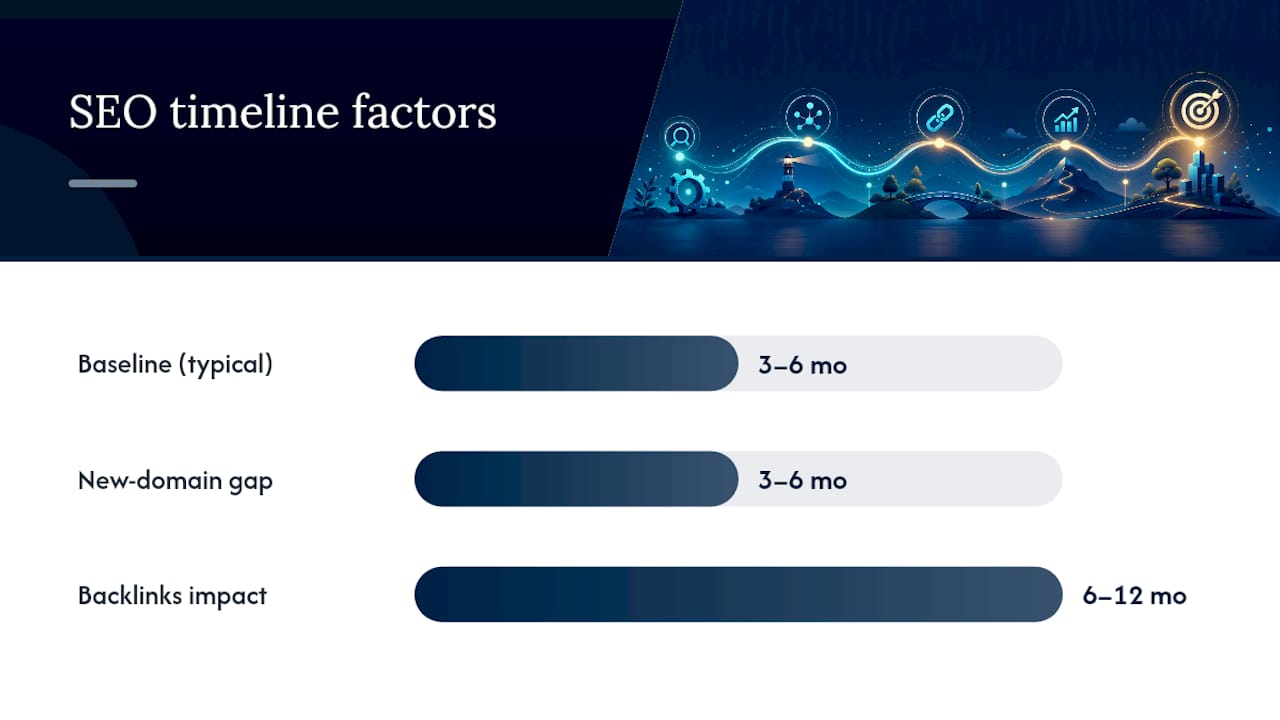
Backlinks and off-page signals compound slowly. Link building typically takes 6 to 12 months to show its full impact, and link velocity matters less than link quality. Ten links from relevant, respected sites will outperform a hundred links from low-quality directories.
External events like algorithm updates can accelerate or derail a timeline overnight. A core update that rewards topical depth can lift a well-built site in weeks; a manual penalty can erase months of progress just as fast.
- Domain age and trust history
- Competitive density in your niche
- Internal resourcing and publishing cadence
- Technical crawlability and site speed
- Content depth and search intent match
- Backlink quality and acquisition pace
- Algorithm volatility and recovery time
Pro Tip: Audit your top three competitors’ domain age and backlink count before setting your own timeline expectations. If they’ve been building authority for eight years, your six-month goal needs a reality check.
The Typical SEO Timeline: What to Expect Month by Month
Months 0 to 1 are audit and fix territory. This is where technical SEO work happens: resolving crawl errors, fixing broken redirects, cleaning up duplicate content, and confirming Google can actually index your pages. Check Google Search Console during this window for a rising count of indexed pages. That’s your first real signal the work is registering.
Months 1 to 3 bring the first visible movement, usually in impressions rather than clicks. Indexed pages tend to increase in month one, with impressions following in months one through three. You’ll likely see your site start appearing for long-tail, low-competition queries you weren’t ranking for before. Clicks are still thin here, and that’s normal, not a failure.
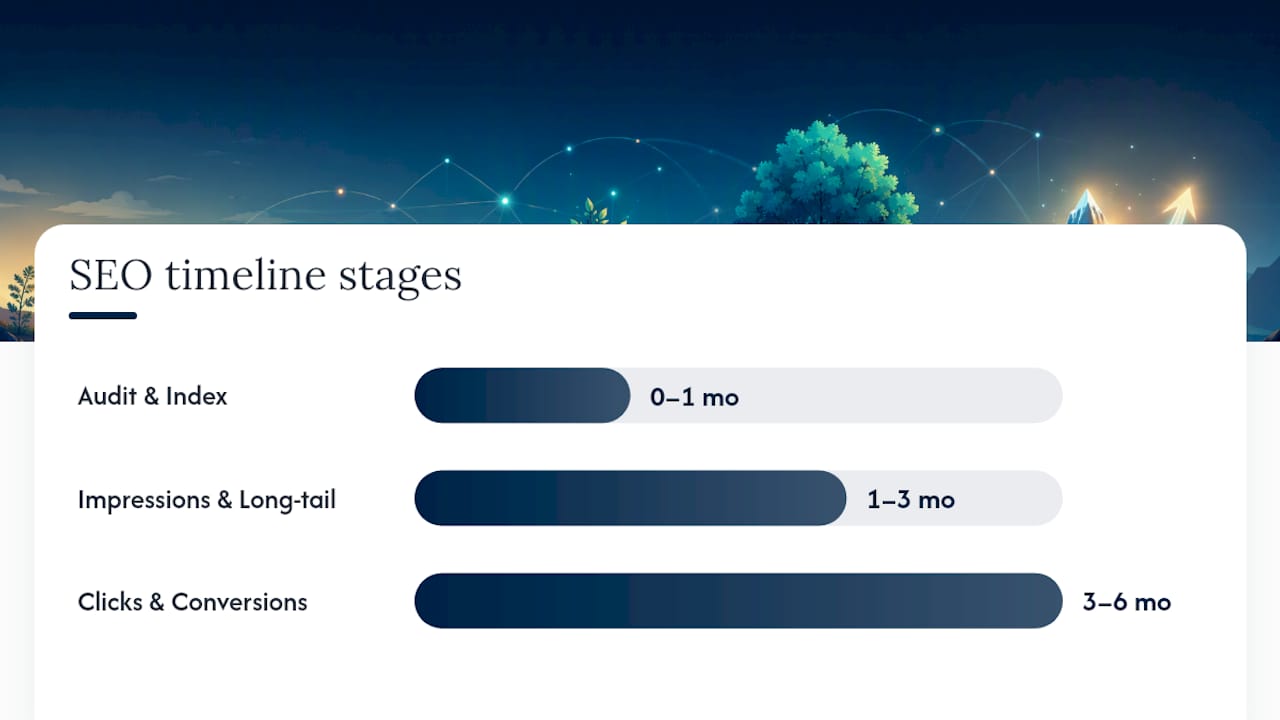
Months 3 to 6 is when content traction becomes visible. Clicks typically start climbing during this window as pages that were published in month one or two mature and Google gains confidence in them. Some SMBs see their first conversions from organic traffic in this stretch, especially for low-competition, high-intent local queries.
Months 6 to 9 is where compounding starts to show. Backlinks acquired earlier begin contributing authority, older content gets updated and re-indexed with better signals, and more competitive terms start shifting position. This is usually the point where a business owner can look at a report and see a real trend line instead of scattered data points.
Months 9 to 12 and beyond is when ROI becomes clear enough to defend the budget on its own merits. Rankings for competitive terms stabilize, traffic compounds month over month, and the campaign shifts from “building” to “maintaining and scaling.” Most industry benchmarks put material business impact somewhere in this 6 to 12+ month range, and that’s consistent with what Google’s own guidance suggests.
- Month 0 to 1: technical audit, indexation confirmation
- Month 1 to 3: impressions rise, long-tail rankings appear
- Month 3 to 6: clicks climb, early conversions begin
- Month 6 to 9: authority compounds, competitive terms move
- Month 9 to 12+: ROI clarifies, focus shifts to scale
Two exceptions matter here. A hyper-local, low-competition query (think a niche service in a small town with little digital competition) can rank in weeks, not months. On the other end, a manual penalty, a core algorithm update, or competing against enterprise-level domains with a decade of authority can stretch the realistic timeline to 12 to 18 months or more. Studies of top-ranking pages consistently find that most are over a year old, which tells you something important: patience isn’t optional for competitive terms, it’s built into how ranking works.
Early Signals That Prove SEO Is Working (Before Revenue Shows Up)
Revenue is the last metric to move, not the first. If you’re only watching your bank account for proof that SEO is working, you’ll wait months longer than necessary to see confirmation that’s already sitting in your data.
Primary signals live in Google Search Console: indexed page count, total impressions, and new ranking queries you weren’t showing up for before. These are the earliest, most reliable indicators that the work is being recognized.
Secondary signals follow shortly after: clicks, average position, click-through rate, and goal completions or leads. These take longer to move because they depend on someone actually seeing your listing and acting on it, not just Google crawling and indexing your page.
A useful checkpoint rhythm looks like this:
- 30 days: indexed pages should be rising; technical fixes should be live
- 60 days: impressions should show early upward movement, even if small
- 90 days: new ranking queries should appear; clicks may start trickling in
- 180 days: clicks and conversions should show a visible trend, not just noise
SEO teams that track impressions and indexation early tend to have an easier time keeping stakeholders patient than those who only report on final conversions. Build a simple weekly signal dashboard (impressions, indexed pages, top queries) and pair it with a monthly report that ties those signals to business outcomes. That combination gives leadership something concrete to look at between the big milestones.
Red flags look different from normal lag. Flat impressions for 90+ days despite consistent publishing, indexed page counts that stall or drop, or a sudden loss of previously ranking pages all point to a real problem, not just a slow campaign.
SEO Timelines by Scenario: New Sites, Local Pack, and Competitive Niches
Not every business is starting from the same line, and pretending otherwise is how expectations go wrong. Here’s how the baseline shifts by situation.
New domains carry a credibility gap that takes time to close. Expect three to six additional months beyond the standard timeline, often landing total time-to-impact at 9 to 12+ months. The fix isn’t to wait passively. Combine technical fixes, a focused long-tail content plan, and early citation building to shrink that gap faster than a generic “publish and wait” approach would.
Established sites with existing authority can see wins on niche and long-tail queries within weeks of a technical fix or content refresh. Head terms still take sustained effort, but the site isn’t starting from zero trust.
- New domain: 9 to 12+ months for material impact
- Established site: weeks for long-tail wins, months for head terms
- Local pack: 4 to 8 weeks for map visibility
- Organic local rankings: 3 to 6 months
- Competitive or enterprise niches: 6 to 18+ months
Local SEO and Google Business Profile work move faster than almost anything else in this list. An optimized profile with consistent citations can shift map-pack visibility in 4 to 8 weeks, because proximity and relevance carry more weight there than raw domain authority. Organic local rankings for blue-link results still take the standard 3 to 6 months, though. If local SEO strategy is part of your plan, the map pack is usually where you’ll see proof of life first.
Competitive or enterprise-level niches need the longest runway, often 6 to 18+ months depending on how wide the authority gap is between you and the incumbents. If you’re a small business going up against national brands, budget for the long game and pick your battles on more winnable long-tail terms first.
Figuring out which scenario you’re actually in, rather than assuming the generic baseline applies, is the single most useful thing you can do before setting a deadline with your team.
What to Do If SEO Isn’t Working
Six months of consistent, quality work with zero movement in impressions, indexation, or rankings is a legitimate signal to stop and diagnose, not just wait longer.
- Check indexation and crawl health first. Look for crawl errors, robots.txt blocks, or noindex tags accidentally left on live pages in Google Search Console.
- Audit content and intent fit. Thin pages, duplicate content, or content that doesn’t match what the searcher actually wants will underperform no matter how well-optimized the title tag is.
- Review your backlink profile. Look for lost links, a stagnant link velocity, or toxic links pointing at your domain that could be suppressing rankings.
- Look at operational bottlenecks. Delayed publishing, inconsistent cadence, or slow sign-off on technical fixes quietly extend timelines far more than any algorithm does.
Multiple industry sources agree that the six-month mark is the right point to reassess if checkpoints haven’t progressed. If you’ve hit that point, ask for a full technical and content audit before assuming the entire strategy is wrong.
Pro Tip: Before switching providers, ask for raw Search Console data covering the full engagement, not just a summary report. Real numbers over real time reveal whether the work stalled or whether you simply haven’t hit the compounding phase yet.
What Realistic SEO Timelines Actually Look Like in Practice
Clients ask one question more than any other: when will this work? The honest answer is that the timeline is real, but so is the tendency for owners to underestimate it and for some agencies to overpromise on it.
The businesses that handle this best track leading indicators, not just revenue. Building reporting around indexed pages, impressions, and query movement helps because those numbers show up months before conversions do, and they give owners something concrete to evaluate instead of guessing.
The other half of this is internal. Campaigns lose weeks, sometimes months, to slow content approvals, delayed developer access, or unclear sign-off chains. If you want the 3 to 6 month baseline to actually hold, get your team’s approval process sorted before the campaign starts, not three weeks into it.
— Michael
Get a Clear Path to SEO Results With Tradewinds United Media
A lot of the delay in SEO campaigns has nothing to do with Google. It comes from technical debt nobody fixed, content that missed the point of the search query, and reporting so vague that owners couldn’t tell progress from stagnation. Campaigns that fix those specific blockers first start with technical audits, a content plan matched to real search intent, and local visibility work that includes Google Business Profile optimization.

Progress can be tracked against the same checkpoints covered here, indexed pages, impressions, and ranking queries, with regular reports showing what moved and why. No guessing about whether month four is on schedule. If you want a clear read on where your site currently stands and what a realistic timeline looks like for your specific market, request a local SEO report or explore Tradewinds United Media’s full SEO services to get started.
Sources
- How long does SEO take? — Shopify
- How long does SEO take to show results? — Ahrefs
- How long does SEO take to work? — Search Engine Land