For most small businesses, quality should lead and quantity should follow. Lead quantity is how many inquiries you get. Lead quality is how likely each one is to become a paying customer. A thin stream of well-matched leads usually beats a flood of poor fits, but only if the stream is big enough to keep your calendar full. The real job is to set a quality floor, then grow volume above it.
Below, you’ll find how to define a good lead, the numbers to track, a worked example of the math, and the steps we use to raise lead quality without letting volume collapse.
TL;DR
- Quantity counts leads. Quality measures how likely they are to buy. You need both, in that order: set a quality floor, then scale volume.
- Judge marketing by cost per qualified lead and cost per customer, not cost per lead alone.
- Define a qualified lead in writing (fit, need, budget, authority, timeline) and score every inquiry against it.
- Many “bad lead” problems are really follow-up problems. Slow response and broken handoffs waste good leads.
- Feed real sales outcomes back into Google Ads and your analytics so the platforms learn what a good lead looks like.
Table of Contents
- What lead quantity and lead quality actually mean
- Why more leads often fail to produce more customers
- A worked example: when fewer leads win
- Quality and quantity are not opponents
- How to define a qualified lead in your business
- The metrics that connect leads to revenue
- How to improve lead quality without losing volume
- Which one should you prioritize?
- Perspective: why we start with quality
- How we can help
- FAQ
- Sources
What lead quantity and lead quality actually mean
Lead quantity is the number of leads you generate in a period: form fills, calls, chats, quote requests. It tells you how much opportunity is entering the funnel. Lead quality describes how well those leads match what your business sells, and that decides whether the opportunities are worth pursuing.
Quality is not a feeling. Marketing platform guides generally describe it as how likely a prospect is to buy, based on fit, interest, readiness, budget and authority. A person who lives outside your service area, wants a price below your minimum, or was only looking for a free template is a lead by count. By quality, that person is noise.
For a local plumber, a roofer, a dentist or a boutique, quality has a simple practical test: would you be happy if this person called back tomorrow and said yes?
Why more leads often fail to produce more customers
It’s tempting to treat lead volume as the goal. Volume is easy to report and easy to buy. But a bigger number at the top can hide a smaller number at the bottom.
Two things usually go wrong.
You optimized for the wrong signal. Guidance on lead generation warns that chasing form-fill volume rather than sales outcomes can pull in more low-quality leads and make selling harder, because a form fill is not a buyer. This is common in Google Ads accounts that optimize for any conversion, including a click on a phone number in the footer or a newsletter signup.
Good leads leak after they arrive. Sometimes the problem is not who showed up but what happened next. Slow response, inconsistent follow-up or broken systems let promising leads go cold. Before you decide your leads are bad, check how fast you answer them. A lead that waited two days for a callback has often already hired someone else.
If you’re seeing a pile of tire-kickers, spam or price shoppers, our guide on why all your leads look like price shoppers or spam walks through the usual causes.
A worked example: when fewer leads win
The numbers below are a hypothetical illustration, not client results. They show why cost per lead alone misleads.
| Campaign A (volume) | Campaign B (quality) | |
|---|---|---|
| Ad spend | $4,000 | $2,700 |
| Leads | 100 | 30 |
| Cost per lead | $40 | $90 |
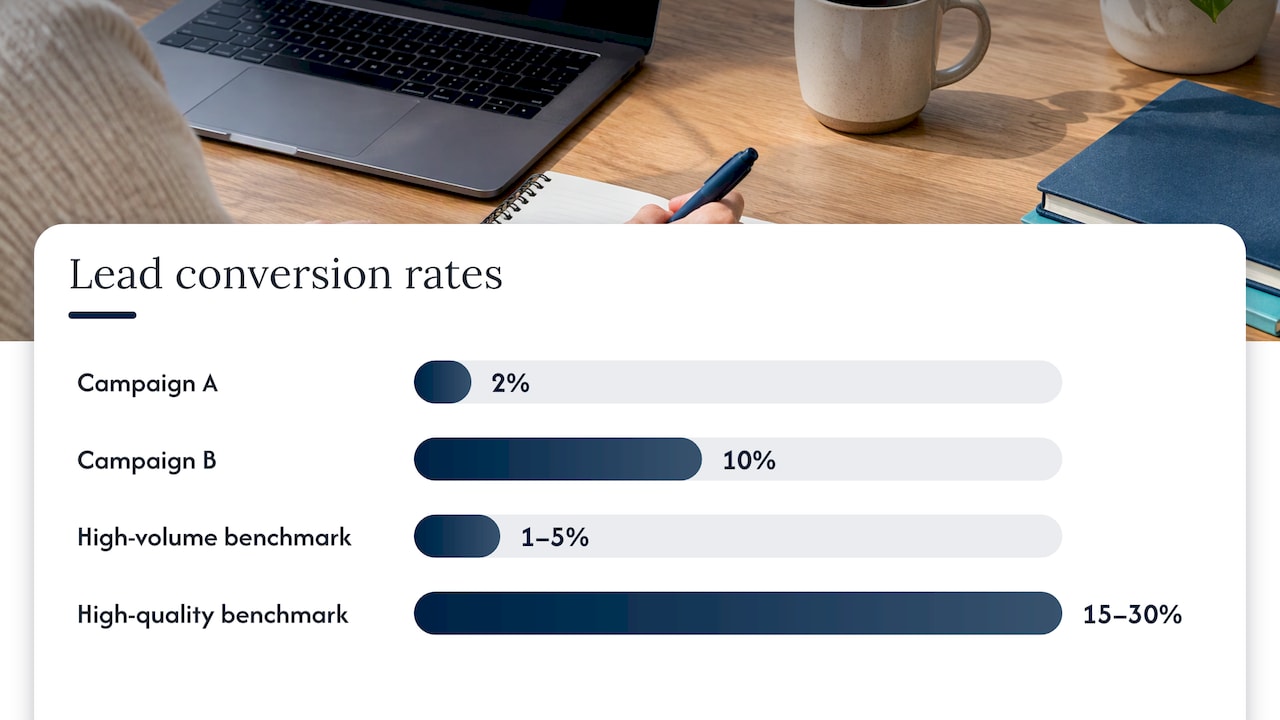
| Lead-to-customer rate | 2% | 10% |
| New customers | 2 | 3 |
| Cost per customer | $2,000 | $900 |
Campaign A looks twice as cheap per lead and produces fewer customers for more money. The same logic shows up in published industry analysis: one lead-generation firm’s write-up estimates that high-volume leads convert at roughly 1 to 5 percent while high-quality leads convert at 15 to 30 percent. Treat those ranges as a rough benchmark. Your own close rate is the number that matters, and you can only know it if you track it.
There’s a flip side. If Campaign B had produced three leads, a 10 percent close rate would give you less than one customer a month. Quality only pays when there is enough volume to act on. That is why the goal is balance, not a winner.
Quality and quantity are not opponents
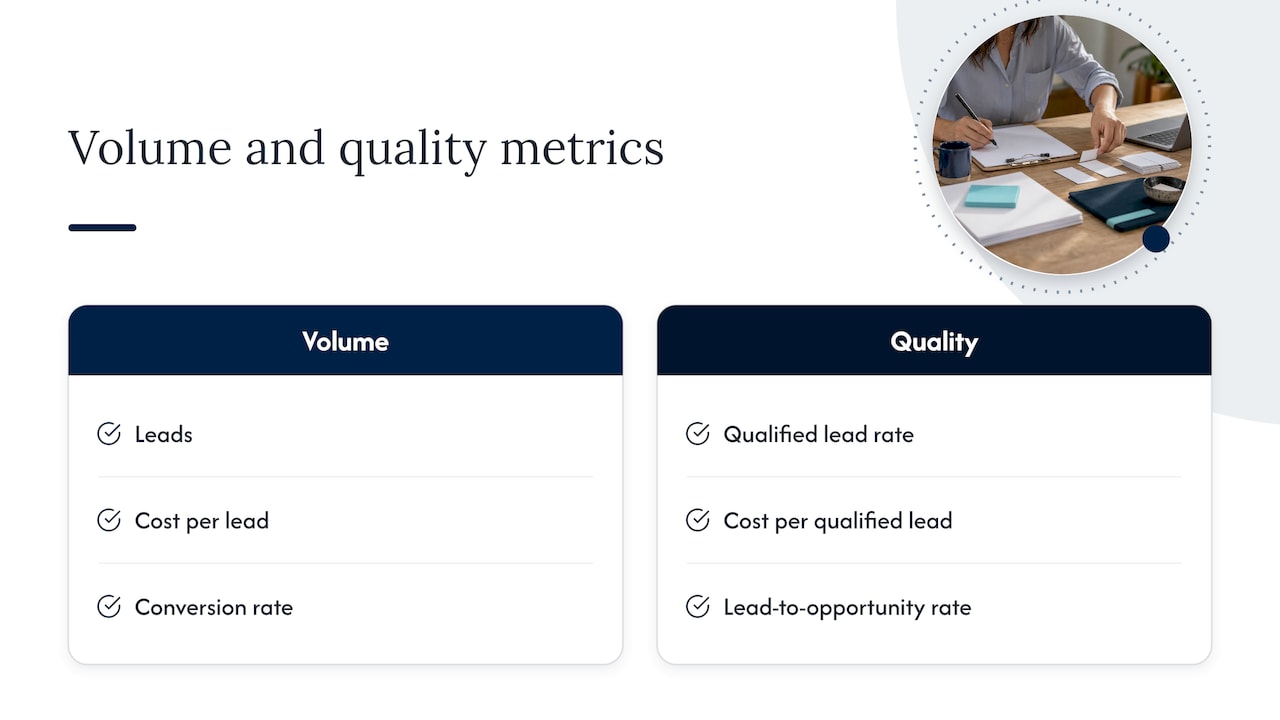
A recent Search Engine Land piece argues that treating them as competing strategies is the core mistake. They are different growth objectives, and the useful move is to watch volume metrics (leads, cost per lead, conversion rate) and quality metrics (qualified lead rate, cost per qualified lead, lead-to-opportunity rate) at the same time.
That framing helps small businesses in practice. If your calendar is empty, volume is the bottleneck and you can loosen targeting a little. If your calendar is full of the wrong jobs, quality is the bottleneck and you should tighten it. Which problem you have decides which lever to pull.
How to define a qualified lead in your business
You can’t improve what you haven’t defined. Start by writing down what a good lead looks like, with input from whoever answers the phone and whoever closes the sale.
Most frameworks come back to the same questions. HubSpot describes a qualified lead as one with a problem you can solve, a budget that fits your pricing, some authority, and a defined timeline. Salesforce boils it down to two core tests: your offer meets their need and they can afford it.
For a local business, turn those into plain screening criteria:
- Location: Are they inside your service area?
- Need: Do they want something you actually sell?
- Budget: Does their expectation fit your typical job size?
- Authority: Are they the owner, or can they approve the spend?
- Timeline: Do they need it this week, this quarter, or someday?
Give each answer a score, add them up, and set a threshold. This is the BANT idea (Budget, Authority, Need, Timeline), and it stays practical for small teams because it can be scored quickly to decide who gets a call first.
MQL vs. SQL in plain terms
You’ll see these labels everywhere. A marketing-qualified lead (MQL) has engaged with your marketing, for example by downloading a guide, but may not be ready to buy. A sales-qualified lead (SQL) has been vetted and shows clear purchase intent. A one-location service business doesn’t need a complex lifecycle model. Two buckets are enough: “worth a same-day call” and “nurture or ignore.”
The metrics that connect leads to revenue
Pick a small set and review it monthly. The U.S. Chamber of Commerce advises defining your lead types and your MQL and SQL criteria before choosing KPIs, and lists funnel conversion rates, MQL-to-SQL conversion, closing percentage, cost per acquisition and cost per lead among the metrics worth watching.
A workable dashboard for a small business:
| Metric | What it tells you | Type |
|---|---|---|
| Leads per month | How much demand you’re generating | Quantity |
| Cost per lead | How cheaply inquiries arrive | Quantity |
| Qualified lead rate | Share of leads that meet your criteria | Quality |
| Cost per qualified lead | What a usable inquiry really costs | Quality |
| Lead-to-customer rate | How often leads become paying jobs | Quality |
| Cost per customer | The number that decides profit | Both |
The project-management platform monday.com makes a similar split, suggesting you track volume metrics alongside quality metrics such as lead-to-opportunity rate and sales velocity, plus cost metrics like cost per lead and customer acquisition cost.
Lead scoring is the tool that ties it together. It ranks prospects on a scale of perceived value, so your team knows where to spend the first hour of the day.
For the wider picture of tying spend to revenue, see our small business guide to marketing ROI tracking.
How to improve lead quality without losing volume
The most useful framing we’ve seen is a quality floor and a volume ceiling. Search Engine Land’s guidance is to set a minimum acceptable quality, then scale within that boundary by widening audiences, keywords and creative. If quality drops as you scale, cut the specific source of inefficient volume rather than switching off the whole campaign.
Here is how that looks in practice.
1. Teach the ad platform what a good lead is
Google’s own guidance for advertisers is to map the full journey from lead to sale, identify the key conversion actions, and use first-party data collected through tags so campaigns can optimize toward real lead-generation outcomes. If your only tracked conversion is “form submitted,” the system will find more people who submit forms, whether or not they buy.
The fix is to track the actions that matter and, better, the outcomes. Our guides on Google Ads conversion tracking and offline conversion tracking with enhanced conversions show how to report closed jobs back to the platform so it learns from sales, not clicks.
2. Track phone calls like leads
For many local businesses, the best leads call. If those calls aren’t attributed to a source, you’ll undervalue the campaigns that bring them. Our practical guide to call tracking attribution covers how to see which keywords and ads produce calls that turn into work.
3. Add the right amount of friction
More friction can mean fewer but more serious leads. At a marketing conference panel reported by MarTech, one Meta advertising lead described adding friction as producing better, more serious leads. Practical versions for a small business: a form field asking for the job type or budget range, a service-area question, or a short note on your minimums. Each added field costs some volume and filters out the least serious people.
You can go the other way when needed. In a Meta test reported in the same article, instant forms drove a 20 percent lower cost per qualified lead than website forms. The right form depends on the platform and the offer, so adjust one thing at a time and measure.
If you run Google Ads lead forms, see how to wire them to your CRM and when they make sense.
4. Tighten who you attract before the click
Quality starts with the message. Ad copy, landing pages and your Google Business Profile should state what you do, where you work, and what jobs you take. Say “emergency AC repair in Tampa” rather than “home services.” The same goes for your site: a page that clearly states services and service area screens out poor fits before they call. Our guide on Google Business Profile optimization covers how to present services accurately, and our piece on why a website stops bringing in business covers the page-level fixes.
5. Respond fast and follow up consistently
Qualification is wasted if nobody picks up. ZoomInfo’s small business guidance names rapid lead response as a high-leverage change. Decide who owns each new lead, how quickly they reply, and how many follow-ups happen before a lead is closed out. Even a simple shared inbox rule and a text-back template can lift conversion from the leads you already have.
6. Review sources monthly and cut selectively
Once a month, list leads by source (paid search, map pack, organic, referrals, social) and note how many became customers. Shift budget toward sources with a low cost per customer. Don’t kill a source that sends few leads but good ones, and don’t scale one that sends many but never closes.
Which one should you prioritize?
Use your situation as the guide:
| Your situation | Prioritize | First move |
|---|---|---|
| Calendar is full of poor-fit jobs, sales team is frustrated | Quality | Add screening questions, tighten targeting, track closed sales |
| Good close rate but too few inquiries | Quantity | Widen keywords and service areas, improve map and organic visibility |
| Plenty of leads, few customers, slow replies | Follow-up | Set response times and ownership before spending more |
| You can’t tell which source works | Measurement | Set up call and conversion tracking first |
Perspective: why we start with quality
We hear the same story from business owners who come to us after a frustrating agency relationship: the report said leads were up, and the phone was still quiet. Nobody had defined what a good lead was, so “more” became the only goal.
Our view is that a marketing report should connect spend to business results. That means tracking the calls and forms, yes, but also asking which of them became customers. When we manage Google Ads, build a site, or work on local search, we want you to see how each effort converts, not just how many clicks it earned.
We would rather help you set a quality floor and then grow volume above it than hand you a bigger number that doesn’t pay the bills. Volume matters. It just matters most once the leads are the right ones.
Michael
Wait
How we can help
If your reports show activity but your pipeline doesn’t feel it, we can help. Tradewinds United Media builds websites designed to turn visitors into inquiries, manages Google Ads campaigns with performance reporting you can follow, and works on local visibility through SEO. Our approach is to give you clear reports and regular updates on how your marketing is performing.

To talk through your lead flow, start from our home page and get in touch.
FAQ
What is the difference between lead quality and lead quantity?
Lead quantity is the number of leads you generate. Lead quality is how well those leads fit your business and how likely they are to buy. Quantity expands your opportunities, and quality decides how many become revenue.
How do I improve lead quality?
Define a qualified lead in writing, score inquiries against it, and track which sources produce customers. Then tighten targeting and add screening questions to your forms. Feeding closed-sale data back into Google Ads helps the platform find more people like your best customers.
What is the difference between an MQL and an SQL?
An MQL has engaged with your marketing but may not be ready to buy. An SQL has been vetted and shows clear intent to purchase. Small businesses can simplify this into leads worth a same-day call and leads to nurture.
Should I ever choose quantity over quality?
Yes, when your close rate is healthy and your calendar is empty. In that case you can widen keywords or service areas, while watching cost per qualified lead so quality doesn’t slip below your floor.
Sources
- Lead Quality vs. Lead Quantity: Which Matters More?
- Lead Quality Secrets for Success, Mailchimp
- Why Most Lead Gen Fails
- Why You’re Getting Leads But Not Sales
- The Economics of High-Quality vs High-Volume Leads
- More leads or better leads? Search Engine Land
- Lead qualification guide, HubSpot
- What Is Lead Qualification and How Does It Work? Salesforce
- Lead Qualification: Scoring Models, BANT & MQL vs SQL
- Small Business Lead Generation, Salesforce
- Demand generation strategies for small businesses, U.S. Chamber of Commerce
- B2B Sales Lead Generation, monday.com
- Lead Quantity vs Quality: Achieving a Balance
- Best practices for generating high-quality leads, Google
- As lead gen grows on social media, MarTech
- How to Create a Lead Generation Strategy for SMBs, ZoomInfo