Reputation management costs run from about $99 a month for basic monitoring software to $10,000 or more per month for enterprise crisis campaigns, with most small businesses landing between $300 and $3,000 monthly. The exact number depends on three things: how much negative content exists, how authoritative the sources hosting it are, and how fast you need results. The sections below break down pricing by business size, service type, and urgency so you can figure out where you actually fall.
TL;DR:
- Costs vary widely, from about $99 for basic monitoring to over $10,000 monthly for crisis management, depending on negative content volume and source authority.
- Pricing models include retainers, fixed project fees, hybrid sprints, and pay-for-performance, with each posing different risks and benefits.
- Small businesses typically budget $300 to $2,000 per month, while enterprises facing coordinated attacks may pay $6,000 to over $10,000.
- Negative content ranking position, source authority, and platform affected significantly influence the cost to address online reputation issues.
- Quick removals can take two to four weeks, while suppression campaigns targeting high-authority negative results generally last three to nine months or longer.
Table of Contents
- What Does Reputation Management Cost Per Month?
- How Do Agencies Bill for Reputation Management Work?
- How Much Should Different Business Sizes Budget?
- Why Do Two Similar Businesses Pay Different Prices?
- What Services Are Included in the Price?
- How Long Does Reputation Management Take to Work?
- What Should You Ask Before Signing a Reputation Management Contract?
- What Are Red Flags in a Cheap Reputation Management Offer?
- How Tradewinds United Media Prices Reputation Work for Small Businesses
- Why Waiting Costs More Than Acting Early
- Get a Straight Answer on Your Reputation Management Budget
- Sources
What Does Reputation Management Cost Per Month?
Pricing splits into five rough bands, and knowing which one applies to you saves a lot of wasted sales calls.
Basic monitoring software sits at the lower end of pricing, generally costing a few hundred dollars per month. You get alerts when your name or brand shows up online, sometimes with sentiment scoring, but typically no personal outreach or content creation is included. It’s a listening tool, not a fix.
Entry-level managed service is the next step up, usually costing several hundred to low thousands of dollars per month. This tier covers review monitoring across Google, Yelp, and industry-specific sites, basic review response templates, and light monthly reporting. It suits a single-location business dealing with a handful of bad reviews rather than a full-blown crisis.
Mid-market packages typically range from low thousands to several thousands of dollars per month. This is where agencies start building out content, actively pursuing directory and press mentions, and managing reputation across multiple locations or a growing employee base (think Glassdoor and Indeed reviews alongside customer feedback).
Enterprise and crisis retainers can be several thousands to over ten thousand dollars monthly. Industry pricing data from Status Labs confirms this range applies when a company faces coordinated attacks, viral negative press, or executive-level reputation threats requiring legal coordination and 24/7 response.
One-time removal or sprint projects usually involve varied one-time fees depending on the complexity and source. A single defamatory blog post might cost a few thousand to address through legal outreach; a coordinated smear campaign across a dozen sites costs far more.
How Do Agencies Bill for Reputation Management Work?
Providers structure fees four main ways, and each comes with a different risk profile for the client.
- Monthly retainer. This is the standard model. It covers ongoing monitoring, review response, and content publishing, usually with a setup fee ($500 to $2,500) and a minimum commitment of three to six months. Retainers work best when the problem is chronic rather than acute, like an ongoing stream of mixed reviews.
- Project-based fixed fee. You pay one price for a defined outcome, such as removing three negative articles or building out five pieces of authoritative content. This model reduces budget uncertainty but shifts risk to the agency if the scope creeps, so read the deliverables list carefully.
- Hybrid sprint plus maintenance. Many agencies now sell a focused 60 to 90 day sprint at a fixed price, followed by a lighter monthly retainer once things stabilize. For urgent situations, this tends to deliver the best value because you’re not locked into a year of full-price service before you know if the tactics are working.
- Pay-for-performance. Rare, and worth scrutinizing. A provider might charge based on ranking improvements or review score changes. It sounds appealing, but it can create pressure toward gray-hat tactics like incentivized reviews, which runs into FTC rules on consumer reviews and testimonials. Ask exactly how “performance” gets measured and verified before signing anything.
How Much Should Different Business Sizes Budget?
Your reasonable budget depends heavily on who you are and what’s actually at stake.
- Individuals and professionals (doctors, real estate agents, consultants) typically spend $200 to $1,000 monthly on review monitoring and basic profile management, sometimes paired with a one-time content push to build out a professional bio and press presence.
- Small businesses with a single location generally budget $300 to $2,000 a month, covering review generation, response management, and light local SEO support to keep the Google Business Profile healthy.
- Mid-market companies with multiple locations or a larger workforce (and the accompanying Glassdoor and Indeed exposure) usually land between $2,000 and $6,000 monthly, since volume of reviews and content needs scale with every added location.
- Enterprise and VIP clients facing coordinated attacks or executive scrutiny often pay $6,000 to $10,000+ monthly for 24/7 monitoring, legal coordination, and PR support layered on top of standard suppression work.
The jump between tiers isn’t arbitrary. It tracks directly with how many platforms need monitoring and how fast a response has to happen.
Why Do Two Similar Businesses Pay Different Prices?
Two businesses with what looks like the same problem can get wildly different quotes, and it usually comes down to seven variables.
- Volume and ranking position of negative content. A negative review buried on page three of Google costs far less to address than one sitting in the top three organic results.
- Authority of the source. Content hosted on major media outlets costs significantly more to displace than a comment on a low-traffic forum, since outranking a high-authority domain requires stronger content and more outreach.
- Platforms affected. Search results, review sites, employer review platforms, social media, and increasingly AI-generated summaries each require different tactics and tools.
- How viral or amplified the content has become. A single bad review is cheap to manage; a story picked up by multiple outlets or shared widely on social media is not.
- Legal complexity. Defamatory or false content sometimes justifies attorney involvement, which adds real cost but can also produce faster removals than SEO suppression alone.
- Urgency and SLA expectations. Wanting results in four weeks instead of four months means more resources thrown at the problem simultaneously, which raises the price.
- Existing owned assets. A business with an active blog, consistent brand identity, and existing PR relationships gives an agency a head start, which usually lowers the total spend needed.
Pro Tip: Before requesting quotes, list every negative item you know about along with its Google ranking position. Providers price blind guesses higher than documented problems because they have to budget for discovery work either way.
What Services Are Included in the Price?
Every quote breaks down into recognizable line items, and knowing them helps you compare apples to apples.
- Monitoring: software-only subscriptions run $99 to $500 a month; managed monitoring with human review typically adds $200 to $800 monthly on top.
- Review generation and response: often billed per location, ranging from $150 to $600 monthly per site, covering solicitation campaigns and response drafting.
- Content creation and SEO for suppression: individual assets (articles, bios, press placements) run $300 to $2,500 each, depending on the writer’s expertise and the platform’s authority.
- Publisher outreach and removal attempts: usually billed as one-time fees, from $500 for a simple takedown request to $5,000+ when legal counsel gets involved.
- Crisis response: senior strategists often bill $150 to $400 per hour, or a premium retainer that can double standard monthly rates during an active crisis.
- Reporting and dashboards: typically bundled into the retainer, though some agencies charge a separate $100 to $300 monthly fee for custom analytics.
How Long Does Reputation Management Take to Work?
Timelines vary by tactic, and setting the wrong expectation is one of the most common reasons clients feel disappointed even when the work is going fine.
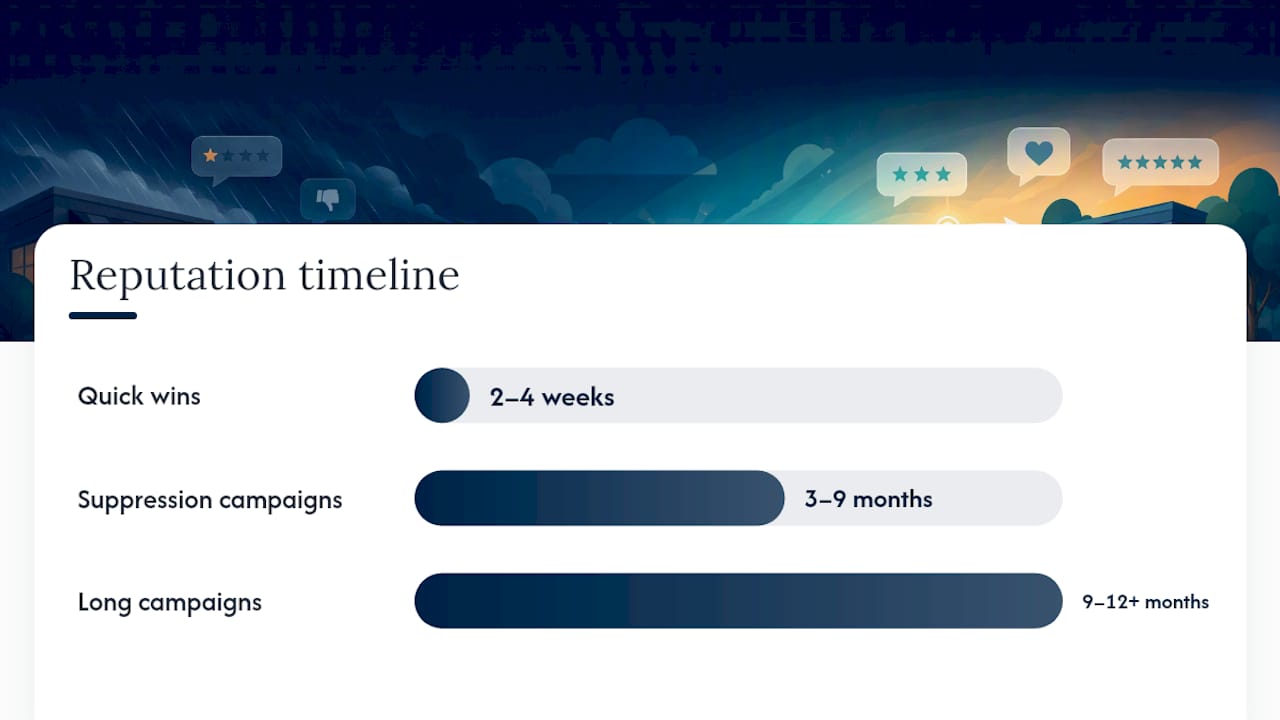
Quick wins, like removing a single outdated listing or getting a review flagged for policy violation, can happen within two to four weeks. Suppression campaigns, which involve building and ranking new content to push negative results off page one, generally take three to nine months. Long campaigns involving high-authority negative press or coordinated attacks across multiple platforms often run nine to twelve months or longer.
A measurable result looks like a specific ranking change (a negative article moving from position two to position seven), a sentiment score shift in monitoring software, or a review average moving up by a fraction of a point over a quarter. Removal is realistic when content violates a platform’s terms of service or is demonstrably false; suppression is the only practical route when the content is accurate, opinion-based, or protected speech. Ask for monthly reporting at minimum, with ranking and sentiment tracked as core KPIs.
What Should You Ask Before Signing a Reputation Management Contract?
Getting quotes that are actually comparable requires giving every provider the same starting information.
- Share the specifics first. Provide the exact URLs, the search queries that surface the problem, which platforms are affected, and who within your business is impacted (you personally, an executive, or the company brand).
- Request a written scope. A transparent proposal names specific deliverables, sets milestone dates, identifies who on the team does the work, and outlines any legal steps involved.
- Ask direct questions. How likely is removal versus suppression for this specific content? How will results be measured? Does any work get subcontracted out? Is there a refund or guarantee clause, and what exactly does it cover?
- Negotiate a smaller first commitment. A common and reasonable approach, as outlined in reputation pricing guidance from Social Czars, is starting with a three-month sprint with defined milestones before agreeing to a longer retainer.
What Are Red Flags in a Cheap Reputation Management Offer?
Some pricing is cheap because the provider is efficient. Other pricing is cheap because it doesn’t work or breaks the rules.
- Guaranteed removals. No legitimate provider can guarantee content comes down, especially from third-party platforms they don’t control.
- Extremely low all-in prices paired with vague deliverables (“we’ll handle everything”) instead of a specific list of actions and assets.
- No references or verifiable case studies. Ask for examples of past work you can check against public search results, without expecting the provider to violate another client’s confidentiality.
- No milestone structure. A contract with a single lump payment and no checkpoints gives you zero leverage if results stall.
Pro Tip: If a proposal mentions incentivizing reviews or “managing” what gets posted rather than responding to what’s already there, that’s a compliance risk under current FTC review rules, not a shortcut worth taking.
Negotiate for milestone-based payments, clearly defined KPIs in the contract itself, and a documented escalation path if targets aren’t met. For anything involving defamation, false statements, or coordinated harassment, loop in an attorney or PR counsel before signing anything.
How Tradewinds United Media Prices Reputation Work for Small Businesses
Tradewinds United Media builds reputation management into local SEO campaigns rather than selling it as an isolated service, which keeps monthly costs closer to the small-business end of the range rather than agency markups built for enterprise clients. Review monitoring, response management, and Google Business Profile optimization run together under one retainer, with reporting that shows exactly what moved and when. For a business dealing with a handful of bad reviews or gaps in its local visibility, that combined approach usually fits comfortably within the entry-level to mid-market budgets described above.
Why Waiting Costs More Than Acting Early
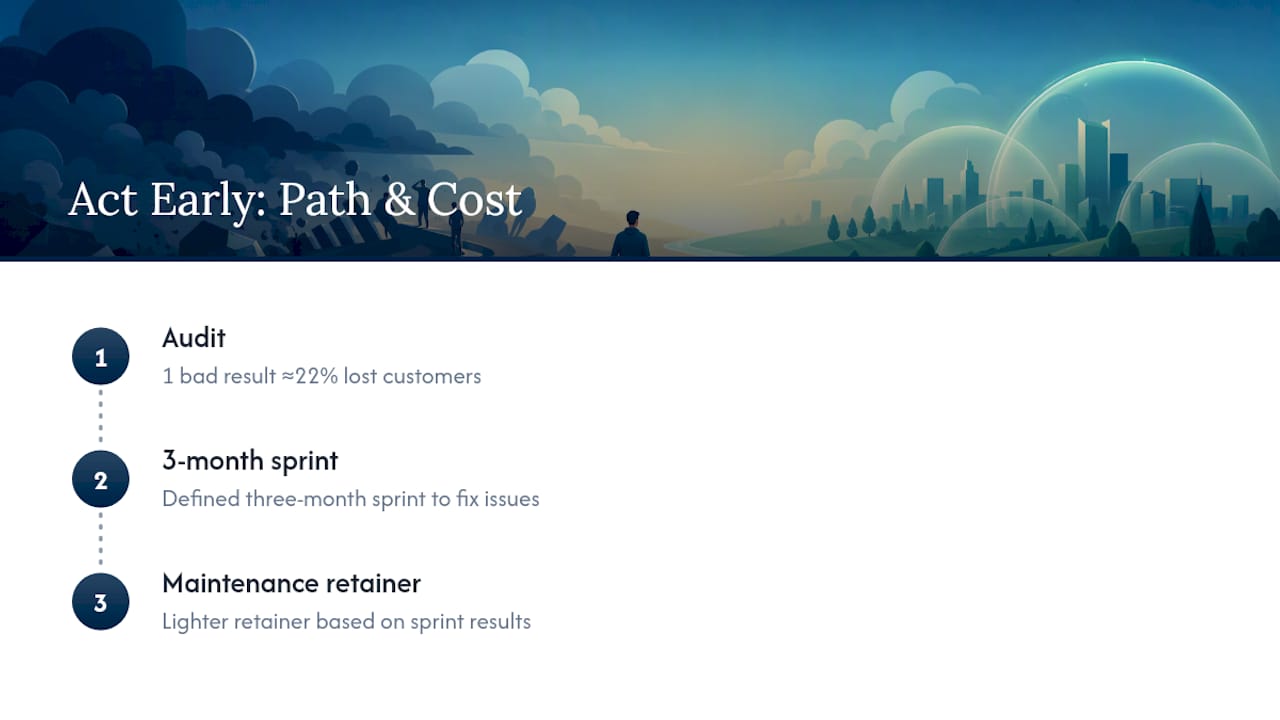
Every negative result you leave unaddressed compounds. One negative page-one search result can cost a business roughly 22% of potential customers, and that number gets worse, not better, with each additional bad result stacking up. I’ve seen the math play out the same way across industries: businesses that act on a single bad review or a slipping star rating spend far less than those that wait until it’s a pattern with momentum behind it.
The path that makes sense for most businesses is an audit first, then a defined three-month sprint, then a lighter maintenance retainer based on what the sprint actually proved. Reputation, as Harvard Business Review has argued, functions as a real financial asset. Treat the spend accordingly, and insist on reporting that ties dollars to measurable movement, not vague promises of “improvement.”
— Michael
Get a Straight Answer on Your Reputation Management Budget
Most agencies quote a flat monthly number without telling you what specifically drives it up or down. Tradewinds United Media prices reputation work based on what’s actually happening in your search results and review profiles, not a generic package, so you’re not paying enterprise rates for a problem that only needs a focused sprint.

For local businesses across the United States, that means a monitoring and response plan sized to your actual exposure, bundled with the local SEO work that keeps new reviews and search visibility working in your favor long after the initial cleanup. If you want a clear read on where your business stands right now, request a Local SEO Report and get specific findings instead of a generic price quote.
Sources
- Trade regulation rule on the use of consumer reviews and testimonials — Federal Register
- How Much Does Reputation Management Cost? Pricing Breakdown & What to Expect — Status Labs
- Reputation and its risks — Harvard Business Review
- How to build brand identity that grows with your business — SEMrush Blog