Google’s Map Pack runs on three pillars: relevance, proximity, and prominence. Of these, only relevance and prominence respond to your effort, mainly through a complete Google Business Profile, accurate location data, and steady review growth. Proximity is fixed by geography and cannot be optimized, so expect results to vary by searcher location and treat consistency across your market as the realistic goal.
TL;DR:
- A single manual search is unreliable because results vary by location, device, and history; check positions weekly across fixed points in your service area.
- Choose the most specific accurate primary category, complete services and hours, match your website’s business details, and never add keywords to your business name.
- Ask for reviews after jobs, reply within a few days, and track monthly review velocity; incentives or selective requests violate Google’s policies.
- Prioritize accurate citations and earned local mentions over bulk directory submissions; track profile performance monthly and compare trends quarterly.
Table of Contents
- The Three Core Map Pack Signals: Relevance, Proximity, and Prominence
- Google Business Profile Optimization Checklist, Field by Field
- Reviews and Reputation: What to Track and How to Act
- Website and On-Page Signals That Support Map Pack Visibility
- Citations, Local Mentions, and Link Signals Worth Earning
- How to Measure and Audit Map Pack Performance
- A 30 to 90 Day Map Pack Action Plan
- Setting Realistic Priorities for Map Pack Work
- Where Tradewinds United Media Fits Into Your Map Pack Plan
- FAQ
- Sources
The Three Core Map Pack Signals: Relevance, Proximity, and Prominence
Google states that local results are built primarily on relevance, distance, and prominence, and each pillar pulls from different inputs.
Relevance measures how well your business profile matches what someone typed. It draws on your primary category, business description, services list, and the words in your reviews. Proximity measures physical distance between the searcher (or the location named in their search) and your business address or service area. It is computed per search, which is why two people in the same city can see different Map Pack results. Prominence measures how well known and well reviewed your business is, pulled from review volume and ratings, local mentions, links, and general web presence.
Here is how the controllable signals split from the fixed ones:
- Relevance levers you control: primary and additional GBP categories, business description, services list, and website content.
- Prominence levers you control: review volume and recency, owner responses, citations, and earned local mentions.
- Proximity, a constraint, not a lever: the distance between the searcher and your listed address or service area.
Most owners waste time trying to “beat” proximity. Instead, confirm your address and service-area boundaries are accurate, then put your energy into the two pillars that actually respond to work.
Google Business Profile Optimization Checklist, Field by Field
Your Google Business Profile is the single highest-leverage asset for Map Pack visibility, and Whitespark’s 2026 local ranking factors survey consistently ranks primary category, proximity, and business-title relevance near the top of practitioner priorities. Work through these fields in order:
- Choose the most specific primary category available, then add every additional category that genuinely applies to your services.
- Standardize your name, address, and phone number to match your signage and legal paperwork exactly, and correct any map pin that sits on the wrong building.
- Set service-area rules honestly: if you travel to customers, define a realistic radius rather than claiming a region you cannot actually serve.
- Complete your services list and business description using plain language that matches how customers actually search.
- Fill in regular hours and special hours for holidays so your profile never shows stale or incorrect status.
- Upload current photos of your location, team, and work, and keep your product list updated if you sell physical goods.
- Avoid keyword-stuffing your business name: Google’s guidance treats this as a policy violation, not a relevance boost.
For a deeper field-by-field walkthrough, our Google Business Profile optimization playbook covers edge cases like multi-location listings and attribute selection.
Pro Tip: Recheck your pin placement on a desktop map view every few months. A dragged pin from an old move or a shared building address is one of the most common, and most overlooked, causes of lost visibility.
Reviews and Reputation: What to Track and How to Act
Review signals feed directly into prominence, and the Whitespark survey flags review recency and total volume as increasingly important for 2026. Ratings matter, but the actual text of a review matters too, since it reinforces relevance when customers mention your services or location by name.
- Ask for reviews consistently, right after a completed job or purchase, using a direct link rather than a vague request.
- Respond to every review, positive and negative, within a few days to show active management.
- Never offer incentives for reviews or ask only satisfied customers to leave feedback, both of which violate Google’s policies.
- Triage negative reviews quickly: acknowledge the issue publicly, then move specifics to a phone call or email.
- Track review velocity monthly, not just star average, since a steady trickle of new reviews signals an active business.
Our guide on how to respond to bad reviews includes templates you can adapt. For teams managing review replies at scale, LocalReviewReply’s playbook walks through response workflows across multiple locations.
Pro Tip: Reply to negative reviews with a calm, specific acknowledgment rather than a generic apology. Future customers read your response more closely than the complaint itself.
Website and On-Page Signals That Support Map Pack Visibility
Your website backs up what your GBP claims. A location page for each service area, written for real visitors rather than stuffed with city names, helps relevance without tripping spam filters.
- Build dedicated location and service pages with genuine local detail, internal links between them, and clear calls to action.
- Implement LocalBusiness structured data using the most specific subtype available, such as ProfessionalService, and validate it with a schema validator before publishing, since Google’s structured data documentation treats markup as a clarity tool rather than a ranking guarantee.
- Match your HTML NAP exactly to your GBP listing, down to abbreviations and suite numbers.
- Write title tags and meta descriptions around real local queries, and keep mobile load times and Core Web Vitals in reasonable shape.
Citations, Local Mentions, and Link Signals Worth Earning
Not all citation work pays off equally. Moz’s local ranking factors guidance notes that prominence responds more to independent evidence, links, press mentions, and quality directory listings, than to bulk citation submissions.
- Audit your existing citations first and fix any mismatch between your HTML NAP and your GBP listing before adding new ones.
- Prioritize a handful of strong, earned local mentions over dozens of low-quality directory entries.
- Pitch local editors and bloggers with something genuinely newsworthy, a sponsorship, event, or partnership, rather than a generic press release.
- Sponsor local events or teams when it fits your budget, since these tend to generate natural, link-backed mentions.
How to Measure and Audit Map Pack Performance
A single manual search tells you almost nothing, since local results are personalized by location, device, and search history. A repeatable audit routine matters more than any one snapshot.
- Check rankings from multiple fixed locations across your service area, not just your own office.
- Track Map Pack presence and position weekly, alongside clicks, calls, direction requests, and booking requests.
- Pull GBP performance data monthly to watch trends in profile views, searches, and customer actions.
- Review trends quarterly: compare review velocity, average rating, and citation consistency against your prior quarter.
Our local SEO reporting service builds this kind of tracking into a monthly report so changes are visible rather than guessed at.
A 30 to 90 Day Map Pack Action Plan
Guidance only helps when it is sequenced. Here is the order we use with clients working through a 30 to 90 day Map Pack ranking plan:
- Days 1 to 30: audit and fix every GBP field, launch a review outreach script, and record a baseline ranking check across several fixed locations.
- Days 31 to 60: publish location pages with structured data, fix citation mismatches, and respond to every outstanding review.
- Days 61 to 90: pitch local editors and partners for earned mentions, push a focused review growth campaign, and compare your 90 day metrics against the baseline.
Pro Tip: Write down your baseline numbers before you touch anything. Without a before snapshot, you cannot prove a single change worked.
Setting Realistic Priorities for Map Pack Work
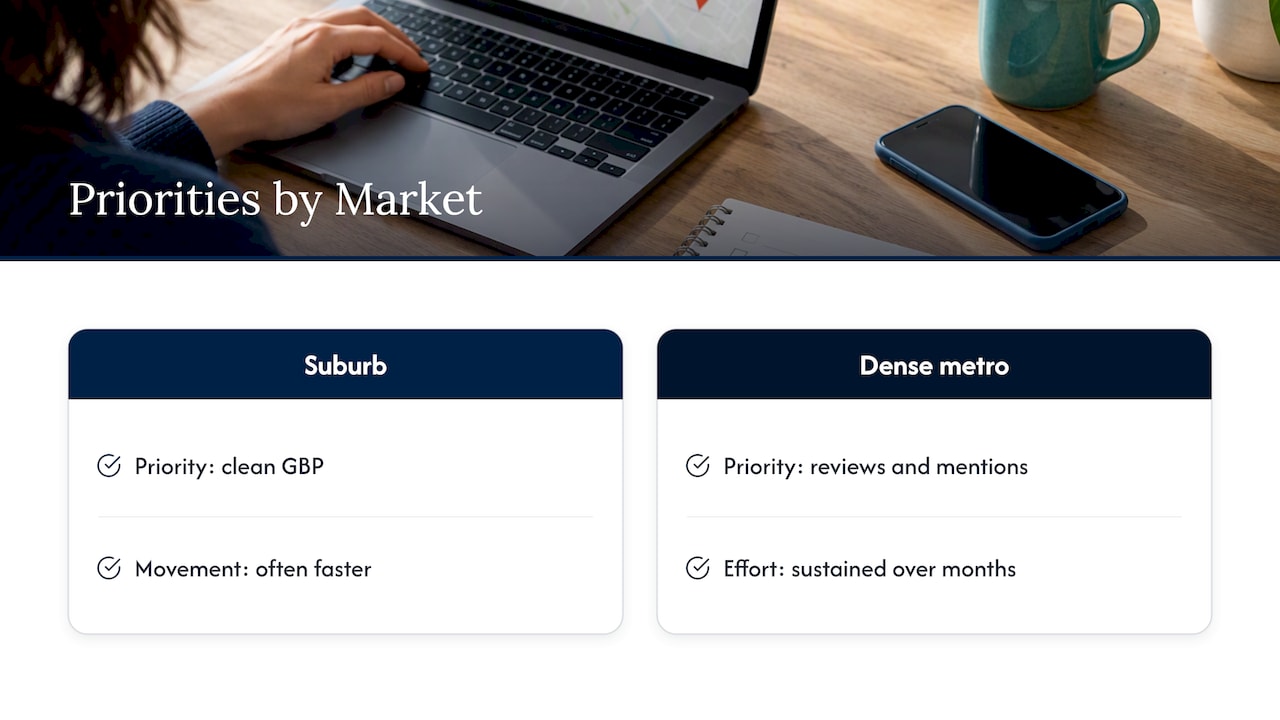
Budget and geography change everything about where to start. A single-location business in a low-competition suburb often sees faster movement from a clean GBP profile alone, while a business in a dense metro area needs sustained review growth and real editorial mentions to stand out.
Quick wins tend to be mechanical: fixing a wrong pin, completing missing fields, clearing a backlog of unanswered reviews. Earned mentions and sustained review growth take months, not weeks. If you want a second opinion on where your profile stands, consider contacting a marketing consultant for a diagnostic.
— Michael
Where Tradewinds United Media Fits Into Your Map Pack Plan
Local visibility work involves optimizing your Google Business Profile, conducting ongoing local SEO, and managing reputation to keep your reviews current and well handled. Our 30 to 90 day Map Pack ranking plan turns this article’s checklist into a scheduled, managed process instead of something you have to track yourself.

Engagements often include reporting so you can track what changed and when, rather than relying solely on assurances. If your listing needs structured data cleanup or a page built for local search, our website design and SEO services handle that groundwork directly. Visit our Local Map Domination page to request an audit and see where your profile currently stands.
FAQ
What are the main Google Map Pack ranking factors?
Google bases local results mainly on relevance, distance, and prominence. Relevance and prominence respond to your Google Business Profile completeness, reviews, and local mentions, while distance depends on the searcher’s location and cannot be changed.
How important is NAP consistency for Map Pack rankings?
Keeping your name, address, and phone number identical across your website and Google Business Profile supports both relevance and prominence by removing confusion about which business a mention refers to. Mismatched NAP details, especially a pin in the wrong place, are a common and fixable cause of lost visibility according to Whitespark’s survey.
Do Google Posts and Q&A affect local ranking?
Keeping your Google Business Profile active through Posts and answered Q&A supports relevance by adding fresh, on-topic content tied to your listing. Neither is confirmed as a major ranking factor on its own, but an active profile generally reflects the same completeness and engagement signals Google already rewards.
How does mobile and voice search affect Map Pack results?
Mobile and voice searches tend to carry stronger location context, which puts more weight on proximity and on your profile matching natural, conversational phrasing. Making sure your services and description use the language customers actually say, rather than stiff keyword phrases, helps relevance across both search types.
How often should I audit my Map Pack visibility?
Check rankings from multiple fixed locations weekly and review full GBP performance data monthly, since a single manual search is unreliable due to personalization. A quarterly review of citation consistency, review velocity, and ranking trends catches slower-moving issues that weekly checks miss.
Sources
- Tips to improve your local ranking on Google – Google Business Profile Help
- Local business structured data documentation
- Whitespark’s Official 2026 Local Search Ranking Factors Report