Start with marketing KPIs such as lead quality, lead-to-customer conversion rate, customer acquisition cost, return on marketing investment, and revenue or booked jobs by channel. Give each one an owner, a target, and a review date. Below, we show you how to choose them, set up GA4, Google Business Profile, and CRM tracking, and run a regular weekly review.
TL;DR:
- A candidate qualifies as a KPI only when it has a named owner, a target tailored to your business, a fixed review date, and an action for poor results.
- Limit primary KPIs to one to three, add three to five diagnostics, and split conversion rates by channel to expose differences in close rates.
- Link Google Business Profile to GA4, mark calls and bookings as key events, standardize campaign tags, and pass lead sources into your CRM.
- Review campaign lead volume, cost per lead, and conversion weekly; assess customer acquisition cost and return on marketing investment monthly, after enough deals close.
Table of Contents
- What is a marketing KPI, and how is it different from a metric?
- Which marketing KPIs should small businesses track first?
- How do you choose the right KPIs for your business?
- How do you set up tracking for your marketing KPIs?
- How do you set targets, owners, and review cadence?
- What does a lean KPI dashboard look like?
- Which metrics should you stop treating as KPIs?
- How do you track social media marketing KPIs?
- How do you evaluate reputation management KPIs?
- Why we think fewer KPIs beat more dashboards
- How we can help you put KPI tracking in place
- FAQ
- Sources
What is a marketing KPI, and how is it different from a metric?
A metric is any number you can pull from a tool. A KPI is a metric tied to a decision: if it moves, you change budget, creative, or follow-up. Clicks, sessions, and impressions are useful diagnostics, but they rarely tell you whether to spend more or less.
Run every candidate through the decision-use test:
- Owner: one named person is responsible for the number.
- Target: you know what “good” looks like for your business, not someone else’s.
- Review frequency: you look at it weekly, monthly, or quarterly, on a fixed day.
- Action: a bad reading would change what you do next.
If a number fails any of these, it is a diagnostic, not a KPI. The framework is simple: pick the business outcome first, choose one to three KPIs that measure it, then keep a short list of supporting diagnostics that explain why the KPIs moved. A small team that tracks too many numbers can struggle to act on them.
Which marketing KPIs should small businesses track first?
The most useful KPI stacks favor measures tied to revenue over vanity numbers. Harvard Business School Online frames a practical stack around lead quality (marketing qualified leads), conversion rates, return on marketing investment, customer acquisition cost, and lead volume. Here is how we would prioritize them for a small team:
- Lead quality and MQL conversion. Count the leads that fit your ideal customer and show real intent, not every form fill. Qualified inquiries are more valuable than random ones.
- Lead-to-customer conversion rate. Split it by channel, so you can see whether search, ads, referrals, or social turn inquiries into paying customers at different rates.
- Customer acquisition cost (CAC) and cost per lead (CPL). CAC is total marketing and sales cost divided by new customers won. CPL tells you what each inquiry costs before it closes.
- ROMI and ROAS. Return on marketing investment compares revenue attributed to marketing against what you spent. ROAS does the same for ad spend alone.
- Revenue or booked jobs by channel. This ties spend to the outcome you actually bank.
Add retention or repeat purchase rate if you sell something people buy again. CTR, CPC, and sessions stay on the diagnostic shelf.
Marketing KPIs tied to revenue and clear ownership outperform vanity metrics, according to Harvard Business School Online. Treat every number you cannot connect to a sale as secondary.
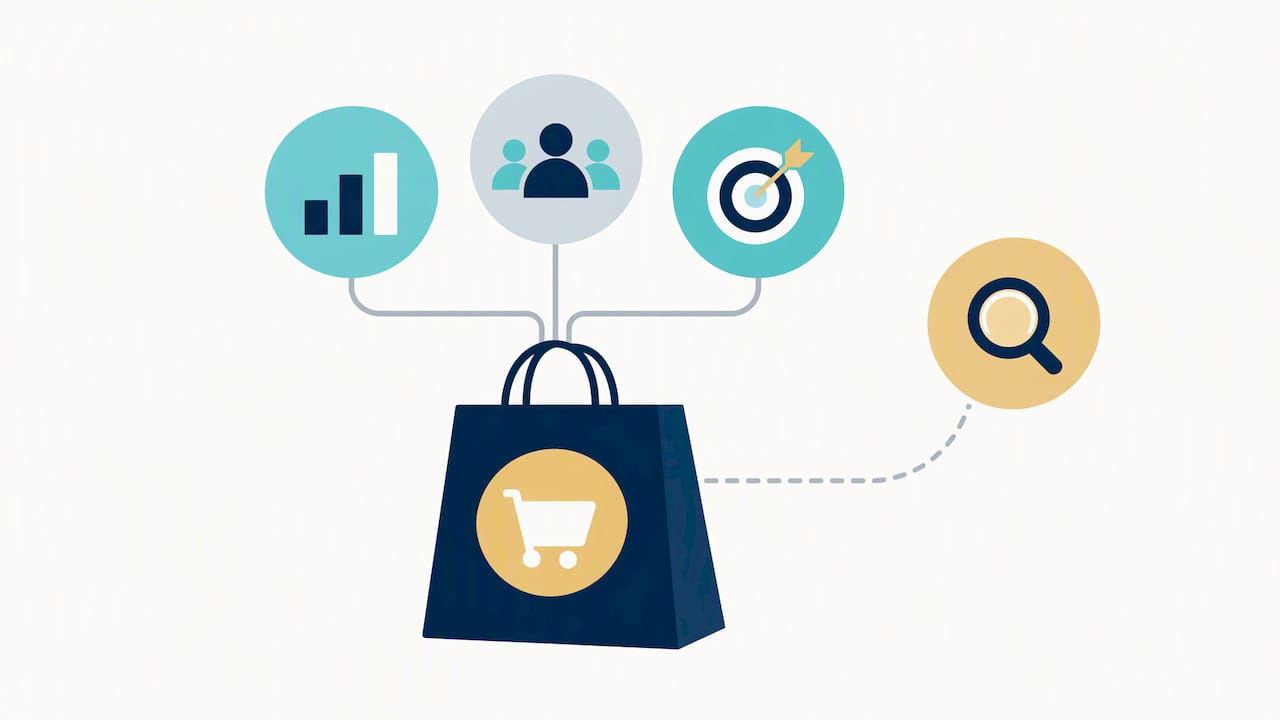
Search visibility is a channel-level number worth watching alongside these. This overview of search visibility metrics explains which visibility measures matter for growth, and it pairs well with the conversion KPIs above.
How do you choose the right KPIs for your business?
Use a short, repeatable process you can finish in an afternoon.
- Start from the primary outcome. For a plumber it is booked jobs, for a store it is online revenue, for a software seller it is paid accounts.
- Pick one to three primary KPIs. Add three to five diagnostics that explain movement in them.
- Apply the budget filter. Ask whether a swing in this number would change your budget or tactics. If not, drop it from the dashboard.
- Segment by channel and customer type. A blended conversion rate hides the fact that phone calls from Google Business Profile may close at a different rate from cold form fills.
- Assign an owner, a target, and a cadence. Write them next to each KPI.
A local service business might run on booked jobs, cost per booked job, and review volume. An ecommerce shop might run on revenue by channel, CAC, and repeat purchase rate. A B2B lead-gen firm might run on MQLs, MQL-to-customer rate, and CAC.
Pro Tip: Write your KPI list on one page. If it will not fit, you are tracking diagnostics, not KPIs.
How do you set up tracking for your marketing KPIs?
Good KPIs need clean data. Work through the setup in this order.
- Mark key events in GA4. Record form submissions, calls, bookings, and purchases as events, then flag the ones that matter as key events so they count as conversions.
- Link your Google Business Profile to GA4. Google’s linking guidance explains that website clicks, calls, direction requests, messages, and bookings can be shared with your GA4 property and flagged as key events. For local businesses, this brings map and search interactions into the same reports as your website. Our Google Business Profile playbook covers the profile side.
- Tag campaigns with UTMs. Use the same source, medium, and campaign naming every time.
- Sync your CRM. Pass the lead source into the CRM so you can follow a lead from first click to closed revenue.
- Run a data hygiene check. Use consistent naming, test every conversion yourself, and remove duplicate events.
| KPI | Where it is measured | Setup step |
|---|---|---|
| Lead volume and source | GA4 and CRM | Key events plus UTMs |
| Calls, directions, bookings | Google Business Profile in GA4 | Link profile to property |
| Lead-to-customer rate | CRM | Pass lead source into deal record |
| ROMI and ROAS | CRM plus ad platform | Match spend to closed revenue |
Local keyword intent also helps you segment channels; our local keyword research guide shows how.
How do you set targets, owners, and review cadence?
A KPI without a date is a wish. Turn each one into a SMART statement: specific, measurable, achievable, relevant, and time-bound. University of California guidance on SMART goals is a useful template for the format. A good statement reads like this: “Sam will cut cost per booked job to a set dollar target by the end of the quarter, reviewed every Monday.”
Match the rhythm to how fast each number moves:
- Weekly: campaign KPIs such as lead volume, CPL, and conversion rate.
- Monthly: pipeline, CAC, and ROMI, once enough deals have closed to mean something.
- Quarterly: strategy, channel mix, and whether the KPI list itself still fits.
When a KPI misses its target, escalate in this order:
- Check the supporting diagnostics to find where the funnel leaks.
- Reassign budget or change the creative or landing page.
- Set one experiment with a date to judge it.
What does a lean KPI dashboard look like?
Put the top KPIs first, each with its trend, target, and a status flag. Below them, show funnel diagnostics, then channel detail. Salesforce recommends aligning sales and marketing on funnel-stage KPIs such as visitor-to-lead, lead-to-MQL, and MQL-to-SQL, with top-line numbers shown before the diagnostics.
Use the weekly review to act, not to admire charts:
- Confirm tracking is healthy: events firing, no sudden zeros.
- Look at how each top KPI moved against its target.
- Scan diagnostics for the cause of any miss.
- Assign one or two actions, each with an owner and a date.
| Business type | Top KPIs on the dashboard | Key diagnostics |
|---|---|---|
| Ecommerce | Revenue by channel, CAC, repeat purchase rate | Cart abandonment, ROAS by campaign |
| B2B lead generation | MQLs, MQL-to-customer rate, CAC | Cost per lead, form completion rate |
| Local service | Booked jobs, cost per booked job, calls | Direction requests, review volume |
Which metrics should you stop treating as KPIs?
Some numbers feel productive and change nothing.
- Followers, impressions, and email opens only matter if you can link them to leads or sales. Keep them as diagnostics.
- Missing UTMs leave you guessing which channel produced a lead. Fix it by standardizing naming and checking every live campaign link.
- Duplicate conversions inflate results. Have whoever manages your tags audit event firing after every site change.
- CRM mismatches happen when sales records lack a lead source. Make source a required field and review it monthly.
These fixes are easier to address once someone owns them.
How do you track social media marketing KPIs?
Social media earns its place only if you tie it to outcomes. Start with the job each platform does for you. If a platform exists to drive inquiries, measure inquiries from it: tagged link clicks, form fills, calls, and messages that begin there. If it exists to keep customers engaged, measure repeat visits or repeat purchases from followers.
For a small business, a workable set looks like this:
- Leads or sales from social, counted through UTM-tagged links and your CRM source field.
- Engagement rate on posts that carry a call to action, which tells you whether the offer resonates, not whether the post was pretty.
- Cost per lead for paid social, compared directly against search and referral channels.
- Reach and follower growth as diagnostics only.
Review them monthly, not daily. Social results swing from post to post, and a daily look invites overreaction. Compare the cost per lead and close rate of social leads against your other channels, and move budget toward whichever channel produces customers at the lowest cost. If you are weighing paid options, our comparison of Google Ads and Facebook Ads shows how to judge them on the same scorecard.
How do you evaluate reputation management KPIs?
For local businesses, reviews shape whether someone calls you or the competitor down the street. A few measures cover much of what you need.
- Review volume: how many new reviews arrive each month. A steady flow signals an active business and keeps your profile fresh. Set a monthly target and ask satisfied customers right after the job is done.
- Review sentiment: the average rating and the themes inside the text. Read the written reviews, because recurring complaints about wait times or pricing point to fixes outside marketing.
- Response time: how quickly you reply, especially to negative reviews. Set a clear response-time rule, and name who is responsible.
Track these in the same monthly review as your pipeline numbers, and watch whether calls and direction requests from your Google Business Profile rise as review volume and rating improve. Our reputation management strategy lays out an operating plan, and our templates for responding to bad reviews help you hit your response-time target without sounding defensive.
Why we think fewer KPIs beat more dashboards
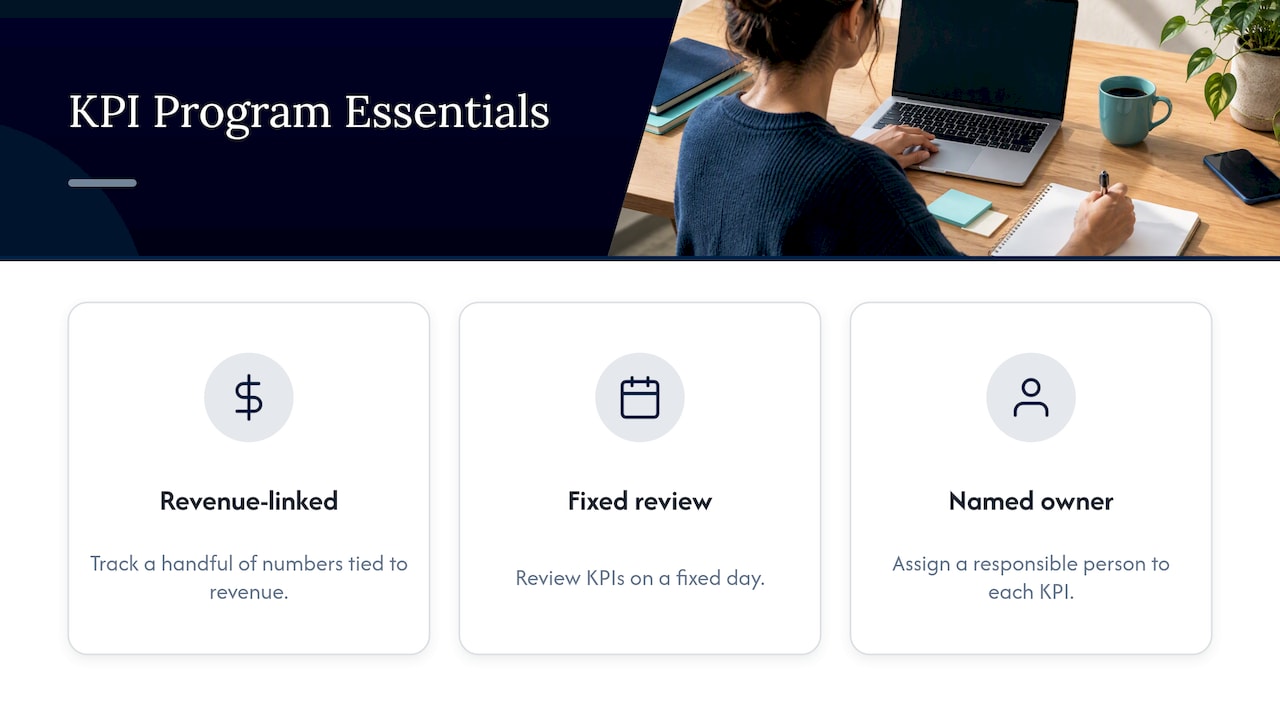
Most small businesses do not have a measurement problem. They have a decision problem. They collect plenty of numbers, then nobody owns them, so nothing changes. We think the strongest KPI program is the smallest one that still changes how you spend. That means a handful of revenue-linked numbers, reviewed on a fixed day, with a named person responsible for each.
Our services support exactly this: website design, SEO and Google Ads management, Google Business Profile work, and reputation management. We provide performance reporting and regular updates.
— Michael
How we can help you put KPI tracking in place
If you want the setup done right, we can build it with you. We offer website design, SEO, Google Ads management, Google Business Profile optimization, and reputation management, all reported against the KPIs above. The best first step is a local SEO report and an agreed KPI dashboard. Contact us to discuss your needs.

FAQ
What are good KPIs for marketing?
Good marketing KPIs connect spend to revenue. Start with lead quality, lead-to-customer conversion rate, customer acquisition cost, return on marketing investment, and revenue by channel, as outlined in Harvard Business School Online’s KPI guide. Treat clicks and impressions as supporting diagnostics.
What are the 5 main KPIs?
For most small businesses, useful KPIs include lead quality, conversion rate, customer acquisition cost, return on marketing investment, and revenue or booked jobs by channel. Each needs an owner, a target, and a review date to count as a true KPI.
What are the top 5 sales KPIs?
Sales KPIs can follow the funnel, including lead-to-MQL and MQL-to-SQL rates. Aligning them with marketing KPIs, as Salesforce suggests, keeps both teams working from the same funnel. This sales conversion rate explainer covers the definition and how to improve it.
What are the top 3 KPIs?
If you need to prioritize, choose lead quality, conversion rate, and cost per acquired customer. Together they show whether you attract the right people, convert them, and do it at a price your margins can support.
Sources
- Connect your Business Profile to Google Analytics – Google Business Profile Help
- 7 Marketing KPIs You Should Know & How to Measure Them
- Salesforce