Reviews do not directly lift your website in standard organic search results, but they do influence where you show up in Google Maps and the local pack, and they strongly affect whether people click and call once they see you. For a local business, that second part is where most of the money is. Below is what Google has said, what the available research suggests, and what to do about it this quarter.
TL;DR
- Google has said customer reviews are not a ranking signal for regular web search results. The star ratings you sometimes see there are a display feature, not proof of a ranking boost.
- Reviews matter most for local visibility. Google lists prominence as a core local factor, and review quantity and ratings feed into it.
- Recent, consistent reviews with real detail, plus professional replies, build trust and conversions even where they don’t change rank.
- A few negative reviews won’t sink you. Leaving them unanswered is the bigger risk.
- Ask every customer, never pay for reviews, and treat star markup on your own site with care.
Table of Contents
- The short answer: organic rankings versus local rankings
- How much weight do reviews carry in local search?
- Which review factors matter
- Why reviews still matter beyond rankings
- Do negative reviews hurt SEO?
- How to get more reviews without breaking Google’s rules
- Can reviews show up as stars on your own website?
- Reviews and your website: how they work together
- Where to start if you only have an hour
- Get help turning reviews into local visibility
- FAQ
- Sources
The short answer: organic rankings versus local rankings
The question “do reviews help SEO?” mixes two different systems, and the answer changes depending on which one you mean.
Standard organic results are the blue links for a query like “best accounting software.” In 2021, Google’s John Mueller clarified that customer reviews are not a signal for web search ranking. Star ratings can appear as rich results, but that display does not mean reviews are pushing the page up.
Local results are the map and the three-pack of businesses you see for “plumber near me.” Here reviews matter. Google explains that local results are mainly based on relevance, distance and prominence, and reviews feed into prominence. Google’s help page says more reviews and positive ratings can improve a business’s local ranking.
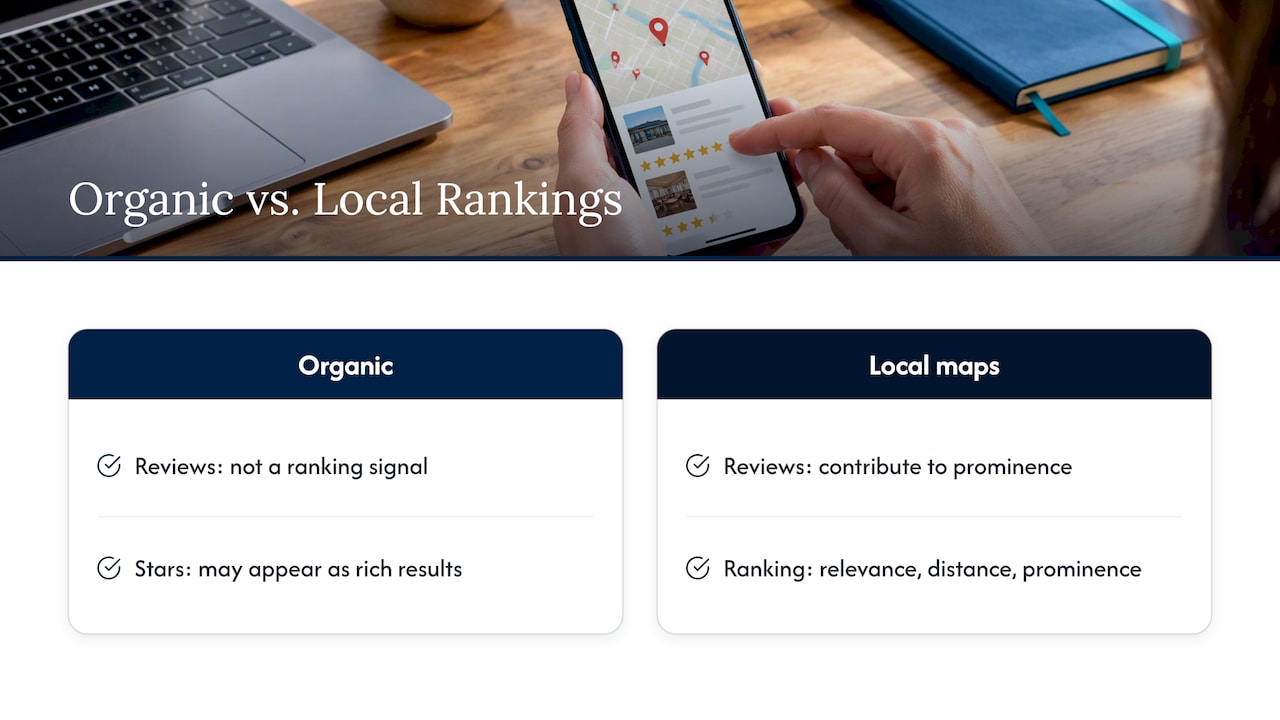
So if your goal is to rank a blog post nationally, reviews are not your lever. If your goal is to be found by people within a few miles of your shop or service area, reviews are one of the most important things you can manage.
How much weight do reviews carry in local search?
Google does not publish a weighting, so any percentage comes from practitioner surveys rather than from Google. One widely cited source is a 2021 Whitespark survey of local SEO experts. As reported by Search Engine Journal, it put reviews at roughly 17% of the influence on Map Pack rankings, and only about 5% for local organic results.
Treat those figures as expert opinion, not as a formula. What they tell you is useful, though:
- Reviews are a meaningful piece of the map ranking puzzle, but not the only one.
- Your Google Business Profile setup, categories, website relevance and location still do heavy lifting.
- A strong review profile on top of a weak profile or a thin website won’t carry you alone.
If you want the full picture of everything that moves the map pack, our guide to map pack ranking factors you can change in 90 days lays them out in order of effort.
Which review factors matter
The same Search Engine Journal report on the expert survey lists the review traits most associated with stronger map results: high star ratings (4 to 5), keywords in reviews, and the quantity of reviews. Other write-ups add recency and replies. Here is how to think about each one in practice.
Quantity and consistency
A business with 300 reviews usually looks more established than one with 12. But a steady trickle beats a burst. Ten reviews this month and ten next month looks like a healthy operation. Eighty reviews in a week followed by silence looks odd to customers and may look odd to Google’s spam systems too.
Star rating
You don’t need a perfect 5.0. Shoppers often distrust it. What matters is staying solidly in the 4s and showing that you handle the occasional miss well.
Keywords and detail in the text
Reviews that mention the service and the neighborhood (“replaced our water heater in Plano, done in one morning”) give Google and customers more context than “great service.” You can’t script this, and you must not write reviews for people. What you can do is ask better questions. A request like “What did we help you with, and how did it go?” tends to produce more useful reviews than “Please leave us 5 stars.”
Your replies
Google’s own guidance says that replying to reviews shows customers their feedback matters. Replies also give you a natural place to mention the service in plain language. Keep them human, not stuffed with keywords.
Why reviews still matter beyond rankings
Even where reviews are not a direct ranking input, they change how your listing performs once it appears. A higher click-through and call rate is the practical payoff.
Search Engine Land’s guide by Miriam Ellis argues that review acquisition and management should be central to any local SEO strategy because of their effect on trust, conversion and brand perception. The same guide notes that reviews can demonstrate experience, expertise, authoritativeness and trustworthiness, while being clear that E-E-A-T is not itself a set of ranking factors.
That distinction is worth keeping straight. Reviews don’t “rank you” by being trustworthy. They make the person looking at your listing more willing to choose you, and a business that gets chosen keeps getting found.
Do negative reviews hurt SEO?
One or two bad reviews will not damage your local visibility. According to the Search Engine Journal report, a few negative reviews won’t hurt rankings, but they can if left unanswered, and a pile of bad reviews reflects poorly on your ability to rank prominently.
The bigger effect is on people. A BrightLocal study cited by Search Engine Journal found that 92% of consumers said negative reviews make them less likely to use a business. That is a conversion issue, and it is fixable.
A practical approach to negative reviews:
- Reply fast. The same guide cites a survey in which 20% of consumers expect a response within one day. A separate 2022 ReviewTrackers study reported that 53.3% expect a response within seven days. Aim for 48 hours.
- Acknowledge the specific problem. Don’t paste a template that could apply to anyone.
- Take the detail offline. Offer a phone number or email and a named person.
- Flag what breaks Google’s rules. Spam, off-topic content and conflicts of interest can be reported through your profile. A review you simply dislike cannot.
- Fix the cause. If three reviews mention late arrivals, scheduling is the real problem.
We’ve put together response templates for bad reviews if you want wording to start from.
How to get more reviews without breaking Google’s rules
Google’s help page on getting more reviews says you can ask customers through your review link or a QR code, and reply to reviews, while offering incentives for reviews is prohibited. That last part trips up well-meaning owners. A discount, a gift card or a raffle entry in exchange for a review is an incentive, and it can get reviews removed or put your profile at risk.
A simple system that stays within the rules:
- Ask at the right moment. Right after the job is finished or the purchase is made, while the experience is fresh.
- Make it one tap. Use your Google review link in a text, an email signature, a receipt or a QR code on a card or invoice.
- Ask everyone. Don’t filter for happy customers only. Selectively gating who gets the link is the kind of practice that can run afoul of Google’s policies on review solicitation, and it also hides honest feedback you could learn from.
- Train your team. Give technicians, front desk staff and sales reps one sentence to say and one link to share.
- Never write or buy reviews. Fake reviews are against Google’s policies and against the law in many cases, and they put the whole profile at risk.
A sample 30-day rhythm
| Week | Action | Goal |
|---|---|---|
| 1 | Set up your review link and QR code; write a two-line ask for staff | Everyone asks the same way |
| 2 | Send requests to the last 30 days of customers | Catch recent, still-fresh experiences |
| 3 | Reply to every review, including old ones | Replies on 100% of reviews |
| 4 | Look at the themes in your reviews; fix one recurring complaint | Fewer repeat negatives |
Then repeat the ask for every new customer. The goal is a steady flow, not a one-time push.
Can reviews show up as stars on your own website?
This is where many owners get tripped up. Google documents review snippet markup, which may produce stars in search results. But Google also states that when the business controls the reviews about itself, pages using LocalBusiness or other Organization structured data are ineligible for the star review feature.
In plain terms:
- Marking up the testimonials you collected and display on your own homepage generally will not earn you stars in search.
- Markup is not a ranking trick. Mueller’s clarification covers this too: stars may be displayed, but that doesn’t make reviews a web-ranking factor.
- Real, visible reviews on your site still help visitors decide. Show them. Just don’t expect the markup to do magic.
If your site is a product or recipe page with genuine third-party reviews, different rules may apply, and a developer should check Google’s documentation against your specific page type.
Reviews and your website: how they work together
Since reviews mostly influence local visibility, the best way to use them is to connect them to the pages that convert the visit. A few ways to do that:
- Put real customer quotes on service pages. A roofing page with a short quote from a nearby homeowner persuades better than any slogan.
- Match the language. If customers keep describing you as “same-day” or “on time,” that is what they care about. Say it on your site.
- Link your site and profile clearly. The profile should point to the right landing page for each service, not a generic homepage.
- Keep the basics consistent. Name, address and phone should match across your site and listings.
A site that loads fast, reads clearly and makes the phone number obvious turns review-driven traffic into leads. If your current site is working against you, our small business website design guide explains what to fix first.
Our perspective
We see the same pattern with small business owners again and again. They hear “reviews are an SEO factor,” go chasing stars, and then wonder why a blog post isn’t climbing. The honest picture is more useful: reviews are a local visibility and trust lever, and they work best alongside a well-built Google Business Profile and a website that answers what searchers want.
That is why we treat reputation and local SEO as one job. The review you earn today shows up in the map pack, in the click a stranger decides to make, and in the call that follows. We track those three things in plain-language reports, so you can see whether review work is turning into inquiries and not just a higher number on a profile.
If you’ve been burned by an agency that promised rankings and sent a vague report, ask for the opposite: a clear plan, regular updates, and results measured in calls, form fills and booked jobs.
Michael
Where to start if you only have an hour
Not every owner has time for a full reputation program. If you only have an hour this week, do this:
- Open your Google Business Profile and copy your review link.
- Text or email it to your ten most recent happy customers with a one-line, personal ask.
- Reply to every unanswered review, positive or negative.
- Write down the one complaint that appears most often.
- Add one real customer quote to your most important service page.
That sequence builds momentum and covers the three things that matter: volume, responsiveness and relevance.
Get help turning reviews into local visibility
If you’d rather hand this off, we run reputation management, Google Business Profile work and local SEO for small businesses, along with the website and ad campaigns that sit around them. We set up the review process, handle replies, and report on what the work produces in actual leads. See how it fits together on our local SEO and reputation management page, or talk to us about our SEO services.

If you are comparing costs first, our overview of reputation management pricing and questions to ask will help you judge any proposal, ours included.
FAQ
Do reviews help SEO?
For local visibility, yes. For standard organic rankings, Google has said no. Reviews can influence where you appear in Maps and the local pack through the prominence factor, and they affect whether searchers choose you. They are not a confirmed ranking signal for regular web results.
Do reviews matter for local SEO?
They do. Google says local rankings rely on relevance, distance and prominence, and review volume and ratings contribute to prominence. Practitioners also point to review text, recency and replies as useful parts of a healthy profile, even though Google doesn’t publish exact weights.
How many reviews do I need to rank?
There is no magic number. What matters is how you compare with the competitors showing up for your search in your area. Look at the businesses in your local pack, note their review counts and ratings, and aim to match or beat them with a steady stream of new reviews.
Will a bad review hurt my rankings?
A few won’t. Search Engine Journal’s reporting says unanswered negative reviews are the bigger concern, and many bad reviews can weaken your prominence. Reply promptly, address the specific issue and fix any recurring problem.
Can I offer a discount for a review?
No. Google prohibits offering incentives in exchange for reviews. Ask every customer, make it easy with a link or QR code, and let the feedback be honest.
Sources
- Google: Customer Reviews Not A Signal For Web Search (Search Engine Journal)
- Tips to improve your local ranking on Google (Google Business Profile Help)
- How Google Reviews Impact Map Pack & Organic Search Rankings (Search Engine Journal)
- Tips to get more reviews (Google Business Profile Help)
- Google Reviews & SEO: Advanced Strategies That Scale (Search Engine Land)
- Google Reviews: The Complete Guide For Businesses (Search Engine Journal)
- Review snippet structured data (Google Search Central)