Most negative search results cannot be deleted by Google. Google can take down a narrow set of results, mostly private data and content that breaks its policies. Everything else stays up until the website that hosts it changes it. So the practical answer for a business is a sequence. Ask the source to fix the page, ask Google to remove what qualifies, and build a body of accurate, credible content and real customer reviews that pushes the rest off page one. Our team handles this kind of work through reputation management, local SEO and content, and the sections below show where each step succeeds and where it stalls.
TL;DR
- Google removes results that break its policies or expose private information. It cannot remove content from the website that hosts it.
- Contact the site owner first. That is the only route that deletes the page itself.
- A bad Google review comes down only if it violates Google’s review policies. Disliking it is not enough.
- When removal fails, you bury the result: publish useful content, collect honest reviews and strengthen your business profile so better pages outrank it.
- Suppression is measured in weeks and months, and it is a habit you keep up, not a one-time fix.
Table of Contents
- First, sort the result into the right bucket
- Step 1: Ask the website owner to change or delete the page
- Step 2: Ask Google to remove what qualifies
- Negative Google reviews: what can and cannot come down
- Step 3: Bury what stays
- How long it takes, and how to tell it is working
- When to talk to a lawyer
- Where we fit in
- Our view
- FAQ
- Sources
First, sort the result into the right bucket
Before you do anything, decide what kind of result you are dealing with. The right route depends on it, and sending the wrong request wastes weeks.
| Type of result | Best route |
|---|---|
| Your private data (home address, phone, ID numbers, bank details) | Google’s personal information removal request |
| A page on a site that charges for removal | Google’s exploitative site request |
| A review on your Google Business Profile that breaks policy | Report the review |
| A false and damaging statement | Site owner first, then Google’s defamation webform or a lawyer |
| An accurate but unflattering article, forum thread or complaint | Ask the owner, then bury it with better content |
The last row is the most common one for small businesses, and it is the one people least want to hear about. An honest one-star complaint on a third-party site is usually not eligible for removal. It is something you outrank.
Step 1: Ask the website owner to change or delete the page
Google’s own guidance is blunt about this. Google cannot remove content from the websites that host it, so for content that does not violate its policies, contacting the website owner is the best option. Even when Google does remove a result, the page stays reachable by its URL, through social media and through other search engines.
Here is how to find the person who can act:
- Look for a “Contact us” link or an email address on the site’s homepage.
- If there is none, run a Whois lookup (a public database showing who registered a domain) and use the registrant or administrative contact.
- If you still cannot reach anyone, contact the hosting company.
Google describes these same three routes on its Contact a website owner page. Once the owner changes or removes the page, you can send Google a webpage removal request so the old version drops out of search.
What to put in the message
Keep it short, polite and specific. Give the exact URL, say what is inaccurate or outdated, and say what you want done: corrected, updated or deleted. If the problem is a factual error, attach proof. If it is an old story about a problem you have since fixed, ask for an update rather than deletion. Editors and webmasters say yes to reasonable corrections far more often than to demands.
One rule from Google’s guidance on legal requests also applies here: reach out to the content owner first and gather clear evidence showing why a statement is untrue and damaging. That evidence file is useful whichever route you end up taking.
Do not offer payment, discounts or free service in exchange for taking down a review. Google’s Maps policy lists incentivized reviews, including payment or discounts for revising or removing a negative review, as prohibited content. It can turn one bad review into a policy problem for your own listing.
Step 2: Ask Google to remove what qualifies
Google does remove some results, but the categories are specific.
Personal and private information
Google lists removable personal data including addresses, phone numbers and email addresses, confidential government IDs, bank or credit card numbers, images of signatures or IDs, private records such as medical records, and confidential usernames and passwords. It may also remove doxxing content, meaning a page that pairs personal information with threats or collects significant personal information with no legitimate purpose. If you are a sole proprietor whose home address ended up on a lead-list site, this is the route.
The request form asks for the relevant URLs and supporting context, and Google sends an automated email confirmation after you submit.
Sites that charge to take content down
Some sites publish negative content and then demand payment to remove it. Google will consider removing content from exploitative sites when you are the subject of the content, the site is not a business review site, and the site requires payment to itself or other agencies for removal. If Google agrees, the URL stops appearing in its results, though the content may remain on the web.
False and damaging statements
For defamation, Google asks for a webform with exact URLs, an explanation of how the content concerns you or your business, why it is false and harmful, and a valid email address. It also asks you not to submit duplicates. Removal under this process does not delete the content from the original site, and it does not remove it from search results in other jurisdictions.
If you are the website owner
If the unwanted page is on a site you control, delete the information at the source. Then use the Search Console Removals tool to hide it temporarily, and ask Google to recrawl the changed URLs. Google’s page on removing web results explains that the Refresh Outdated Content tool tells Google to update a result once the site no longer shows the information. Our Search Console setup guide walks through getting the account set up and reading its reports.
A note on the “right to be forgotten”
You may see this suggested online. It began with a May 2014 European Court ruling, applies to queries based on a person’s name, and Google respects the territorial scope of the laws involved. Corporations usually have no right to delist content for queries based on a company name. For a US business owner it is rarely a usable path.
Negative Google reviews: what can and cannot come down
For local businesses, the review stars beside your name often hurt more than any article. The rule is simple. Google says you can report any review, but only reviews that violate its policies are eligible for removal, and you should not report a review just because you dislike it. Google also stays out of disputes between businesses and customers.
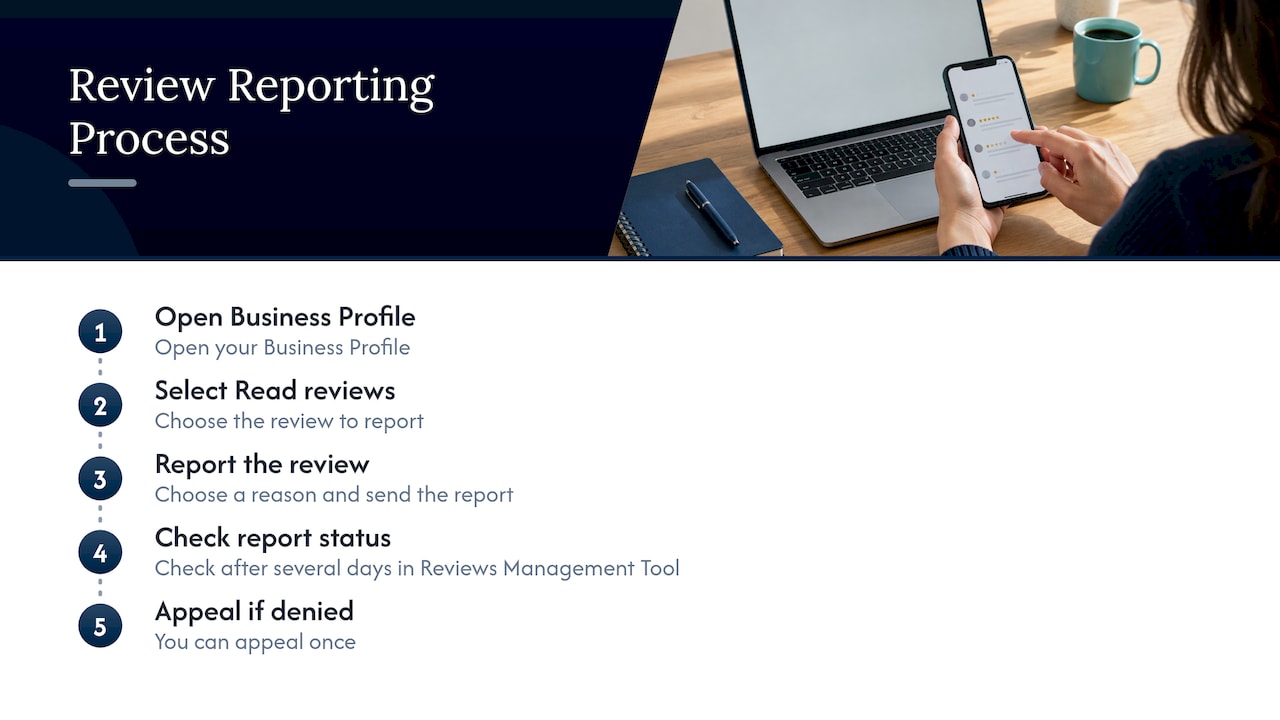
To report a review, open your Business Profile, select Read reviews, select Report next to the review, choose the reason (for example spam or profanity) and send the report. Evaluation typically takes several days. You can check status in the Reviews Management Tool, and a denied report can be appealed once.
What tends to qualify? Search Engine Land’s guide to negative Google reviews lists spam or fake content, misleading information, off-topic content, restricted content and illegal content. Google’s policy also covers conflicts of interest, such as current or former employees or competitors, and posts meant to undermine a competitor. Google says its automated systems remove the vast majority of fake and fraudulent content before anyone sees it, with human operators handling flagged content around the clock.
A real customer with a real complaint does not fit those categories. For that review the move is a calm, specific public reply, and our guide to responding to bad reviews gives templates. A thoughtful reply is read by the next prospect, and it often matters more than the star count itself.
Step 3: Bury what stays
When the owner will not budge and Google will not remove the result, you are left with suppression. This is not a trick. Google’s own guidance for exactly this situation is to publish useful, positive information so preferred content can outperform the negative page. Its suggestions include creating a Google profile, asking happy customers to give a fuller picture of the business, and publishing positive content about yourself or your business.
In plain terms, search results for your business name are a shelf with ten slots. Right now a negative page holds one of them. Your job is to fill the other slots with pages you control or earn, so the negative one slides down to page two, where far fewer people look.
Build the assets that can take those slots
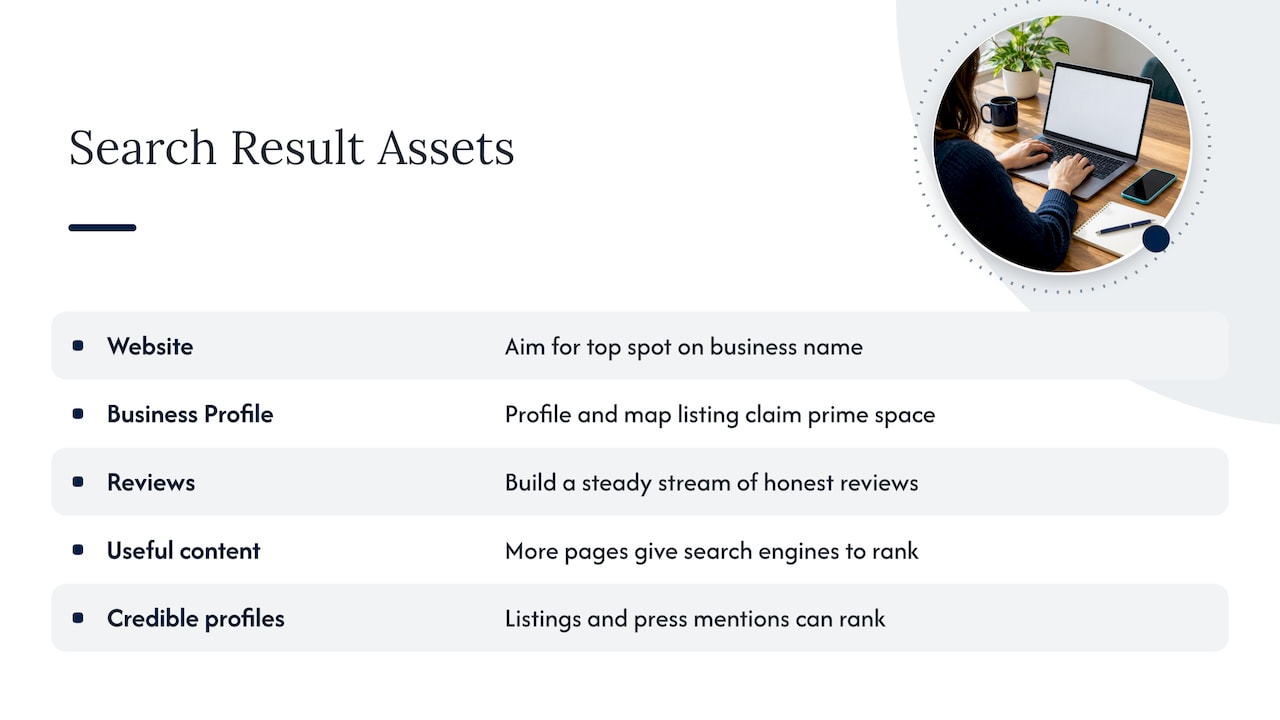
A fast, clear website. Your own site should hold the top spot for your business name. A thin or outdated site leaves room for others to rank above it. Our small business website guide covers what a site needs to earn that position.
A complete Google Business Profile. For local searches, the profile and its map listing take prime space. Accurate categories, services, photos and hours help it hold that space. See our Business Profile optimization playbook.
Real reviews, steadily. The simplest counterweight to a bad review is a steady stream of honest new ones. Ask satisfied customers right after a job is done, with one simple follow-up. We explain a method in getting more Google reviews, and the link between reviews and rankings in do reviews impact SEO. Never pay for reviews or write them yourself.
Useful content that answers customer questions. Service pages, local guides, project write-ups, FAQs and case studies all give search engines more of your pages to rank. Our pieces on how content marketing builds long-term growth and brand authority explain the approach.
Profiles and mentions on credible sites. Social profiles, local chamber of commerce listings, industry associations and press mentions can all rank for your name. Keep each one complete and consistent with your website.
Why facts beat tricks
It is tempting to flood the web with low-quality pages. Search Engine Land’s reputation analysis argues that aggressive tactics rarely work and that facts matter more than manipulation, especially now that AI Overviews summarize content about a brand. The same piece notes that lasting suppression is a commitment you keep up year after year, not a one-off job. Build pages that deserve to rank and they keep working.
How long it takes, and how to tell it is working
Expect weeks to months, not days. New pages need time to be crawled and to build authority, and a result that has sat at position three for years will not fall overnight.
Track three simple things, and do it on a schedule rather than whenever you worry:
- The first page for your business name. Search it in a private browser window and note which ten results appear and in what order.
- The negative result’s position. A slide from position three to position nine already cuts how many people see it.
- Your own assets climbing. Note which of your pages, profiles and reviews are gaining ground.
Also search the name variations customers use: your name plus “reviews,” “complaints” and your city. These are the searches where a bad result hurts most. If you want this watched and reported in plain numbers each month, that is the kind of ongoing performance reporting we provide.
When to talk to a lawyer
Most negative results are not legal matters. A negative opinion is not defamation. Consider an attorney when a statement is a false claim of fact that you can disprove, when it looks like a coordinated attack, or when damage continues after you have reported and appealed through the platform.
Search Engine Land notes that a defamation case must establish a false statement presented as fact, publication to a third person, fault amounting to at least negligence, and damages, with standards that vary by jurisdiction and a higher bar for public figures. Keep screenshots with dates, the exact URLs, copies of your emails to the site owner and any proof the claim is false. A defamation attorney in your state can tell you whether the case is worth pursuing.
Where we fit in
If you have been through the steps above and a negative result still sits on page one, or you simply do not have the hours to work through site owners, forms and content calendars, that is when owners hand it to us. We offer reputation management, Google Business Profile services, SEO and content marketing together, so the review work, the profile work and the pages that crowd out a bad result are planned as one effort. You also get performance reports and regular updates, so you can see what moved and why.
For a closer look at how this works, read our 90-day reputation management strategy and our overview of reputation management and local SEO. When you are ready to talk, start at Tradewinds United Media.

Our view
Business owners usually come to us after a bad week. A one-star review or an unfair article has turned up, and they want it gone today. We understand that. The honest truth is that most of these items are not Google’s to delete, and the owners who recover fastest are the ones who stop fighting a single result and start building a stronger first page.
That is why we treat reputation as part of local visibility, not a separate emergency service. Your website, your Business Profile, your reviews and your content all feed the same search results. When they are accurate, current and active, one negative result loses its power. When they are thin, one negative result can dominate.
We built our approach around reporting you can read. Our clients should see what we did, what moved and what comes next, because a reputation plan you cannot see is hard to trust. If an agency has left you guessing before, ask for that clarity first, wherever you go.
Michael
FAQ
Can I pay someone to remove negative search results?
Paying a site or a middleman to delete a page is risky. Google treats sites that demand payment for removal as exploitative and may delist them if you report them. A better use of budget is a plan that builds your own content, reviews and profiles so negative pages lose visibility.
How do I get a negative Google review removed?
Report it from your Business Profile and choose the policy it breaks, such as spam or profanity. Google reviews reports over several days, and a denied report can be appealed once. Reviews that are merely critical but genuine will not be removed, so reply publicly and keep collecting new reviews.
Does burying a result make it disappear?
No. The page still exists and can be found by anyone who searches deeper or visits the URL. Burying pushes it down so fewer people see it. The real fix is changing or removing the page at its source, which is why the site owner comes first.
How long does it take to push a negative result down?
Plan on weeks to months. Newly published pages and reviews need time to be indexed and to gain authority. Keep publishing and collecting reviews, because lasting results come from a continuing effort, not a single push.
Sources
- Contact a website owner – Google Search Help
- Content removal options outside of Google Search
- Defamation Overview – Google Legal Help
- Remove my private info from Google Search
- Report a problem – Google Search Help
- Remove content about you on exploitative sites
- Remove web results from Google Search
- Right to be Forgotten Overview – Google Legal Help
- Report inappropriate reviews on your Business Profile
- Prohibited and restricted content – Maps User Generated Content Policy
- How local reviews on Google Maps work
- How to handle negative Google reviews – Search Engine Land
- Managing your reputation through search results – Google Search Central
- Google AI Overviews: How to remove or suppress negative content – Search Engine Land