You do not rank for “near me” keywords by typing “near me” onto your website. Google works out what “near” means from the searcher’s location, then picks businesses by relevance, distance and prominence. The work that pays off is a complete Google Business Profile, steady reviews, consistent business details and genuinely local pages. This guide shows what to do, in what order, and what to skip.
TL;DR
- “Near me” is a location signal, not a phrase to repeat. Google reads the searcher’s position and ranks businesses on relevance, distance and prominence.
- Your Google Business Profile does most of the heavy lifting. Treat it as the main asset, and your website as its supporting evidence.
- Fresh reviews, accurate hours and a correct address matter more than keyword tricks.
- Target real place names (city, neighborhood, landmark) on your site, and build pages only when they help a customer.
- Track calls, direction requests and booked jobs, not just rankings.
Table of Contents
- What “near me” searches are, and why they matter
- How Google decides who is “near”
- Stop forcing “near me” into your copy
- Build your Google Business Profile first
- Keep your name, address and phone number identical everywhere
- Reviews: volume, rating and recency
- Make your website back up the profile
- Perspective: what we see when small businesses ask about “near me”
- A 30-day plan to win more “near me” searches
- Should you pay for ads while organic grows?
- Measuring what matters
- Where we can help
- Common mistakes to avoid
- FAQ
- Sources
What “near me” searches are, and why they matter
A “near me” search is a query like “plumber near me” or “coffee shop nearby”. The person wants a local business, and wants it now. Search Engine Land describes these queries as high-intent and proximity-driven, and Semrush frames them the same way: the user wants nearby businesses or services.
The intent is what makes them valuable. One roundup of local statistics reports that 76% of people who run a “near me” search visit a physical business within 24 hours, and that 88% of smartphone users doing local discovery visit a related store within seven days. Treat those figures as directional, since they come from a compilation of third-party studies. The pattern is still clear: these searchers are close to buying.
A caution on keyword tools. The phrase “near me keywords” itself shows modest volume, and individual terms such as “electrician near me” are often reported low or inconsistent because Google’s data lumps them together. Low tool numbers do not mean low value. One call from a ready buyer can pay for a month of effort.
How Google decides who is “near”
Google states that local results are based mainly on three factors, and its local ranking guidance explains each:
| Factor | What it means | What you control |
|---|---|---|
| Relevance | How well your profile matches what the person searched | Categories, services, description, website content |
| Distance | How far you are from the searcher, or from the location they named | Almost nothing, beyond an accurate address or service area |
| Prominence | How well known and trusted you are | Reviews, links, mentions, consistent listings |
The honest takeaway is about distance. You cannot trick Google into thinking you are closer than you are. If a searcher stands two blocks from a competitor and eight miles from you, a profile tweak will not reverse that. What you can do is become the most relevant and most prominent option within your true service area, so you win the searches where you are a reasonable distance away.
This also explains why the same “near me” search shows different businesses to two people on the same street. The results are personal to the moment and place.
Stop forcing “near me” into your copy
The most common mistake we see is sprinkling “near me” through headings and paragraphs. It reads badly, and nobody types it into a conversation. A sentence like “Best HVAC repair near me in our area” tells a customer you wrote for a robot.
The better approach is to answer the question behind the query. Someone searching “emergency plumber near me” wants to know whether you serve their area, whether you are open, how fast you arrive, and whether people like you. Write for that.
The tactics that replace keyword stuffing:
- Use real place names. Pair your service with the city and neighborhoods you actually serve: “water heater repair in Tampa” or “in Seminole Heights”. One SEO guide that ranks for this topic makes the same point: aim at the keyword plus your actual region rather than the literal phrase.
- Answer conversational questions. “Where can I find a same-day tire repair?” is a better page section than a repeated keyword.
- Let “near me” appear naturally, or not at all. Wording like “serving customers near downtown” is fine when it is true and reads well.
If you want a method for finding the exact terms your customers use, our local keyword research guide walks through it, including Google’s autocomplete and your own call logs.
Build your Google Business Profile first
For a “near me” search, the map results usually appear above the standard listings. Those map results are built from Google Business Profiles. That is why we tell owners to feed the profile before the website.
A checklist worth working through this week:
- Pick the most specific primary category. “Roofing contractor” beats a vague “contractor”. Add secondary categories only if you truly offer those services.
- Fill every field. Hours, holiday hours, phone, website, services, products, attributes, description and photos.
- Use accurate service areas. If you travel to customers, list the areas you really serve. If you do not have a storefront customers visit, hide the address as Google allows.
- Add real photos. Your team, your vehicles, your finished work, your entrance. Recent images signal an active business.
- Post and respond. Updates, offers and replies to reviews show the business is alive.
Our Google Business Profile playbook covers each field in order, and if you are missing the services list, see how to fix the missing services button. Service businesses in particular can find quick wins in our Google Business services fixes.
If your goal is the three-pack of map results specifically, read how to rank in the Google Map Pack.
Keep your name, address and phone number identical everywhere
Consistency is unglamorous and it works. Your business name, address and phone number should match across your profile, website, social pages and directories. A suite number written three different ways, or an old phone number on a directory, creates doubt for Google and for customers.
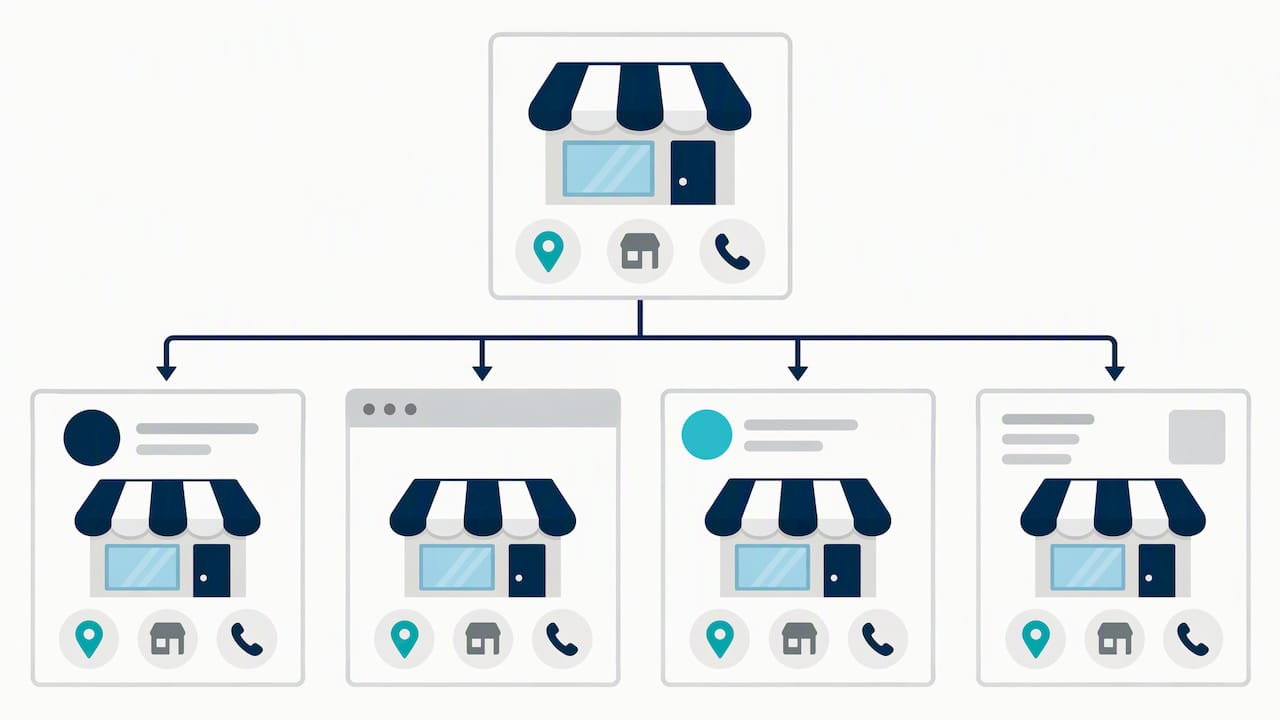
The cost of getting this wrong is practical, not just technical. A commonly cited consumer figure holds that 62% of people avoid businesses with inaccurate hours or addresses, but even without that number, think about the customer who drives to a closed shop. They do not come back.
A simple routine: pick one canonical format, write it down, and audit your top 20 listings against it. Fix the largest directories first, then data aggregators and industry-specific sites. Recheck every time you move, change hours or change numbers.
Reviews: volume, rating and recency
Prominence leans heavily on reviews, and most owners focus on the wrong part. They chase a perfect star rating and ignore freshness. According to one local SEO playbook, a 4.5 average with steady new reviews can outrank a 5.0 profile whose last review is six months old. Treat that as a practitioner’s observation rather than a published Google rule, but it matches what active profiles signal: this business is open and serving people now.
A review routine that works for a small team:
- Ask at the moment of satisfaction: at job completion, at checkout, or in the follow-up text.
- Send a direct link to your review form, so it takes under a minute.
- Aim for a steady weekly pace rather than a burst of 30 reviews followed by silence.
- Reply to every review, positive or negative, within a few days.
- Never buy reviews or offer rewards for them. It violates platform policies and can get reviews removed.
Negative reviews will come. How you answer them is read by every future customer. We keep templates for responding to bad reviews, and our piece on reputation management and local SEO explains why the two disciplines are tied together.
Make your website back up the profile
Your site proves to Google that your profile is telling the truth. Four things matter most.
A clear location and service page structure
Give each core service its own page, and state where you serve. If you have several real locations, give each its own page with the real address, local phone number, hours, photos and staff or manager details.
LocalBusiness structured data
Google documents LocalBusiness structured data, which helps it understand your name, address, hours and type. Use the most specific business subtype available, and make sure the data matches what customers see on the page and on your profile.
Hyperlocal pages that earn their place
A page for a neighborhood is worth building only when it contains something a person in that neighborhood would use: parking notes, common issues in local housing stock, travel times, landmarks, local projects, permit quirks. A page that swaps the city name in otherwise identical text is filler, and it risks being treated as thin content. Never imply you have an office in a place where you do not. If you serve an area from elsewhere, say so plainly.
Here is a quick test. Would a customer in that neighborhood learn something from the page that they could not learn from your homepage? If not, do not publish it.
Mobile speed and a click-to-call button
Most “near me” searches happen on phones, often in a hurry. If your phone number is buried or your page takes forever to load, the searcher moves to the next result. A sticky call button and a visible address are basic conversion tools. If your site is dated, our small business website design guide explains what a modern local site needs.
Perspective: what we see when small businesses ask about “near me”
We hear the same request from owners again and again: “Can you get me to rank for ‘near me’?” The honest answer is that you are asking the wrong question, and the right one is more promising.
Search volume is the wrong yardstick for local work. A phrase with a few hundred monthly searches can still fill a calendar if the searchers are ready to book. So we measure conversion volume: calls, direction requests, form fills and booked jobs that trace back to the profile and website. Rankings are a means, and the reports we send clients show how each effort connects to real business results.
We also tell owners what we will not do. We will not stuff “near me” into your pages, and we will not build a pile of near-identical city pages to look bigger than you are. Both tend to hurt the brand and age badly. We would rather spend your budget on a complete profile, a review habit, clean listings and pages with real local detail, then report what moved.
If you have been burned by an agency that sent rankings screenshots and no leads, that is a fair reason to be skeptical. Ask any provider, us included, to show how each activity ties to calls and customers, and to explain what they are doing each month in plain words.
— Michael
A 30-day plan to win more “near me” searches
You do not need to do everything at once. This sequence puts the highest-impact work first. For a longer roadmap, our 90-day local SEO checklist prioritizes every task.
Week 1: foundation
- Claim and verify your Google Business Profile, or audit the existing one.
- Choose your primary and secondary categories.
- Set your name, address and phone format, and correct your website footer to match.
Week 2: completeness and proof
- Add services, hours, attributes, description and at least 10 fresh photos.
- Start your review request routine.
- Reply to every existing review.
Week 3: website alignment
- Make sure each service has its own page with a clear location signal.
- Add LocalBusiness structured data.
- Check mobile load speed, and add a call button.
Week 4: expansion and measurement
- Build one or two hyperlocal pages with real, useful detail.
- Clean up the most visible directory listings.
- Set up tracking for calls and direction requests, and record your baseline.
A useful reality check: if you run a contractor business, the same fundamentals apply, with extra weight on service-area clarity and project photos. We lay that out in our SEO for contractors page.
Should you pay for ads while organic grows?
Local SEO builds over months. If you need calls this week, paid search can cover the gap. Google Ads lets you target by radius or by named areas, and “near me” style queries often trigger ads above the map results. The trade-off is that ads stop the moment the budget does, while profile and site improvements compound.
Most small businesses end up with a mix. If you are deciding where your first dollar goes, our comparison of SEO, Google Ads and social media spend lays out the trade-offs, and this look at whether Google Ads is a money pit explains how to avoid wasted spend.
Measuring what matters
Track a short list monthly:
- Profile actions: calls, direction requests, website clicks and messages from your Business Profile insights.
- Review velocity: new reviews per month and how fast you reply.
- Local visibility: your position for a handful of money terms, checked from different points in your service area, since results shift by location.
- Leads and revenue: booked jobs and sales tied to those channels, using call tracking or a “how did you hear about us” field.
If calls and direction requests rise while rankings wobble, the work is going the right way. If rankings rise and the phone stays quiet, look at your profile content, your reviews and your page conversion. Our local SEO report is one way to see where you stand today.
Where we can help
If you would rather hand this to a team, we handle local SEO, Google Business Profile work, reputation management and website design for small and local businesses, with clear performance reports and regular updates so you can see what each month’s effort produced. You can start from our home page and tell us about your service area. We do not publish set prices, so scope and cost come after we understand your market.
Common mistakes to avoid
- Repeating “near me” in headings and body text. It hurts readability and gains nothing.
- Cloning city pages. Thin pages add no authority and can invite quality problems.
- Letting the profile go stale. No photos, no replies and no new reviews tell Google and customers you may be closed.
- Inconsistent contact details. Old addresses and phone numbers linger in directories for years.
- Judging success by traffic alone. Local SEO exists to produce calls and customers.
FAQ
Should I put “near me” on my website?
Not as a keyword to repeat. Google determines “near” from the searcher’s location, so your job is to be relevant and prominent in your real area. Use city, neighborhood and landmark names, and let “near” or “nearby” show up only where it reads naturally.
How long does it take to rank for near me searches?
It depends on your competition and your starting point. Profile fixes and fresh reviews can show movement within weeks in lightly contested areas, while competitive markets take months of steady work. We would not promise a specific date or position to anyone.
Do I need a physical storefront to appear?
No. Service-area businesses can appear in local results by setting their service areas correctly in their profile. Distance still matters, so you will do best close to your base. Be accurate about where you operate and avoid listing addresses you do not use.
Are “near me” searches worth it if the tool says low volume?
Yes, because intent is high. Many of these searchers are ready to call or visit, as the local search statistics suggest. Judge the channel by the customers it brings, not by the volume figure.
Sources
- Tips to improve your local ranking on Google, Google Business Profile Help
- Local Business structured data, Google Search Central
- Top 45 Local SEO Statistics, AgencyHandy
- How to Rank for Near Me Searches, VisibleFeedback
- Near Me SEO: Optimize for Local Searches That Convert, Search Engine Land
- How to rank for the words near me in local search, Semrush